

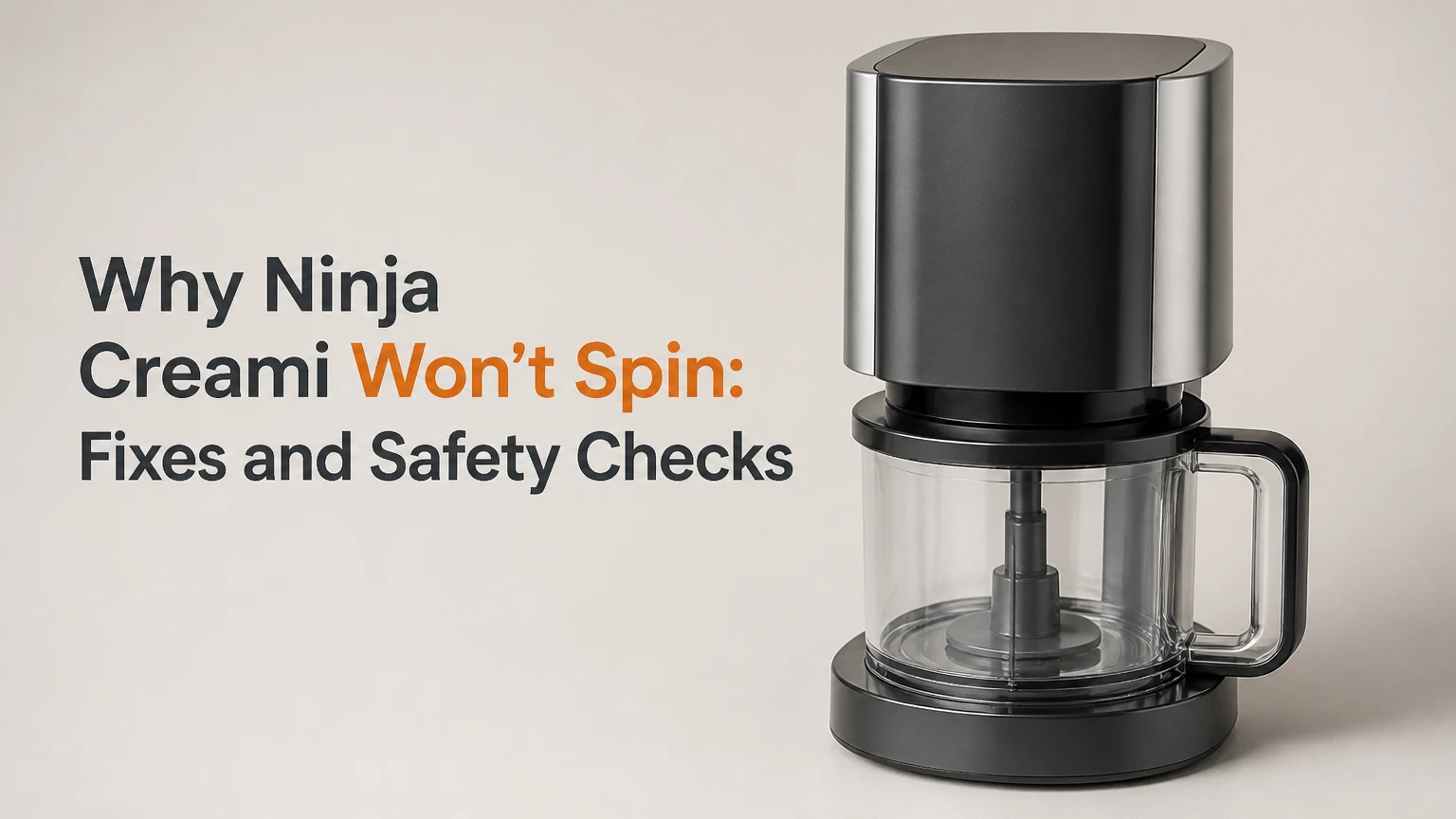
Ninja Creami is a frozen-dessert appliance that shaves a solid, level pint with a motor-driven Creamify paddle. When the paddle will not rotate, the usual causes are an unlatched container, an improperly installed paddle, an overly hard or uneven frozen base, residue in the drive area, or a motor and sensor fault.
Key Facts / Quick Answer
A raised frozen center, often called a hump, can overload the paddle and stop processing.
The outer bowl must be fully locked on many NC300 and NC500 models; Breeze models use a different mounting arrangement.
Unplug the appliance before cleaning the drive shaft, paddle, or bowl interface.
Do not run a Creami empty, process loose ice, or force a frozen pint into the machine.
A replacement paddle or lid commonly costs about $15-$30, while a motor fault usually requires Ninja support.
A one-year limited warranty is typical for United States purchases, but the exact terms depend on model, seller, and proof of purchase.
Why Does a Ninja Creami Stop Spinning?
A Ninja Creami stops spinning when its motor cannot safely drive the paddle or when an interlock does not confirm that the container and lid are correctly installed. The appliance does not churn liquid in the conventional sense. Its vertical shaft lowers a rotating paddle into a frozen mixture, removing thin layers as it travels downward.
The motor therefore encounters a very different load from a standard ice cream maker. A dense, low-sugar base creates more resistance than a sugar-rich base, while a center hump concentrates force at one point. The machine may stop immediately, stop partway through the program, or refuse to start.
The phrase “blade” is common, but the removable component is generally called a paddle or Creamify paddle. It is not designed to cut through a solid ice cube or a completely dry mixture. The frozen base should be prepared according to the owner’s guide for the exact model.
What the Machine Is Checking
The safety system typically depends on several physical conditions:
- The processing container is present and seated.
- The outer bowl or container is rotated into its locked position where required.
- The paddle is installed in the processing lid.
- The lid and shaft can move into their intended processing position.
- The motor load remains within a safe operating range.
The exact sensors and error behavior vary by series. A blinking indicator may identify an incomplete lock, while a stall can indicate excessive resistance. A display code is useful evidence, but the code meaning must come from the manual for that model rather than from a generic online list.
Expert insight: In practice, a unit that refuses to start usually points toward an interlock or installation problem. A unit that starts, strains, and stops more often points toward frozen-base resistance, a damaged paddle, residue, or a drive problem.
How the Ninja Creami Spins
The Creamify paddle attaches to the underside of the processing lid. When the lid is mounted correctly, the motor shaft engages the paddle and moves the assembly downward through the frozen pint while the paddle rotates. The cycle is designed for a prepared frozen base, not for liquid churning or crushing large inclusions.
Ninja’s owner documentation for Creami models commonly requires the base to freeze for approximately 24 hours. That time allows the pint to freeze uniformly. A freezer set near 0°F, or -18°C, is a practical reference point, although household freezer temperatures fluctuate and individual recipes freeze differently.
The machine’s texture depends on formulation as much as on motor power. Sugar, fat, dissolved solids, and stabilizers lower the amount of freely available water and change how hard the pint becomes. A protein-heavy or low-sugar recipe may be nutritious but significantly more resistant to the paddle.
| Condition | Typical value or requirement | Likely effect |
|---|---|---|
| Standard pre-freeze | About 24 hours | Produces a uniformly frozen base |
| Freezer reference | 0°F, or -18°C | Common target for frozen storage |
| Refrigerator safety limit | 40°F, or 4°C, maximum | FDA cold-storage guidance |
| Frozen food discard threshold | 2 hours above 40°F, typical food-safety rule | Reduces bacterial-growth risk |
| Processing container | One prepared pint or approved container | Prevents unsupported or empty operation |
The FDA states, “Keep your refrigerator at 40°F or below and your freezer at 0°F,” in its consumer food-safety guidance. That temperature advice concerns food storage, not a guaranteed Creami performance threshold, so it should not be interpreted as permission to process a rock-hard or damaged pint.
What to Check Before Resetting the Appliance
A structured inspection prevents repeated stalls and avoids replacing a paddle when the real problem is a lock. Remove the processing bowl and examine each contact point under good light.
- Unplug the Creami. Never place fingers near the shaft or paddle while the appliance is connected to power.
- Remove the paddle from the lid. Confirm that the paddle is fully seated and does not wobble excessively.
- Inspect the paddle. Look for bent metal, cracked plastic, missing pieces, or frozen food around the hub.
- Clean the drive area. Use a warm, damp cloth, then dry the components thoroughly.
- Inspect the pint. Look for a raised center, an angled freeze, a cracked container, or ingredients frozen above the permitted fill line.
- Check the bowl and lid. Confirm that threads, tabs, grooves, and locking points are not obstructed.
- Reconnect the bowl correctly. Follow the lock direction printed on the appliance or in the manual.
- Run the correct program. Choose a program that matches the recipe, container, and model.
- Stop if the motor strains. Do not repeatedly restart a stalled cycle.
The warm cloth should loosen residue around the drive interface. It should not involve pouring hot water into the motor housing or immersing the appliance. A short, controlled cleaning is safer than a “hot water reset” that allows liquid to reach electrical components.
Why Is the Frozen Pint Too Hard or Uneven?
A frozen pint becomes difficult to process when the recipe contains little sugar or fat, the freezer is unusually cold, the base froze at an angle, or the surface developed a central mound. A Creami paddle can process a firm frozen base, but it is not a general-purpose ice crusher.
The center hump is especially troublesome. A flat surface lets the paddle enter progressively. A peak forces the paddle to hit a concentrated mass first, increasing resistance and making a protective stop more likely.
Flatten the top only after removing the container from the appliance. Use a spoon to shave down a small hump, or allow the pint to temper briefly in the refrigerator. Do not use a knife to attack a deeply frozen block, because the container can be punctured and plastic fragments can enter the food.
How Much Softening Is Reasonable?
A short tempering period can reduce the initial shock load, but excessive thawing creates a thin liquid layer and an unsafe storage situation. A typical starting point is 5-15 minutes at room temperature, or a longer period in the refrigerator, depending on pint size and room conditions.
Microwaving is not a universal manufacturer-approved correction. If the model’s instructions permit it, use only brief intervals, such as 5-10 seconds, and inspect the surface between intervals. Never microwave a container, lid, or accessory unless its material and manual specifically permit microwave use.
| Frozen-pint condition | Observable sign | Safer response |
|---|---|---|
| Center hump | Raised peak at the surface | Scrape the peak level before processing |
| Low-sugar base | Powdery, chalky, or unusually hard texture | Temper briefly and verify the recipe |
| Freezer burn | Dry white patches or separated surface | Trim affected food or discard if quality is poor |
| Tilted freeze | Frozen layer visibly slopes | Temper until the pint can be leveled safely |
| Overfilled pint | Base reaches above the permitted line | Do not process; remove excess before refreezing |
Expert insight: A harder pint is not always a colder pint. A low-sugar base can resist shaving at ordinary freezer temperatures, while a richer base at the same temperature may process smoothly. Recipe solids and geometry matter together.
Model-Specific Checks for NC300, NC500, and Breeze
Creami troubleshooting depends on the model because container capacity, locking hardware, and display behavior differ. Read the model number from the rating label or packaging before ordering parts. Similar-looking paddles and lids are not automatically interchangeable.
| Series or product family | Container arrangement | First installation check | Error-code caution |
|---|---|---|---|
| NC300, commonly 5-in-1 or 7-in-1 | Pint inside an outer processing bowl | Rotate the outer bowl fully into lock | Use the NC300 manual |
| NC500, commonly Deluxe 11-in-1 | Larger Deluxe container and dedicated bowl system | Confirm Deluxe lid and bowl alignment | Do not assume NC300 codes apply |
| Breeze family | Model-dependent compact container system | Verify the pint is seated at the required height | Consult the exact Breeze guide |
| Replacement assembly | Model-specific paddle, lid, or bowl | Match the part number, not appearance | Seller listings can combine series names |
On many original designs, the outer bowl must rotate until its locking tabs engage. If the bowl is only slightly misaligned, the motor may remain disabled even though the container appears visually close to its correct position.
Deluxe models can display codes or blinking indicators, but online claims that every E2 or E3 message has one universal meaning are unreliable. Record the exact code, light pattern, model number, and whether the machine stopped during processing. That information gives Ninja support a more useful diagnostic record.
What to Do When the Paddle Will Not Start
The safest repair sequence begins with installation and cleaning, then moves to power and recipe checks. This sequence takes about 10 minutes when the machine is cool and the accessories are accessible.
Installation and Drive Test
With the appliance unplugged, remove the lid and paddle. Wash the removable parts according to the manual and dry the paddle hub completely. Inspect the motor-side drive socket without inserting tools into the housing.
Reinstall the paddle until it is firmly retained by the processing lid. A loose paddle can drop into the pint without engaging the drive shaft. Reinstall the bowl and rotate it in the specified direction until the lock is complete.
Reconnect the appliance directly to a wall outlet. Avoid testing through a loose adapter, switched power strip, or extension cord. A power strip is not automatically the cause, but direct connection removes one variable from the diagnosis.
Power Cycle and Cooling Period
If lights remain active after a stop, unplug the unit for at least 60 seconds. A longer cooling period, such as 20-30 minutes, is sensible after repeated stalls because the motor and internal protection system may need to cool.
A reset clears a temporary state. It cannot repair a stripped gear, broken paddle hub, damaged switch, or failed motor. If the appliance repeatedly stops with a properly installed empty accessory, discontinue testing and contact Ninja or an authorized service channel.
The Empty-Container Test
Do not run a Creami empty merely to hear whether the motor spins. The machine is intended to process a prepared frozen base, and an empty run does not reproduce the normal load or prove that the drive system is healthy.
Instead, use the manual’s approved diagnostic instructions. If none exist, limit testing to visual inspection, correct assembly, and a properly prepared pint. This avoids turning a suspected interlock fault into a motor or accessory failure.
What Does a Blinking Light or Error Code Mean?
A blinking light usually means the appliance has not accepted a required operating condition, such as a locked bowl, engaged lid, or correct container position. A displayed error code may indicate an abnormal load or sensor condition, but its interpretation is series-specific.
Record these details before unplugging:
- Exact model number, such as NC300 or NC500.
- Code characters, including whether the display shows E2, E3, or another message.
- Whether the cycle started before stopping.
- Whether the paddle is stuck in the lowered position.
- Whether the bowl, lid, or pint was recently washed or dropped.
Do not bypass a lid switch, tape down a sensor, or hold a lock manually. Those interlocks exist to prevent access to a moving shaft and to control motor loading. Bypassing one can cause injury or damage.
| Symptom | Most probable category | First action | Escalate when |
|---|---|---|---|
| No lights and no response | Outlet, cord, fuse, or internal power | Test a known-good wall outlet | Other appliances work but Creami remains dead |
| Lights blink before start | Bowl, lid, paddle, or sensor lock | Reassemble and lock fully | Correct assembly does not change behavior |
| Starts then stops | Frozen-base load or thermal protection | Stop, inspect hump, cool unit | Stall repeats with approved preparation |
| Loud clicking or grinding | Drive, gear, or paddle damage | Unplug and inspect | Noise remains after cleaning |
| Paddle remains stuck | Frozen residue or mechanical obstruction | Unplug and allow controlled thawing | Shaft will not release without force |
When Should You Replace a Paddle or Lid?
Replace a paddle when its shaft, hub, fins, or retaining interface is bent, cracked, visibly worn, or unable to remain attached to the lid. Replace an outer bowl or processing lid when tabs, threads, locks, or guides are damaged. Do not replace a part solely because a single hard pint stalled.
Typical United States retail ranges are about $15-$25 for a replacement paddle and $20-$30 for an outer bowl lid, although model, seller, shipping, and availability change the final price. Use the official Ninja parts catalog or the model’s parts list to verify compatibility.
| Possible repair | Typical part cost in USD | Typical user time | Replace or service rule |
|---|---|---|---|
| Creamify paddle | $15-$25 | 5-10 minutes | Replace visible hub or fin damage |
| Outer bowl lid | $20-$30 | 5-10 minutes | Match series and locking design |
| Processing bowl | $25-$50 typical | 5-10 minutes | Replace cracks, warping, or failed tabs |
| Motor or base assembly | Often not economical DIY | Professional diagnosis | Stop using after repeated mechanical stalls |
| Warranty evaluation | Usually no diagnostic charge if covered | 1-3 weeks typical shipping cycle | Confirm eligibility before opening the base |
Ninja’s limited warranty is commonly one year from the original purchase date in the United States, but exclusions and requirements vary. Keep the receipt, model number, serial number, retailer, and a short video of the failure. Opening the motor base can complicate warranty support.
Expert insight: Accessory replacement is usually a better first spend than a motor repair only when the defect is visible and the machine’s interlock behavior remains normal. A new paddle cannot correct a failed sensor or damaged drive socket.
When Is the Problem Electrical or Mechanical?
An electrical problem is more likely when the machine has no lights, loses power at the outlet, smells of overheated insulation, or fails identically with correct accessories and multiple approved preparations. A mechanical problem is more likely when the paddle wobbles, the shaft clicks, the bowl will not lock, or the unit makes grinding sounds.
Unplug the Creami and test the wall outlet with another small appliance. Do not use an extension cord as a permanent solution, and do not continue operating after smoke, arcing, a burning odor, or visible cord damage.
The motor can also stop because of thermal protection. Repeatedly restarting the machine immediately after a stall adds heat without solving the resistance. Let the unit cool, correct the pint or accessory, and test only once under proper conditions.
Contact Ninja support when:
- The appliance will not power on at a known-good outlet.
- A correct assembly produces the same error code repeatedly.
- The paddle or shaft remains mechanically stuck.
- The base emits smoke, sparks, or a burning smell.
- The machine is within its warranty period and has no misuse damage.
How to Prevent Future Processing Stalls
Prevention begins with a level, properly formulated pint and ends with cleaning the drive interface after use. The following habits reduce both false lock errors and overloads:
- Freeze the base on a level shelf for approximately 24 hours.
- Keep the mixture below the model’s maximum fill line.
- Smooth the surface before freezing.
- Mark the freeze date on the lid or container.
- Use the prescribed program for the recipe.
- Avoid loose ice, dry ingredients, and large unsoftened chunks.
- Inspect the paddle hub after washing.
- Dry the paddle and lid before reassembly.
- Stop a cycle when the motor strains instead of pressing start repeatedly.
- Store accessories where the paddle cannot be bent.
Large chocolate pieces, hard nuts, frozen fruit chunks, and candy should be added only through a program and preparation method allowed by the model’s guide. A mix-in cycle is not equivalent to forcing a solid inclusion through the initial processing cycle.
The appliance is also a poor fit for instant, liquid-to-dessert preparation. It requires freezer planning and may need a re-spin for some recipes. A compressor machine is more convenient when the priority is making a batch without a 24-hour pre-freeze.
Ninja Creami Compared With Other Ice Cream Makers
Ninja Creami uses a top-down shaving process, while compressor machines churn a liquid mix as they freeze and freezer-bowl machines rotate a paddle around a pre-frozen bowl. The Creami generally offers convenient single-pint customization, but it transfers more preparation responsibility to the freezer and recipe.
| Appliance type | Pre-freeze requirement | Typical batch format | Main failure mode |
|---|---|---|---|
| Ninja Creami | About 24 hours for the base | One pint or model-specific container | Hard or uneven base, lock, paddle, or motor load |
| Compressor maker | No bowl pre-freeze | About 1-2 quarts | Churn motor, compressor, or overfilled mix |
| Freezer-bowl maker | About 12-24 hours for bowl | About 1-2 quarts | Warm bowl, thick mix, or paddle overload |
| High-speed blender | No fixed pre-freeze rule | Variable | Blade stall, overheating, or insufficient liquid |
| Decision factor | Ninja Creami | Compressor maker | Freezer-bowl maker |
|---|---|---|---|
| Planning time | About 24-hour pint freeze | Same-day operation | 12-24-hour bowl freeze |
| Portion control | Single-pint format | Larger batch | Larger batch |
| Texture method | Vertical frozen-base shaving | Continuous freezing and churning | Paddle rotation in frozen bowl |
| Best use case | Custom portions and frozen treats | Frequent family-size batches | Lower-cost traditional batches |
| Limitation | Cannot skip frozen preparation | Higher purchase price and weight | Bowl occupies freezer space |
A Creami is a sensible choice for controlled portions, repeated protein or dairy-free experiments, and households that can plan ahead. It is less suitable when the main requirement is immediate batch production or processing unfrozen ingredients.
Frequently Asked Questions About ninja creami won’t spin
Can I put a Creami pint back in the freezer after it has started to thaw?
Yes, if the food has remained within safe temperature limits and has not spent excessive time warm. Level the surface, cover the pint, and refreeze it completely before processing. If the mixture stayed above 40°F for more than about two hours, follow FDA and USDA food-safety guidance and discard it.
Why does my Creami spin once and then stop?
A Creami that starts and then stops commonly encounters excessive resistance from a hard, low-sugar, overfilled, or uneven pint. It may also be responding to thermal protection. Stop restarting it, inspect the frozen surface, verify the paddle and bowl locks, and allow the base and machine to cool before another approved attempt.
Can a damaged pint cause the paddle to stop?
Yes. A cracked, warped, or badly deformed pint can sit unevenly in the processing bowl and prevent correct engagement. Remove the container from service if it leaks, has sharp damage, or no longer seats flat. A replacement container is safer than forcing a distorted pint into the lock.
Why is my Creami paddle stuck in the pint?
Frozen residue around the paddle hub or an unusually hard base can hold the paddle in place. Unplug the appliance, remove the bowl according to the manual, and allow controlled thawing. Do not twist the shaft with pliers or pull aggressively, because the hub and drive assembly can break.
Does a Creami need a special outlet?
A standard, properly grounded household outlet is normally sufficient when it matches the model’s electrical rating. Test the appliance directly at the wall rather than through an extension cord or overloaded power strip. If the outlet works and the Creami remains dead, the cord, switch, or internal power system may need service.
Should I buy a new machine if the paddle will not spin?
No. First separate an accessory or frozen-base problem from a base-unit fault. A $15-$30 paddle or lid may solve visible damage, while repeated stalls with correct preparation, unusual grinding, no power, or persistent codes justify Ninja warranty or service evaluation before buying another appliance.
Conclusion: Fix the Cause Before Replacing the Creami
When a Ninja Creami won’t spin, begin with the frozen pint, paddle attachment, bowl lock, drive-area residue, and wall outlet in that order. Level an uneven base, temper it briefly when appropriate, use the model-specific manual for codes, and stop immediately if the machine smells burnt, sparks, grinds, or repeatedly stalls. A visible $15-$30 accessory defect is a reasonable replacement, but unexplained base or motor behavior belongs with Ninja support.