

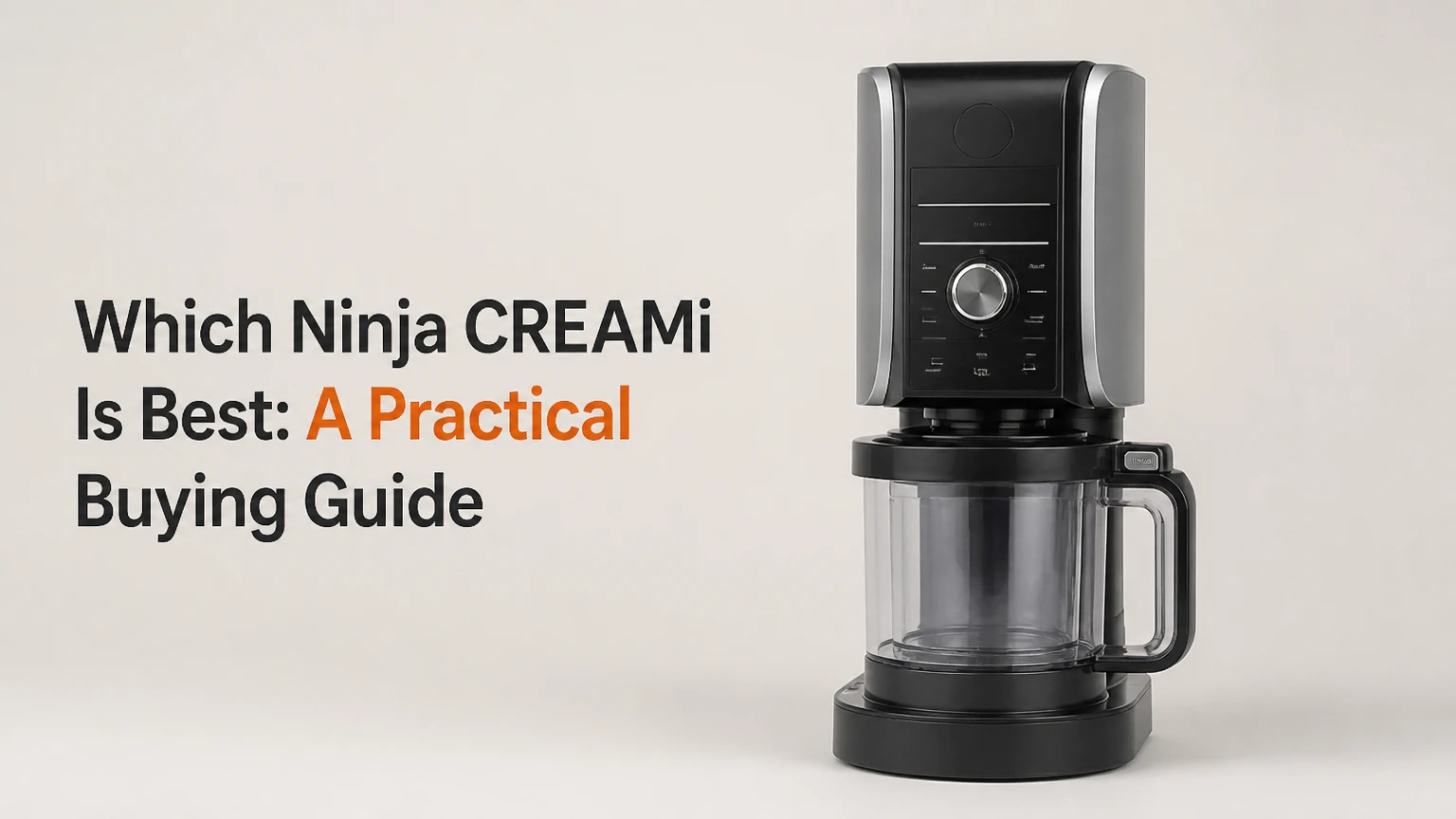
The best Ninja CREAMi for most people is the original 7-in-1 model because it delivers the core frozen-dessert texture at the lowest typical price, about $180-$230 in the United States. Choose the Deluxe for larger households and frozen drinks, or the Swirl when dispensing soft serve matters more than compact storage and simple cleanup.
Key Facts and Quick Answer
- The Ninja CREAMi 7-in-1 is the best general choice for one or two people who mainly make ice cream, sorbet, gelato, and milkshakes.
- The Ninja CREAMi Deluxe 11-in-1 uses 24-ounce containers instead of the original 16-ounce containers, giving families about 50% more capacity per frozen block.
- The Ninja CREAMi Swirl is the better fit for users who specifically want soft-serve dispensing and mix-in control from a countertop machine.
- Every CREAMi requires a prepared base to freeze solid for about 24 hours on a level surface before processing.
- A normal program usually takes 2-3 minutes. A crumbly result often needs one re-spin, not a longer thaw.
- The CREAMi does not make dessert instantly. It shifts the work from churning during preparation to planning frozen containers a day ahead.
Which Ninja CREAMi Is Best?
The best Ninja CREAMi depends on serving size, dessert type, freezer capacity, and how often you will prepare frozen bases. The original model wins for value and simplicity, the Deluxe wins for family-sized portions and drink programs, and the Swirl wins for soft-serve presentation.
A useful decision rule is simple: buy the original if a 16-ounce batch is enough, pay more for the Deluxe if you routinely need 24 ounces or want slushies, and choose Swirl only when its dispensing system is a primary reason for buying. Extra programs have less value when your recipes are mostly standard ice cream.
| User situation | Best model | Typical US price | Reason |
|---|---|---|---|
| One or two people | Original 7-in-1 | $180-$230 | Lowest entry cost and 16-ounce pints |
| Family portions | Deluxe 11-in-1 | $220-$280 | 24-ounce container and larger yield |
| Soft-serve desserts | CREAMi Swirl | $250-$350 | Integrated soft-serve dispensing |
| Protein ice cream | Original or Deluxe | $180-$280 | Lite Ice Cream program and re-spin control |
| Frozen drinks | Deluxe | $220-$280 | Slush and Creamiccino-style programs |
| Small countertop | Original 7-in-1 | $180-$230 | Narrower container and simpler system |
Prices are typical US retail ranges, not permanent manufacturer prices. Bundles, seasonal discounts, included containers, and retailer-specific model numbers can change the comparison.
When should you buy the original 7-in-1?
Buy the original CREAMi when your priority is scoopable ice cream from small batches rather than maximum automation. Its 16-ounce container suits singles, couples, children’s portions, and households that prefer several flavors instead of one large batch.
The original machine’s programs commonly include ice cream, sorbet, gelato, milkshake, smoothie bowl, lite ice cream, and re-spin. Exact labels can vary by model code and market, so confirm the box and manual before purchase.
The smaller container also reduces waste. A 16-ounce pint can provide roughly four 4-ounce servings, although dense mix-ins and generous portions change the yield. Two containers are more useful than a larger machine if the household wants chocolate and fruit flavors at the same time.
When is the Deluxe worth the extra cost?
The Deluxe is worth the extra cost when a household regularly needs more than 16 ounces or will use its frozen-drink programs. A 24-ounce container holds 8 ounces more than the original, which is a 50% capacity increase, although the finished serving count still depends on portion size.
The Deluxe can process a half container in models designed for that function, reducing the need to consume or refreeze a full batch. That flexibility matters to families with different dietary preferences, but the container is taller or wider than the original version and needs compatible storage space.
Do not buy the Deluxe solely because it has more buttons. If you make one pint every week and never prepare slushies, the additional programs may not repay the price difference.
Is the CREAMi Swirl worth choosing?
The CREAMi Swirl is worth choosing for people who will frequently serve soft serve directly from the machine. Its dispensing format changes the experience from processing a frozen pint into scooping to filling cones, cups, or layered desserts through a nozzle.
Soft-serve convenience brings trade-offs. The appliance and dispensing pathway add cleaning steps, occupy more vertical space, and make the purchase harder to justify if the household mainly wants firm, scoopable ice cream. Swirl is a specialty choice, not automatically the highest-performing model for every recipe.
Check the exact Swirl model before buying. Product names, program counts, included containers, and electrical specifications can differ between the United States, Canada, the United Kingdom, and other markets.
How Does the Ninja CREAMi Work?
The Ninja CREAMi works by shaving and reprocessing a fully frozen base with a rotating paddle rather than churning a liquid mixture while it freezes. The process usually takes 2-3 minutes, but the base must freeze for approximately 24 hours first.
That mechanism explains both the machine’s strength and its limits. A conventional compressor ice-cream maker continuously freezes and churns liquid, while the CREAMi starts with a solid block and changes its texture after freezing. The CREAMi can therefore process some low-fat, high-protein, or fruit-based formulas that would be difficult to churn conventionally.
Follow this sequence:
- Blend or whisk the base until the sweetener, dairy, protein powder, or stabilizer is evenly distributed.
- Pour only to the container’s maximum-fill line.
- Freeze the container upright on a level shelf for at least 24 hours.
- Install the container according to the model’s instructions.
- Select the program that matches the base, such as Lite Ice Cream, Sorbet, or Ice Cream.
- Inspect the texture after processing and use one re-spin when the mixture remains powdery.
- Add mix-ins only through the designated mix-in program or method.
| Stage | Typical time | Main requirement | Common failure |
|---|---|---|---|
| Base preparation | 5-15 minutes | Smooth, evenly mixed liquid | Protein or sweetener clumps |
| Initial freezing | 24 hours | Level, upright container | Slanted or soft center |
| First processing | 2-3 minutes | Correct program and locked lid | Powdery or icy texture |
| Re-spin | About 1 minute | Use after first spin if needed | Over-processing mix-ins |
| Mix-in cycle | About 2 minutes | Small, chilled pieces | Large frozen chunks |
| Cleanup | 5-10 minutes | Wash paddle, lid, and container | Residue in the blade area |
An uneven frozen surface is more than a cosmetic problem. A slope can place uneven force on the paddle, while a large hard ingredient can obstruct the blade. Let the machine process the container directly from the freezer unless the recipe instructions specifically call for another method.
Ninja CREAMi Model Comparison
The original, Deluxe, and Swirl models share the same basic concept but target different preparation habits. Capacity, program selection, container compatibility, footprint, and dispensing design matter more than the headline number of programs.
| Feature | Original 7-in-1 | Deluxe 11-in-1 | CREAMi Swirl |
|---|---|---|---|
| Typical container size | 16 oz, 473 ml | 24 oz, 706 ml | About 16 oz, model dependent |
| Program count | 7 | 11 | Up to 13, model dependent |
| Main strength | Standard frozen desserts | Larger batches and drinks | Dispensed soft serve |
| Half-batch flexibility | Limited or model dependent | Designed for partial processing | Model dependent |
| Typical price | $180-$230 | $220-$280 | $250-$350 |
| Best household | One or two people | Families and frequent makers | Soft-serve users |
What programs actually matter?
Program names matter because they change the processing pattern for different bases. A fruit-heavy sorbet, dense protein mixture, and dairy ice cream do not contain the same water, fat, or sugar balance, so one universal setting cannot produce equally good results.
| Dessert or base | Preferred setting | Typical ingredients | Main adjustment |
|---|---|---|---|
| Dairy ice cream | Ice Cream | Milk, cream, sugar | Freeze level and fat balance |
| High-protein base | Lite Ice Cream | Milk, yogurt, protein powder | Re-spin if powdery |
| Fruit puree | Sorbet | Fruit, sugar, acid | Avoid large frozen chunks |
| Dense egg-based base | Gelato | Milk, yolks, sugar | Use a smooth, fully frozen base |
| Milk-based drink | Milkshake | Milk, ice cream, flavoring | Add liquid within fill limits |
| Thick fruit bowl | Smoothie Bowl | Fruit, yogurt, liquid | Follow minimum-liquid guidance |
More programs do not guarantee better texture. Recipe composition has a larger effect than the difference between two adjacent preset labels.
What Size CREAMi Container Do You Need?
Choose a 16-ounce container for individual portions and a 24-ounce container for family service or meal-prep routines. Container capacity is not the same as finished servings because the maximum-fill line, expansion, mix-ins, and serving size reduce the usable amount.
A four-person household serving 4 ounces each can finish one 16-ounce batch in one sitting. A household serving 6 ounces each needs 24 ounces, making the Deluxe more practical. People who want several flavors may still prefer two original containers over one Deluxe container.
| Household pattern | Batch size needed | Practical choice | Storage implication |
|---|---|---|---|
| One serving after dinner | 8-12 oz | Original container | Minimal freezer demand |
| Two 4-ounce servings | 16 oz | Original 7-in-1 | One standard container |
| Four 4-ounce servings | 16 oz | Original or Deluxe | Original may be sufficient |
| Four 6-ounce servings | 24 oz | Deluxe | Larger frozen block |
| Two flavors for four people | 32 oz total | Two original containers | Requires two freeze spaces |
| Weekly flavor rotation | 16-24 oz | Buy extra compatible tubs | Plan 24-hour lead time |
Measure your freezer shelf before ordering. A CREAMi container may fit by volume but fail because a shelf is too low, a drawer is too shallow, or the container cannot stand level.
Which Model Is Best for Protein, Dairy-Free, and Low-Sugar Bases?
The original and Deluxe models are both suitable for protein, dairy-free, and reduced-sugar recipes when the base is formulated for freezing. The Lite Ice Cream setting often suits protein mixtures, but no program can fully compensate for too little sugar, fat, or liquid.
Low-sugar bases freeze harder because sugar lowers the freezing point. Fat contributes richness, while stabilizers reduce free-water migration and help prevent an icy mouthfeel. A typical starting amount for guar gum is about 1/8 to 1/4 teaspoon per pint, but excessive gum creates a sticky texture and should not replace sound recipe balance.
| Base type | Typical texture risk | Useful ingredient | Processing advice |
|---|---|---|---|
| Protein powder and milk | Crumbly, chalky | Yogurt or small stabilizer amount | Use Lite Ice Cream, then re-spin |
| Unsweetened almond milk | Icy and thin | Banana, yogurt, or thickener | Avoid expecting dairy-like richness |
| Greek yogurt | Tangy and dense | Milk or fruit puree | Blend completely before freezing |
| Reduced-sugar base | Hard and icy | Measured sweetener or soluble solids | Follow a tested formula |
| Coconut milk | Firm, fatty, sometimes waxy | Full-fat coconut milk | Process immediately after freezing |
| Fruit puree | Crystalline texture | Sugar and finely blended fruit | Use Sorbet and re-spin if needed |
The practitioner rule is to adjust the recipe before changing the machine. A re-spin can smooth small defects, but it cannot turn an under-sweetened block into conventional premium ice cream.
Price, Running Cost, and Alternatives
The purchase price is only one part of the decision. Extra containers, freezer space, ingredients, replacement paddles, and the value of a 24-hour preparation cycle affect the cost of ownership.
| Option | Typical US purchase price | Preparation model | Best use |
|---|---|---|---|
| Original CREAMi | $180-$230 | Freeze 24 hours, process 2-3 minutes | Small dessert batches |
| Deluxe CREAMi | $220-$280 | Freeze 24 hours, process 2-3 minutes | Larger portions and drinks |
| CREAMi Swirl | $250-$350 | Freeze 24 hours, dispense after processing | Soft-serve presentation |
| Cuisinart FastFreeze | $120-$150 | Faster freezing, more manual steps | Lower budget and compact storage |
| High-power blender | $100-$700 | Blend with added liquid | Smoothies and instant desserts |
| Pacojet | $6,500 or more | Commercial frozen beakers | Professional kitchens |
A CREAMi is not a direct substitute for every ice-cream maker. A compressor machine is better for spontaneous batches because it does not require a pre-frozen container, while a blender is better for smoothies and frozen drinks that need substantial liquid.
The CREAMi is also loud in practice. Typical user measurements often place processing near 75-80 decibels, although room acoustics and measurement distance change the result. A quieter machine, such as a compact churner reported around 69 decibels in some comparisons, may be preferable in an open-plan kitchen.
What does the CREAMi do poorly?
The Ninja CREAMi does poorly when you need dessert immediately, want a large party batch, or expect a low-calorie base to taste identical to a high-fat commercial formula. It also requires washing the paddle and container after use, and its tall processing assembly needs overhead clearance.
The machine is not a freezer. It does not reliably rescue a warm, partially frozen base, and it cannot safely process an overfilled container. It is best understood as a texture-processing appliance with a long preparation lead time.
Common Problems and Safer Operating Rules
Most CREAMi failures come from an unsuitable frozen block rather than a defective motor. The highest-impact controls are a level 24-hour freeze, correct fill height, an appropriate program, and ingredients small enough to avoid stressing the paddle.
- Freeze containers on a level shelf.
- Keep the base below the maximum-fill line.
- Do not process a container that is visibly soft in the center.
- Do not add hard candy, large frozen fruit, or solid chocolate chunks before the first spin.
- Use the designated mix-in cycle for chilled additions.
- Stop using a container or paddle that is cracked, warped, or damaged.
- Follow the manufacturer’s cleaning and dishwasher instructions for your model.
A crumbly first spin is common with low-fat and high-protein recipes. One re-spin often improves cohesion. Re-spinning repeatedly can warm the mixture and may produce a paste-like texture, especially when the base contains gums or a high proportion of banana.
Thawing is a frequent mistake. Letting a pint sit at room temperature changes the block’s surface and can create uneven resistance, while a fully frozen, level block gives the paddle a more predictable path. If a recipe specifically instructs brief tempering, follow that recipe, but do not use thawing as a general fix.
How to Choose Between the Three Main Models
Use this ranking when the models are similarly discounted:
- Original 7-in-1: choose it for the best balance of price, footprint, and everyday dessert capability.
- Deluxe 11-in-1: choose it when 24-ounce batches or frozen drinks will be used at least twice monthly.
- CREAMi Swirl: choose it when soft-serve dispensing is the central reason for purchase.
Before checkout, verify the model number, container size, included accessories, voltage, warranty, and replacement-container availability. A discounted appliance with hard-to-replace containers may cost more over several years than a slightly higher-priced bundle with two compatible tubs.
Frequently Asked Questions About which ninja creami is best
Can the Ninja CREAMi make ice cream without 24 hours of freezing?
The Ninja CREAMi requires a fully frozen base for reliable processing, and approximately 24 hours is the standard preparation period. A shorter freeze can leave the center soft, produce an uneven texture, and increase stress on the paddle. Freeze the container level and upright rather than relying on a brief countertop thaw.
Is the Ninja CREAMi cheaper than buying ice cream?
The Ninja CREAMi can reduce per-serving costs when you make desserts regularly from milk, fruit, yogurt, or pantry ingredients. The calculation changes if you buy many specialty ingredients, replace containers, or make only a few batches yearly. Compare the appliance price plus ingredients against your normal annual dessert spending.
How many people does one CREAMi pint serve?
A 16-ounce CREAMi container commonly provides four 4-ounce servings, while a 24-ounce Deluxe container can provide four 6-ounce servings. Actual yield depends on the maximum-fill line, mix-ins, and portion size. Large family gatherings usually require multiple frozen containers and at least 24 hours of preparation.
Can you put a whole frozen banana or candy bar in a CREAMi?
Do not put a whole frozen banana, candy bar, or other large hard item into the container before processing. Blend the banana into the base, chop soft additions into small pieces, and use the model’s mix-in procedure. Large rigid pieces can obstruct the paddle or damage the processing assembly.
Is the Ninja CREAMi safe for making dairy-free desserts?
The Ninja CREAMi can make dairy-free desserts from bases such as oat milk, soy milk, almond milk, or coconut milk. Dairy-free formulas often contain less fat or sugar than dairy ice cream, so they may taste icier or require a re-spin. Prevent cross-contact by washing containers carefully when allergies matter.
Should you buy a used Ninja CREAMi?
Buy a used Ninja CREAMi only after checking the paddle, container threads, lid, locking mechanism, and power cord. Replacement parts may be model-specific, and missing containers can erase the original saving. A used original model is usually the safest value purchase when the seller provides the correct compatible accessories and a working demonstration.
Final Verdict
The original 7-in-1 is the best Ninja CREAMi for most buyers because its 16-ounce capacity, core programs, and typical $180-$230 price cover the main use case without paying for specialized features. Choose the Deluxe for 24-ounce family batches and frozen drinks, and choose the Swirl only when soft-serve dispensing justifies its larger, more complex design. The best choice is the model that matches your freezer space and preparation habits, not the one with the longest program list.