

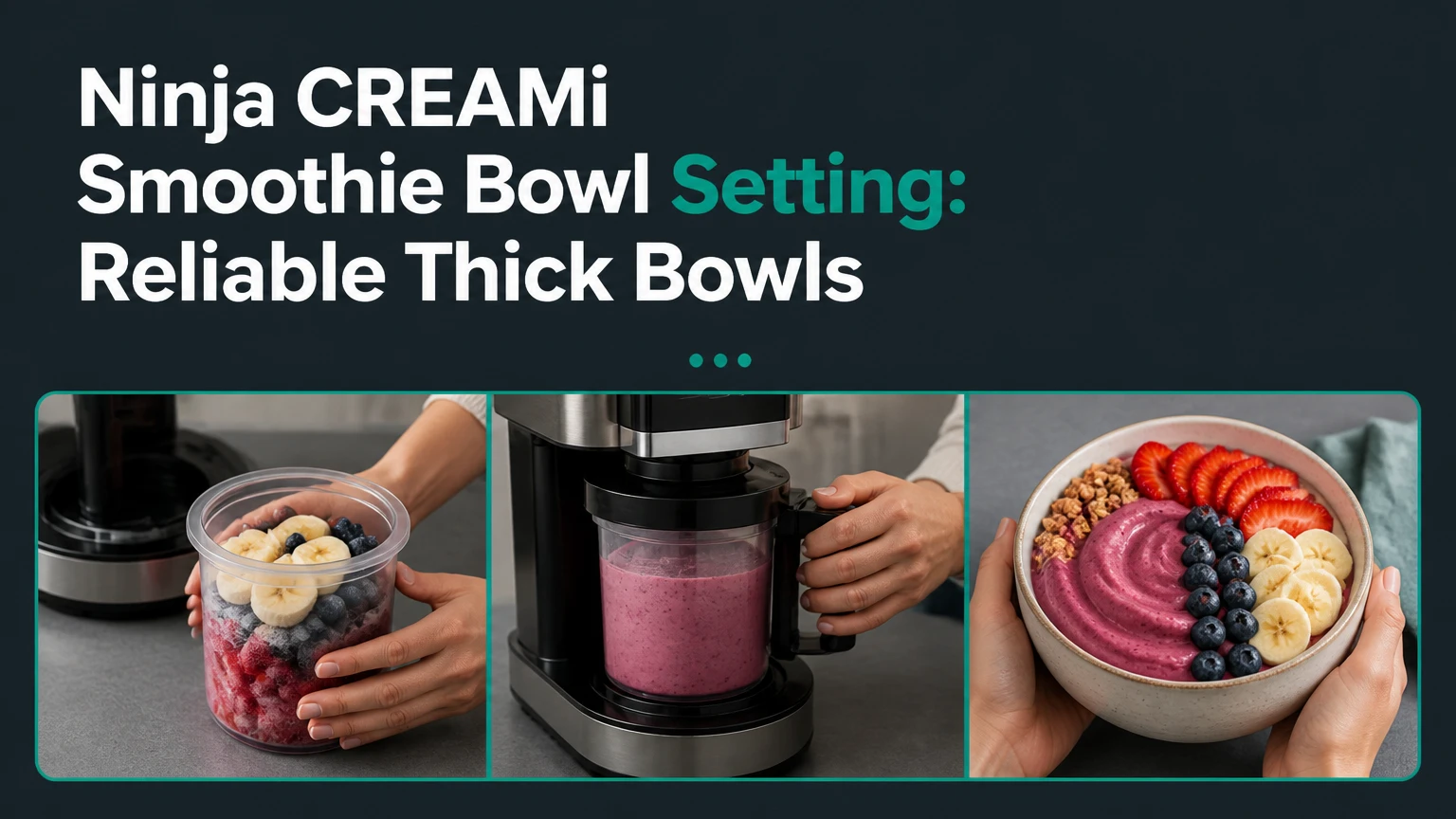
The Ninja CREAMi Smoothie Bowl setting processes a fully frozen fruit-based mixture into a thick, spoonable bowl. It works by moving the CREAMi paddle through the frozen pint from above, so the base needs far less liquid than a conventional blender, but the pint must freeze solid for about 24 hours and stay below the maximum fill line.
Key Facts at a Glance
- The Smoothie Bowl program is available only on Ninja CREAMi models whose control panel or manual lists that program.
- A prepared pint normally requires at least 24 hours in a freezer set near 0°F, or -18°C, before processing.
- The mixture should freeze level, with no large whole fruit pieces, ice cubes, or raised central hump.
- The program is designed for a thick bowl, not a pourable smoothie or soft-serve texture.
- A crumbly result usually needs a Re-Spin and, if necessary, 1-2 teaspoons of liquid rather than a complete recipe restart.
- Ninja does not generally publish a consumer-facing RPM specification for the Smoothie Bowl program, so claims of a precise 2,500-3,500 RPM range should not be treated as verified operating data.
What Does the Ninja CREAMi Smoothie Bowl Setting Do?
The Ninja CREAMi Smoothie Bowl setting turns a frozen fruit mixture into a dense spoonable preparation by shaving and recombining material from the frozen surface. The program is useful for acai-style bowls, mango bowls, banana bowls, green fruit bowls, and protein mixtures that would become too thin in a high-speed blender.
A CREAMi is not blending a liquid vortex in the same way as a Vitamix or similar machine. The paddle travels downward through the frozen contents, which explains both its texture advantage and its operating limits. The method reduces the need for added liquid, but it cannot safely process a pint that is only partly frozen or contains large, hard inclusions.
Ninja’s owner documentation repeatedly emphasizes using the correct container, installing the outer bowl and paddle correctly, and processing only ingredients prepared according to the relevant model instructions. The Smoothie Bowl setting therefore describes a programmed appliance cycle, not a universal recipe formula. Program names and available functions differ across CREAMi generations.
Which CREAMi Models Include the Program?
The Smoothie Bowl program is most closely associated with the Ninja CREAMi Deluxe models, including the NC501 series, while several standard seven-function CREAMi machines use programs such as Smoothie, Sorbet, Gelato, Ice Cream, and Milkshake without offering Smoothie Bowl. Check the button labels and owner’s guide for the exact model rather than assuming every CREAMi has the feature.
| CREAMi configuration | Typical container size | Smoothie Bowl availability | Practical implication |
|---|---|---|---|
| Standard CREAMi, seven-function class | 16 oz | Model-dependent, often absent | Use the listed Smoothie or Sorbet program |
| CREAMi Deluxe NC500 or NC501 class | 24 oz | Commonly included | Follow the Deluxe fill line and program guide |
| CREAMi Breeze models | 16 oz | Model-dependent | Confirm the program before buying ingredients |
| Regional or newer variants | Model-specific | May differ by market | Use the printed manual and control-panel labels |
The 16-ounce and 24-ounce figures describe common container capacities, not permission to fill every recipe to the rim. Expansion, air space, and the model’s maximum fill mark still control the usable quantity.
How Does the Smoothie Bowl Program Work?
The CREAMi paddle enters a frozen base from the top and removes thin layers while the container rotates. The resulting particles combine into a dense mixture because the ingredients were frozen together and the machine adds little liquid during processing.
The mechanism creates a different texture from a blender. A blender needs enough liquid to pull ingredients toward its blades, while a CREAMi can process a frozen block with only the moisture already present in the recipe. That advantage disappears when a base contains too little water, too much insoluble fiber, or an uneven frozen surface.
Ninja does not provide a standard consumer specification for the program’s exact RPM, friction temperature, or guaranteed two-and-a-half-minute duration across all models. Cycle time depends on the machine, program, load, and operating conditions, so the display and owner’s guide are more reliable than generic RPM claims.
Why Does the Frozen Base Need to Be Level?
A level frozen surface lets the paddle engage the pint evenly and reduces stress caused by a tall ridge or central mound. A raised hump can cause uneven contact, produce a rough texture, or make the machine work harder than intended.
After filling, tap the container gently on the counter to release large air pockets, then smooth the surface with a spoon. Freeze the container upright and uncovered only as directed by the manual, or with its storage lid if that is the approved setup. Do not freeze the base at an angle.
How Do You Use the Ninja CREAMi Smoothie Bowl Setting?
Use the CREAMi in seven practical stages: prepare a pourable base, fill below the marked line, freeze it level for about 24 hours, install the paddle and outer bowl, select the named program, inspect the texture, and Re-Spin only when the result needs correction. Total active preparation commonly takes 5-10 minutes, while freezing is the controlling time factor.
Before You Start
| Requirement | Typical specification | Why it matters |
|---|---|---|
| Frozen pint | 1 container, solid for 24 hours | Prevents slush and uneven processing |
| Freezer temperature | About 0°F, -18°C | Supports a consistently hard base |
| Liquid | 2-8 tablespoons per pint recipe | Allows blending before freezing |
| Active preparation | 5-10 minutes | Covers blending, filling, and leveling |
| Tools | Blender, spoon, CREAMi container | Produces a uniform frozen mixture |
Step 1: Blend a Smooth Base
Combine fruit with enough liquid to make a smooth pourable mixture before freezing. For a 16-ounce container, start with approximately 1 cup of fruit and 2-4 tablespoons of liquid; for a 24-ounce Deluxe container, use approximately 1.5 cups of fruit and 4-8 tablespoons of liquid.
Use frozen fruit only if your blender can safely process it with the chosen liquid. Fresh banana, yogurt, milk, juice, or coconut water can provide moisture, while nut butter, avocado, or coconut cream contributes fat and body.
You will know the base is ready when no large seeds, peel fragments, or hard fruit chunks remain. A common mistake is placing whole frozen strawberries or ice cubes directly into the pint, which can leave hard pieces for the paddle to encounter.
Step 2: Fill and Level the Container
Pour the prepared base into the correct CREAMi container and stop at the model’s maximum fill line. Leave the required headspace because frozen ingredients expand and a filled container can interfere with processing.
Scrape down the sides, tap out visible air pockets, and flatten the top. You will know the container is prepared correctly when the surface is even and the fill level remains below the printed mark.
Overfilling is more serious than producing a slightly small bowl. Expansion can push ingredients into areas that should remain clear and make the lid, spindle, or paddle difficult to operate.
Step 3: Freeze the Pint Solid
Freeze the container upright for at least 24 hours in a freezer near 0°F. The outside may feel firm before the center is ready, especially when the base contains sugar, fat, or a deep volume of puree.
Ninja manuals commonly direct users to freeze bases for 24 hours, but the actual requirement is a completely solid pint. A shallow freeze, warm freezer, recently loaded freezer, or warm ingredient mixture can extend the practical wait.
You will know the base is ready when pressing the surface reveals no soft center and the contents do not shift when the container is gently tilted. Do not process a partially frozen pint to save time.
Step 4: Install the Paddle and Outer Bowl
Remove the storage lid, fit the processing paddle into the outer-bowl lid, and lock the pint into the outer bowl as described for your model. Confirm that the outer bowl is fully seated before selecting a program.
The machine should be assembled without force. If the paddle does not lock, stop and inspect the lid, shaft, and bowl for residue or misalignment rather than pressing harder.
Step 5: Select Smoothie Bowl
Choose Smoothie Bowl only when the control panel lists it for your model. Press the program button and allow the machine to complete its programmed cycle without holding the container or interrupting the drive mechanism.
The cycle duration is model-specific. A typical run may take roughly 2-3 minutes, but the display is the controlling reference, not a universal two-and-a-half-minute promise.
You will know the program completed when the machine stops and the result looks dense, cohesive, and scoopable. A slightly uneven first pass does not automatically indicate a failure.
Step 6: Re-Spin a Crumbly Result
Run Re-Spin when the processed base looks powdery, dry, or loosely granulated. If the mixture remains dry after one Re-Spin, add 1-2 teaspoons of milk, juice, coconut water, or another compatible liquid to the center well, then run Re-Spin again.
A dry result usually reflects low moisture, a low-sugar formula, a very cold freezer, or an unevenly frozen base. A large pour of liquid can turn the bowl thin, so add liquid incrementally.
You will know the correction worked when the powder binds into a moist, spoonable texture. Do not add liquid merely because the surface has small frozen shavings; judge the bowl after pressing a spoon into the center.
Which Ingredients Produce the Best Bowl Texture?
Fruit with natural water and soluble fiber, combined with a modest amount of fat or dairy, produces the most reliable CREAMi bowl. Banana, mango, berries, yogurt, and acai puree are forgiving because they provide moisture, solids, or both.
| Bowl style | 16-ounce starting formula | 24-ounce starting formula | Texture adjustment |
|---|---|---|---|
| Acai berry | 100 g acai puree, 140 g berries, 60 ml juice | 150 g acai puree, 210 g berries, 90 ml juice | Add 15 g banana for less iciness |
| Tropical mango | 220 g mango, 60 ml coconut milk | 330 g mango, 90 ml coconut milk | Add 15 ml lime juice for brightness |
| Green fruit | 80 g spinach, 170 g banana and mango, 75 ml milk | 120 g spinach, 255 g banana and mango, 110 ml milk | Blend greens completely before freezing |
| Protein berry | 180 g berries, 180 ml milk, 25 g protein powder | 270 g berries, 270 ml milk, 38 g protein powder | Add 30 g yogurt if powdery |
The formulas are starting points, not official Ninja recipes. Fruit sweetness, fiber, protein powder type, and container size change the result. Whey, casein, plant protein, and collagen also absorb liquid differently.
Can You Add Nut Butter or Yogurt?
Yes. One tablespoon, approximately 16 grams, of nut butter or 60-100 grams of yogurt can make a low-fat fruit bowl smoother and less icy, provided the total mixture stays below the fill line.
Fat slows the perception of ice crystals, while yogurt contributes milk solids and acidity. Excess nut butter can make the base dense and difficult to process, and a large amount of Greek yogurt can produce a tangy, chalky bowl when paired with protein powder.
A practical rule is to add one body-building ingredient per pint: nut butter, yogurt, avocado, coconut cream, or a measured protein powder portion. Combining several large additions requires more liquid and makes the nutritional profile harder to predict.
How Should You Handle Greens and Seeds?
Blend leafy greens with the liquid first, then add fruit and blend again. Spinach usually integrates more easily than kale because kale has tougher fibers and stronger flavor.
Chia, flax, raspberry seeds, and acai seeds can remain perceptible after processing. If a smooth texture matters, strain the blended base before freezing; if fiber matters more, keep the particles and use a Re-Spin only when the bowl is genuinely dry.
How Does CREAMi Compare With a Blender?
A CREAMi produces a thicker frozen bowl with less added liquid, while a high-speed blender is faster for fresh smoothies and easier for batches that do not require a 24-hour freeze. A food processor can handle frozen fruit, but it usually needs more stopping, scraping, and liquid management.
| Criterion | Ninja CREAMi | High-speed blender | Food processor | Best fit |
|---|---|---|---|---|
| Preparation time | 5-10 minutes plus 24-hour freeze | 5-10 minutes, no freeze required | 5-15 minutes, no freeze required | Blender for immediate drinks |
| Added liquid | Approximately 2-8 tablespoons | Often 120-300 ml | Often 60-180 ml | CREAMi for dense bowls |
| Finished texture | Spoonable frozen base | Drinkable to thick smoothie | Chunky to thick puree | CREAMi for bowl texture |
| Batch size | 16 or 24 oz container | 32-64 oz jar typical | 7-14 cup bowl typical | Blender for groups |
| Active control | Programmed cycle | Tamp and scrape may be needed | Frequent scraping common | CREAMi for repeatability |
| Main limitation | Requires solid frozen pint | Can warm and thin mixture | Can leave uneven pieces | Depends on timing |
A blender is better when the goal is a drink, a large batch, or a bowl made immediately from fresh ingredients. The CREAMi is better when a thick frozen result matters more than speed.
The CREAMi is not a replacement for a blender. It does not efficiently liquefy a fresh smoothie, and it is poorly suited to hot ingredients, large unblended chunks, or recipes that must be served immediately.
What Does Each Bowl Cost?
A homemade CREAMi bowl typically costs about $1.50-$3.50 when made with supermarket fruit, dairy or plant milk, and modest toppings. Premium acai packets, branded protein powder, nut butter, and granola can move the total above $4.
| Ingredient category | Typical quantity | Typical USD cost | Cost per bowl |
|---|---|---|---|
| Frozen berries | 200-300 g | $5-$9 per 1.5-2 lb bag | $1.00-$1.80 |
| Mango or banana | 200-330 g | $1.50-$4 per package | $0.50-$1.50 |
| Milk, yogurt, or coconut milk | 60-270 ml | $3-$8 per container | $0.20-$1.00 |
| Protein powder | 25-38 g | $25-$45 per tub | $0.80-$2.00 |
| Granola and seeds | 15-35 g | $4-$10 per package | $0.30-$1.25 |
The appliance’s typical retail price often falls around $170-$250, depending on model, promotions, and included containers. Divide the appliance price by the number of bowls you expect to make, then add ingredients and toppings for a realistic ownership cost.
What Problems Occur Most Often?
The most common CREAMi bowl failures are incomplete freezing, excessive liquid, low-moisture recipes, an uneven surface, and incorrect program selection. Each failure has a different fix, so adding more liquid is not the universal solution.
| Symptom | Likely cause | Corrective action | Avoid next time |
|---|---|---|---|
| Powdery or crumbly | Low moisture or low sugar | Re-Spin, then add 1-2 tsp liquid | Increase liquid slightly before freezing |
| Slushy or watery | Partially frozen base or excess liquid | Refreeze until solid | Freeze 24 hours and respect fill line |
| Large icy pieces | Whole frozen fruit or weak blending | Stop and remove hard pieces if safe | Blend fruit before freezing |
| Uneven texture | Frozen hump or tilted container | Level the base; Re-Spin if appropriate | Freeze upright on a flat shelf |
| Paddle will not engage | Misassembled bowl or lid | Unplug and inspect alignment | Lock parts without force |
| Loud or strained operation | Hard obstruction or incorrect assembly | Stop the cycle and inspect | Never process ice chunks directly |
Why Is the Bowl Icy?
An icy bowl usually contains too much free water relative to sugar, fruit solids, or fat. Water forms larger crystals during freezing, especially when the mixture is mostly juice or low-sugar milk.
Use whole fruit puree, banana, yogurt, or a small amount of nut butter to increase solids. Replacing a large volume of juice with puree often improves texture more effectively than adding extra fat.
Should You Thaw the Pint First?
A short rest of approximately 5 minutes can help a very hard pint, but prolonged thawing is unnecessary and can create a partially melted outer layer with a frozen center. The owner’s guide for your specific model should take priority over generalized thawing advice.
A safer practical test is to inspect the surface for a solid, level freeze and process the pint promptly. Never microwave, heat, or aggressively pry the frozen block.
What If the Machine Stops or Makes an Unusual Sound?
Stop the machine if the bowl becomes unusually loud, the paddle appears jammed, the container shifts, or the motor strains. Unplug the appliance before checking assembly, frozen obstructions, the paddle, and the container.
Do not force the paddle through large ice cubes, whole frozen fruit, utensils, or a container that exceeds the fill line. Persistent mechanical noise requires Ninja customer support or service, not repeated processing cycles.
How Should You Finish and Store the Bowl?
Add toppings after the base reaches the desired consistency, then serve immediately for the firmest spoonable texture. Granola, sliced banana, coconut flakes, cacao nibs, seeds, and measured nut butter work better when added after processing because they retain their texture.
For integrated pieces, make a center well about 1-1.5 inches deep, add a small quantity of mix-ins, and select Mix-In if your model supports it. Use dry additions in modest amounts because dense granola or large frozen chocolate pieces can make the finished bowl difficult to scoop.
Do not store a partially melted bowl at room temperature. If you refreeze leftovers, expect a harder or icier texture and process the frozen portion again only according to the appliance instructions. Treat dairy, cut fruit, and other perishable ingredients as refrigerated foods before freezing.
FAQ
Can You Use Fresh Fruit in a CREAMi Smoothie Bowl?
Yes, fresh fruit can be blended into the base before freezing, and ripe banana, mango, and berries work particularly well. Fresh fruit still needs to be combined into a level mixture and frozen solid for about 24 hours. Fresh whole pieces should not be placed directly into the pint as hard inclusions.
Can Protein Powder Make the Bowl Dry?
Protein powder can make a bowl dry, chalky, or crumbly because the powder absorbs available water. Start with about 25 grams in a 16-ounce recipe or 38 grams in a 24-ounce recipe, then add yogurt or milk if the processed texture does not bind after one Re-Spin.
Can You Make a Low-Sugar Smoothie Bowl?
Yes, but low-sugar formulas commonly process more icy and crumbly because sugar lowers freezing point and helps limit crystal growth. Use fruit puree, yogurt, avocado, or a small amount of nut butter for body, then correct a dry result with 1-2 teaspoons of liquid rather than a large pour.
Is the Smoothie Bowl Setting Suitable for Frozen Yogurt?
The setting can process a frozen yogurt-style fruit base when the model supports the program, but the result depends on yogurt fat, sugar, and water content. Full-fat yogurt generally produces a softer mouthfeel than nonfat yogurt, while very thick Greek yogurt may need milk or fruit puree for easier processing.
Can You Make a Bowl Without a Smoothie Bowl Button?
Yes, but the correct substitute depends on the model and its manual. A listed Sorbet, Smoothie, or another fruit-oriented program may produce an acceptable result, although program timing and texture can differ. Do not select a program solely because its name sounds similar.
How Many Toppings Should You Add?
Use approximately 15-35 grams of toppings per bowl, depending on density and serving size. Granola, seeds, coconut, cacao nibs, and sliced fruit can be added after processing, while only small quantities should enter a Mix-In cycle to prevent pulverizing the ingredients.
The Bottom Line
The Ninja CREAMi Smoothie Bowl setting is the right choice for a thick frozen fruit bowl when you can plan around a solid 24-hour freeze. Use a blended, level base, respect the model’s fill line, select only a program your machine actually provides, and correct a crumbly result with a controlled Re-Spin. The setting does not replace a blender for immediate drinks, large batches, or pourable smoothies.