

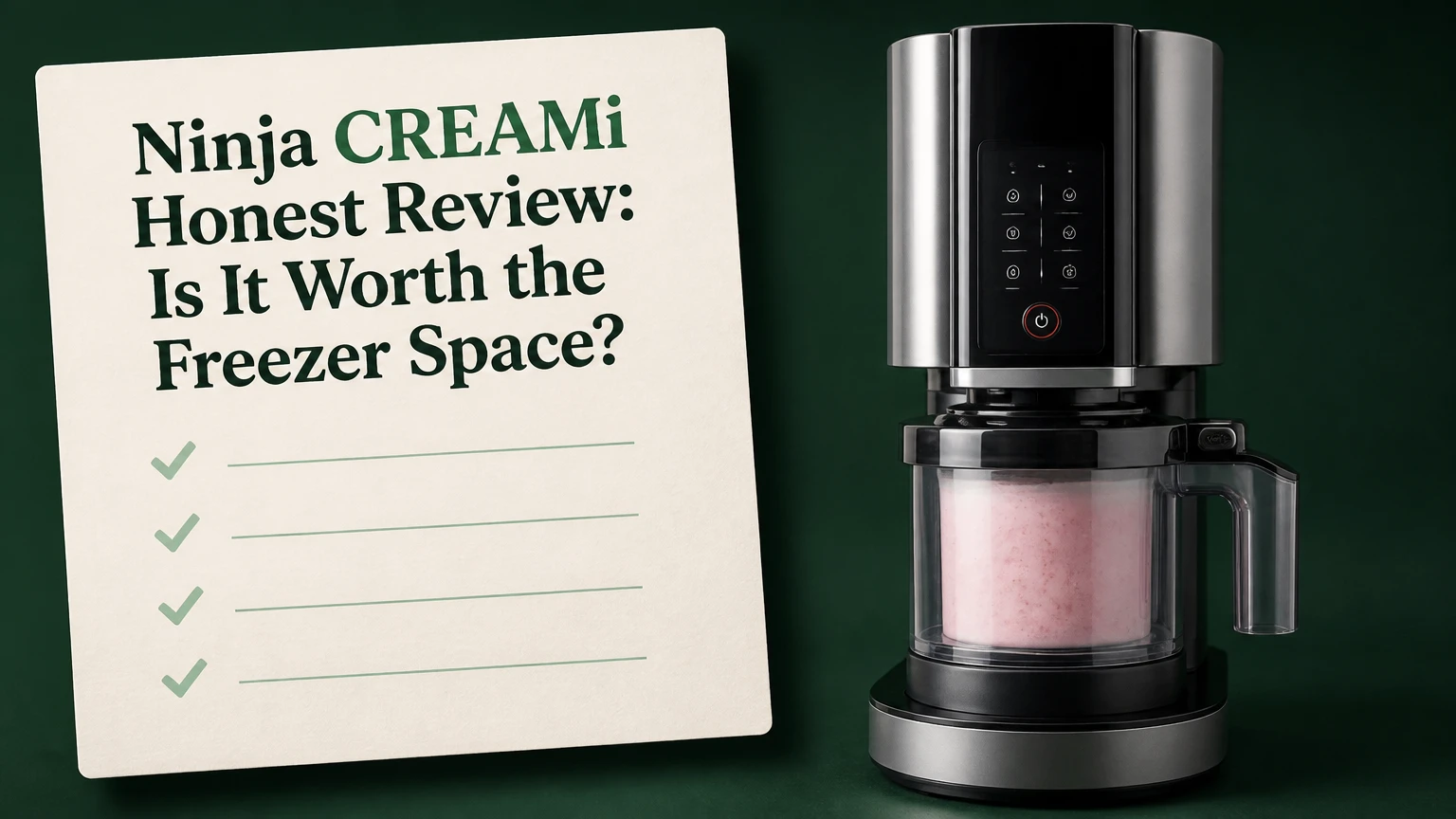
The Ninja CREAMi is worth buying for dense, low-fat, high-protein, and dairy-free frozen desserts, but it is not a fast ice cream maker in the usual sense. The machine processes a solid frozen base in roughly 1.5-5 minutes, while the complete workflow requires at least 24 hours of freezing, freezer space, and occasional re-spins.
Key Facts at a Glance
- The Ninja CREAMi processes a frozen pint rather than churning a liquid base as it freezes.
- A standard CREAMi pint needs at least 24 hours in a freezer before processing.
- The original model uses 16-ounce containers, while the Deluxe model uses 24-ounce containers.
- A first cycle commonly produces a crumbly texture, and one re-spin often improves it.
- Typical operating noise is around 80 dB, which is louder than a normal blender conversation.
- The Ninja CREAMi is strongest with high-protein, low-fat, fruit-based, and portion-controlled desserts.
What Is the Ninja CREAMi?
The Ninja CREAMi is a countertop frozen-dessert processor that turns a frozen block of prepared ingredients into ice cream, sorbet, gelato, milkshakes, smoothie bowls, and related desserts. Unlike a traditional Cuisinart-style ice cream maker, the Ninja CREAMi does not freeze and churn a liquid mixture simultaneously.
The distinction determines the ownership experience. You prepare a base, pour it into a pint, freeze it level for at least 24 hours, and process it when needed. The machine then breaks down the frozen block into a dense dessert, rather than creating a lighter, airier product through continuous churning.
The result can resemble soft-serve immediately after processing. A second freeze makes it firmer, but repeated freezing and thawing may create a harder texture. The appliance therefore rewards planned batches more than spontaneous dessert making.
How Does Creamify Processing Work?
The Ninja CREAMi uses a vertically moving Creamerizer paddle to shave and micronize the frozen base from the surface downward. The paddle breaks ice crystals and distributes ingredients through the pint, producing a compact texture with relatively little incorporated air.
Traditional ice cream makers rely on a chilled bowl or compressor, a rotating dasher, and a liquid base that freezes during agitation. The CREAMi shifts the hard work to the blade and motor. That design explains why skim milk, protein powder, cottage cheese, bananas, and fruit purées can produce acceptable textures without the fat level normally needed in a churner.
The method has a mechanical consequence. A raised hump or uneven frozen surface makes the blade encounter resistance at an angle, so leveling the pint before processing is a safety step rather than a cosmetic preference.
What Does the CREAMi Process?
| Dessert setting | Typical base | Processing result | Common finishing step |
|---|---|---|---|
| Ice Cream | Whole milk, cream, sugar | Dense scoopable dessert | Re-spin after 1 cycle |
| Lite Ice Cream | Milk, protein powder, sweetener | Soft, low-fat texture | Add 1 tablespoon milk |
| Sorbet | Fruit purée, sugar, water | Compact fruit dessert | Re-spin for smoothness |
| Gelato | Milk, sugar, reduced air base | Thick, moderately firm texture | Serve immediately |
| Smoothie Bowl | Frozen fruit, yogurt, liquid | Spoonable thick bowl | Add liquid sparingly |
| Milkshake | Processed ice cream, milk | Drinkable dessert | Use 1-2 tablespoons milk |
Which Ninja CREAMi Model Should You Buy?
The original 16-ounce CREAMi is the better value for individual servings and basic frozen desserts, while the 24-ounce Deluxe is better for households that need larger batches or more preset programs. The discontinued Breeze can make sense only when replacement containers, warranty status, and used pricing are favorable.
| Model family | Container size | Program count | Best practical use |
|---|---|---|---|
| Original NC300 series | 16 ounces | 7 programs | One or two-person portions |
| Deluxe NC501 series | 24 ounces | 11 programs | Larger household batches |
| Breeze series | 16 ounces | 5 programs | Used-market budget purchase |
| Newer model variants | 16-24 ounces | Model-specific | Check container compatibility |
The Original model includes Ice Cream, Lite Ice Cream, Sorbet, Gelato, Milkshake, Smoothie Bowl, and Mix-in functions. The Deluxe adds options such as Frozen Yogurt, Creamiccino, Frozen Drink, Slushi, and Italian Ice, and its container design allows processing of the upper or lower portion.
The program labels do not mean each setting creates a fundamentally different mechanical process. They adjust processing behavior for different ingredient densities and expected textures. A buyer should prioritize container size, included pints, warranty, and regional availability over program count alone.
The Breeze is less attractive when accessories are difficult to replace. CREAMi containers are model-specific enough that a cheap used machine can become expensive if its outer bowl, paddle, or pint is missing.
How Much Does a Ninja CREAMi Cost to Own?
A Ninja CREAMi typically costs about $150-$300 in the United States, before ingredients and extra containers. Imported units can cost substantially more; for example, reported Bangladesh retail and import prices may range from approximately $325 to $575 after currency conversion, shipping, and seller markup, so local warranty coverage matters.
| Ownership item | Typical USD range | Typical timeframe | Buying implication |
|---|---|---|---|
| Original CREAMi machine | $150-$220 | 1 purchase | Lowest entry cost |
| Deluxe CREAMi machine | $200-$300 | 1 purchase | Higher capacity and programs |
| Extra pint container | $15-$30 | 1 replacement | Useful for batch rotation |
| Dessert ingredients | $1.50-$5 per pint | Per batch | Protein and specialty ingredients cost more |
| Replacement paddle or lid | $20-$50 | As needed | Verify model compatibility |
Electricity is a minor cost compared with ingredients and appliance price. The larger economic issue is utilization: a $200 machine used twice per week over two years costs about $0.96 per use before ingredients, whereas a machine used twice per month costs about $4.17 per use.
The CREAMi becomes more economical when it replaces purchased protein desserts, single-serve frozen yogurt, or specialty dairy-free products. It becomes less economical when a household wants occasional conventional ice cream and already owns a reliable blender.
What Is the Ninja CREAMi Workflow?
The Ninja CREAMi workflow takes at least 24 hours from liquid base to finished dessert, although active machine time is usually 1.5-5 minutes. The most important success factor is a uniformly frozen, level pint, not the speed of the processing cycle.
- Prepare a uniform base. Blend or whisk milk, yogurt, fruit, sweetener, and powders until no dry pockets remain. An immersion blender or milk frother helps disperse protein powder and powdered sweeteners.
- Fill below the maximum line. Leave expansion room and avoid packing solid ingredients above the marked fill limit.
- Freeze the pint level. Place the container on a flat freezer shelf for at least 24 hours. A freezer near 0°F, or approximately -18°C, is the practical target.
- Inspect the surface. Scrape down a raised mound before processing. Do not process a pint with a central hump or a visibly tilted frozen surface.
- Select the closest program. Use Lite Ice Cream for lower-fat or protein bases, Sorbet for fruit-heavy mixtures, and Ice Cream for traditional dairy bases.
- Run a re-spin when needed. If the first cycle looks powdery, add about 1 tablespoon of compatible liquid and re-spin once.
- Add mix-ins last. Create a well if required, add chocolate pieces or nuts within the recommended size, and use the Mix-in program.
- Clean immediately. Remove the paddle, rinse residue from the lid and spindle area, and dry components before storage.
You will know the batch worked when the texture is uniform from edge to center, the paddle has not encountered unusual resistance, and the dessert holds a soft mound rather than appearing as dry snow. The main mistake is treating the CREAMi like a blender that can process partially frozen ingredients.
How Long Does the Dessert Process Take?
| Workflow stage | Typical duration | Active effort | Main risk |
|---|---|---|---|
| Base preparation | 5-12 minutes | Blending and measuring | Powder clumps |
| Initial freezing | 24 hours | None | Uneven or short freeze |
| First processing cycle | 1.5-3 minutes | Machine monitoring | Powdery texture |
| Re-spin cycle | 1.5-3 minutes | Add liquid if needed | Over-softening |
| Mix-in cycle | 1-2 minutes | Add measured pieces | Large hard inclusions |
| Total elapsed time | 24-25 hours | 10-20 minutes active | Poor batch planning |
The machine is fast only after the freezer has done its part. A traditional compressor machine can produce dessert in 20-40 minutes from a liquid base, while the CREAMi can produce a serving in minutes from a prepared frozen pint.
That difference matters for dinner parties. The CREAMi favors preparing several pints in advance, whereas a compressor churner favors making one fresh batch on demand.
How Good Is the Ninja CREAMi Texture?
The Ninja CREAMi produces a dense, smooth texture that often exceeds traditional makers with low-fat or high-protein formulas. Full-fat bases can taste rich, but the CREAMi cannot fully compensate for an unbalanced recipe, excessive water, large ice crystals, or a base with too little dissolved sugar.
High-protein recipes are its strongest category. Whey or casein powder, Greek yogurt, milk, and a measured sweetener can become a thick dessert after a re-spin, although excessive protein powder may leave a chalky finish. Cottage cheese bases can become smooth when blended thoroughly before freezing, but they retain a tangy dairy flavor.
Fruit sorbets are also reliable because the blade can break down frozen fruit crystals efficiently. Water-heavy mixtures, such as unsweetened juice, tend to freeze hard and may need a tablespoon of liquid after the first cycle.
Does the CREAMi Make Real Ice Cream?
The Ninja CREAMi makes an ice-cream-style dessert, but its texture is denser and less aerated than many churned ice creams. The difference is measurable in eating experience: traditional churning incorporates air, while the CREAMi primarily reduces crystal size in a frozen block.
A standard dairy base with cream, milk, sugar, and egg yolk can taste like ice cream, but the machine does not automatically perform pasteurization or custard cooking. Recipe safety remains the user’s responsibility. Egg-based mixtures should be cooked according to a trusted recipe and cooled before freezing.
The honest limitation is texture after storage. A CREAMi pint that is processed, melted, and refrozen may become harder or icier than a freshly churned product. The best serving window is immediately after processing or after a short firming period.
How Does the CREAMi Compare With Alternatives?
The Ninja CREAMi is the best choice for low-fat and high-protein recipes, while a compressor ice cream maker is better for immediate batches and a conventional churner is cheaper for occasional full-fat ice cream. A blender is more versatile for drinks but cannot reliably reproduce the CREAMi’s dense frozen-dessert texture.
| Appliance | Preparation time | Texture method | Typical USD price |
|---|---|---|---|
| Ninja CREAMi | 24-hour freeze plus 1.5-5 minutes | Frozen-block micronizing | $150-$300 |
| Freezer-bowl Cuisinart | 8-24-hour bowl freeze plus 15-25 minutes | Churning during freezing | $60-$150 |
| Compressor ice cream maker | 20-40 minutes | Active chilling and churning | $250-$700 |
| Pacojet | Pre-frozen block plus about 1 minute | Commercial frozen-block processing | $6,000-$7,000 |
| High-power blender | 5-10 minutes with frozen ingredients | Blending and friction | $100-$600 |
The CREAMi has a narrower purpose than a blender and a more deliberate workflow than a compressor machine. Its advantage is recipe flexibility, especially when the mixture would fail in a churner because it lacks cream or sufficient fat.
Pacojet remains the professional benchmark for frozen-block processing, but the price and commercial construction place it in a different category. The CREAMi borrows the general processing concept at a household price, not the durability, speed under continuous service, or capacity of restaurant equipment.
Is the CREAMi Better Than a Cuisinart?
The Ninja CREAMi is better than a freezer-bowl Cuisinart for high-protein, low-fat, and single-serving recipes; the Cuisinart is better when you want a fresh, conventionally churned batch without freezing individual pints for a full day. Neither appliance wins every use case.
| Decision factor | Ninja CREAMi | Freezer-bowl Cuisinart | Better choice |
|---|---|---|---|
| Minimum preparation | 24-hour pint freeze | 8-24-hour bowl freeze | Cuisinart for one batch |
| Processing time | 1.5-5 minutes | 15-25 minutes | CREAMi |
| Low-fat texture | Strong performance | More icy risk | CREAMi |
| Batch flexibility | One pint per container | One bowl per cycle | CREAMi for rotation |
| Air incorporation | Low | Moderate | Cuisinart for lighter ice cream |
| Operating noise | Approximately 80 dB | Approximately 65-75 dB, typical | Cuisinart |
| Counter footprint | About 6-7 inches wide | About 8-10 inches wide, typical | CREAMi |
The CREAMi’s containers occupy freezer space, which can be a decisive disadvantage in small kitchens. A freezer-bowl machine also needs freezer space, but one bowl may be easier to accommodate than four pint containers.
Who Should Buy a Ninja CREAMi?
A Ninja CREAMi suits people who will prepare multiple frozen bases, value controlled portions, or want creamy results from ingredients that traditional ice cream makers handle poorly. It is a weak purchase for anyone who needs immediate dessert from room-temperature ingredients or dislikes appliance cleaning.
| User situation | Recommended model | Reason | Main compromise |
|---|---|---|---|
| Single person, protein desserts | Original NC300 | 16-ounce portion size | One-day advance planning |
| Family of three or more | Deluxe NC501 | 24-ounce container | Higher purchase price |
| Small apartment | Original NC300 | Smaller pint workflow | Approximately 80 dB operation |
| Dairy-free recipe testing | Original or Deluxe | Good low-fat texture control | Stabilizer experimentation |
| Occasional classic ice cream | Traditional churner | Lower entry price | Weaker low-fat results |
| Frequent dinner parties | Compressor maker | Fresh larger batches | Higher cost and footprint |
Is the Ninja CREAMi Good for Protein Ice Cream?
The Ninja CREAMi is particularly effective for protein ice cream because its blade can create a smooth texture from bases with little cream and substantial protein powder. A practical starting formula is milk or a milk alternative, Greek yogurt, one measured serving of protein powder, and enough sweetener to reduce the perception of ice.
Protein formulas vary widely. Whey can produce a softer, slightly elastic texture, while casein absorbs more liquid and may require an extra tablespoon or two during re-spin. A quarter teaspoon of guar gum can help a low-fat pint, but too much produces a gummy mouthfeel.
The machine does not eliminate calorie trade-offs. Sugar contributes dissolved solids and softness, so replacing all sugar with a low-calorie sweetener may create a harder, icier result unless the recipe includes other solids.
Can You Use Almond Milk or Other Dairy-Free Bases?
The Ninja CREAMi can process almond milk, oat milk, soy milk, coconut milk, fruit purée, and blended tofu bases, but unsweetened, low-solid liquids often produce a powdery or icy first cycle. Dairy-free bases improve when they contain fat, protein, fruit solids, nut butter, or a small amount of stabilizer.
Coconut milk usually creates the richest dairy-free result because its fat content limits large ice crystals. Almond milk needs more structural support, such as banana, nut butter, cocoa, dates, or a controlled amount of guar gum. Oat milk can become smooth but may taste starchy after freezing.
Use a clean paddle and container when preparing dairy-free desserts for someone with an allergy. The appliance is not automatically allergen-free after ordinary dairy processing.
What Problems Occur Most Often?
The most common Ninja CREAMi problems are a raised frozen hump, a powdery first cycle, dry edges, ingredient clumps, overfilling, and odor in the lid or paddle. Most problems come from base preparation or freezing conditions rather than a defective motor.
| Symptom | Likely cause | Recovery action | Prevention |
|---|---|---|---|
| Powdery surface | Low-fat or hard base | Add 1 tablespoon liquid, re-spin | Use enough solids |
| Central hump | Base froze unevenly | Scrape level before processing | Freeze on a flat shelf |
| Icy outer ring | Edges froze harder | Warm closed pint for 30-60 seconds | Use a balanced recipe |
| Powder clumps | Poorly mixed ingredients | Blend base again next batch | Use immersion blender |
| Mixture above fill line | Overfilling | Remove excess before freezing | Stop below maximum line |
| Sour or stale odor | Residue in lid or paddle | Wash, rinse, air-dry fully | Clean after every use |
A warm-water treatment can help a stubborn icy edge, but the closed pint should not be heated until the dessert melts substantially. The aim is to soften the outer layer enough for the paddle to reach it, not to thaw the entire batch.
Do not keep running cycles against a hard, uneven block. Unusual grinding, repeated stalls, or a locked outer bowl warrants stopping the machine and checking the paddle, pint surface, and container alignment.
Why Is the First Spin Powdery?
A powdery first spin usually means the frozen base has low fat, low sugar, high water content, or an especially cold outer layer. Add about 1 tablespoon of compatible liquid, then run one re-spin; repeated re-spins cannot repair a poorly balanced recipe or a severely uneven freeze.
This behavior is normal for many high-protein recipes. The first cycle reduces the block into fine particles, and the re-spin distributes moisture through those particles. The final texture should be creamy and cohesive rather than wet.
If the result stays sandy, change the formula next time. Increase dissolved solids with yogurt, fruit, sugar, or another compatible ingredient instead of adding large amounts of liquid after processing.
Why Does the Pint Need 24 Hours?
The 24-hour rule gives the entire base enough time to freeze into a uniformly hard block. A pint frozen for only 4-6 hours may appear solid near the surface while remaining softer in the center, which creates uneven resistance and inconsistent texture.
Freezer temperature, container placement, sugar content, and recipe volume affect freezing speed. High-sugar bases may remain softer after 24 hours, while water-heavy mixtures can become extremely hard. The safest standard is still a full overnight freeze.
Is the Ninja CREAMi Loud?
The Ninja CREAMi is loud during processing, with typical measurements reported around 80 dB depending on distance, room acoustics, and program. The short operating cycle limits exposure, but the sound is unsuitable for early-morning use in an apartment with sleeping neighbors or children nearby.
The machine should sit on a stable, level counter with clearance around its vents. Do not hold the outer bowl during processing, and do not attempt to reduce noise by placing the appliance on an unstable towel or soft surface.
Noise is less important for a user who processes one pint for two minutes in a kitchen with a closed door. It matters much more for shared walls, open-plan apartments, and households that expect several consecutive batches.
How Do You Clean and Maintain the CREAMi?
Clean the Ninja CREAMi paddle, lid, pint, and outer bowl after every use, with particular attention to the underside of the processing lid and the area around the paddle shaft. Dairy, protein powder, and fruit residue can dry inside crevices and create odors.
The pint and lid are generally easier to clean immediately than after residue hardens. Remove the paddle according to the model’s release mechanism, rinse trapped food, and let parts air-dry before reassembly. Avoid storing the machine with damp components sealed together.
Do not process hot liquids, use damaged containers, or substitute incompatible pints. Keep the motor base away from running water. Inspect the paddle for cracks and the pint for deep scratches, especially when processing hard frozen inclusions.
Honest Limitations of the Ninja CREAMi
The Ninja CREAMi is not a replacement for a blender, a compressor ice cream maker, or a commercial Pacojet. It cannot turn a warm liquid into frozen dessert immediately, and its small containers make large-batch entertaining slow unless several pints are prepared in advance.
The machine also exposes recipe weaknesses. Low-sugar fruit mixtures, watery milk alternatives, and poorly dispersed powders may need formulation changes rather than another button press. Results vary more with ingredients than many buyers expect.
Freezer capacity is another overlooked cost. Four original pints require vertical and horizontal room, and Deluxe containers occupy more volume. In a compact freezer, the appliance may become inconvenient even when the finished dessert is excellent.
The Bottom Line: Is the Ninja CREAMi Worth It?
The Ninja CREAMi honest review verdict is yes for planned, portioned frozen desserts, especially high-protein, low-fat, fruit, and dairy-free recipes. The Original NC300 is the value choice for smaller households, while the Deluxe NC501 earns its higher price when 24-ounce batches and additional programs will be used regularly.
Buy the Ninja CREAMi if you have freezer space, can plan one day ahead, and will process pints at least several times per month. Choose a traditional or compressor ice cream maker if immediate batches, lighter churned texture, quieter operation, or large entertaining capacity matters more than low-fat recipe performance.
Frequently Asked Questions
Can the Ninja CREAMi replace a blender?
No. The Ninja CREAMi processes frozen dessert blocks, while a blender handles liquids, sauces, smoothies, soups, and general food preparation. A blender can prepare the CREAMi base, but it usually cannot produce the same dense, uniform dessert without adding substantial liquid that changes the recipe.
How many servings does one CREAMi pint make?
One original 16-ounce pint provides approximately two 8-ounce servings or three smaller 5-ounce servings. A Deluxe 24-ounce container provides three 8-ounce servings. Actual serving count changes with mix-ins, melting, and whether the dessert accompanies another dish.
Can you process only half a pint?
The Deluxe model supports processing the top or bottom portion of a 24-ounce container when the remaining dessert stays level and the instructions permit that setting. The original model is less flexible for partial processing, so check the manual for the exact model before using a reduced volume.
What should you not put in a Ninja CREAMi?
Do not process hot mixtures, loose hard objects, oversized chocolate or nut pieces, a frozen mound, or a container filled above the maximum line. Hard inclusions should be mixed in after the main cycle through the Mix-in setting, using pieces small enough to distribute safely.
Does the CREAMi make frozen yogurt?
Yes. The Deluxe NC501 includes a Frozen Yogurt program, while the original model can process yogurt bases through the setting recommended by its manual and recipe guidance. Greek yogurt creates a thicker result, but unsweetened yogurt may need sweetener or fruit solids to reduce iciness.
How often should the CREAMi be cleaned?
Clean the pint, paddle, lid, and outer bowl after every batch. Rinse residue before it dries, inspect the paddle shaft for trapped dairy or protein powder, and air-dry parts fully before storage. Immediate cleaning takes less time than removing hardened residue and prevents persistent odors.