

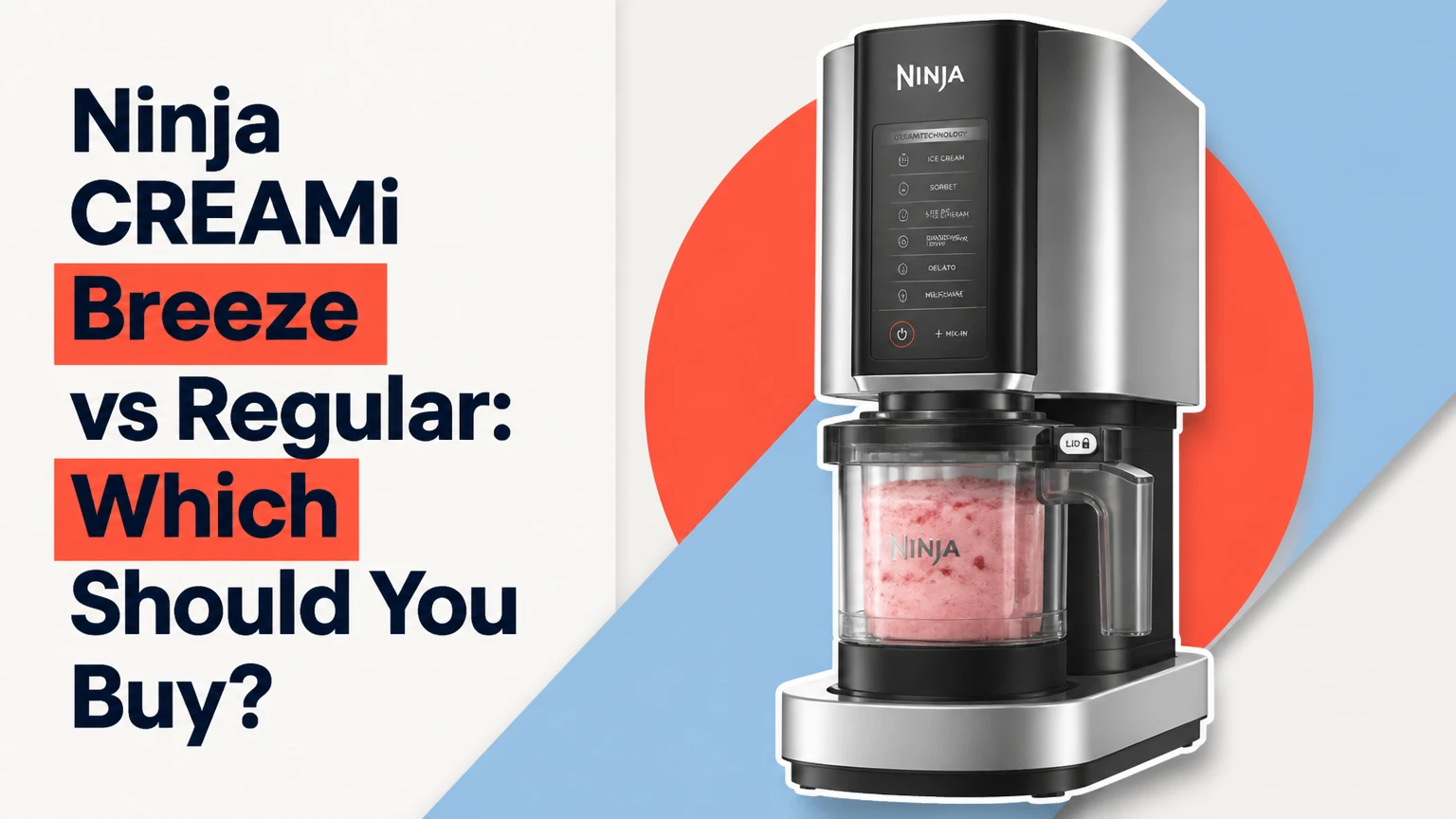
The Ninja CREAMi Breeze is the more compact direct-pint design, while the regular Ninja CREAMi NC301 uses a 16-ounce pint inside a separate outer processing bowl. For most buyers, the regular NC301 is the better purchase because it has broader parts support, a larger recipe ecosystem, and lower secondhand risk. The Breeze is worth considering only when a verified warranty and replacement parts are available.
Key Facts at a Glance
- The regular Ninja CREAMi NC301 processes a 16-ounce pint inside an outer bowl with a blade lid.
- The Ninja CREAMi Breeze NC200 and NC201 attach the blade assembly directly to the pint.
- Both machines require a completely frozen base, typically for at least 24 hours at approximately -18°C to -20°C.
- A first processing cycle commonly takes about 1.5-4 minutes, with re-spin adding roughly 1-2 minutes.
- Breeze availability is substantially more limited than NC301 availability, and used units can be difficult to support.
- Frozen bases with a raised center, overfilled containers, or unsuitable ingredients can damage parts or produce poor texture.
What Is the Difference Between Ninja CREAMi Breeze and Regular?
The main difference is the container architecture. The regular Ninja CREAMi places its pint inside a large outer processing bowl, whereas the Breeze places the blade lid directly on the pint and loads that pint into the appliance. That makes the Breeze smaller to handle, but the direct-load design creates more dependence on model-specific parts.
Both machines use Ninja’s Creamify Technology rather than a compressor or a traditional pre-chilled churn bowl. Each machine starts with a solidly frozen mixture, then shaves and recombines that block into a dessert.
| Decision factor | Regular Ninja CREAMi NC301 | Ninja CREAMi Breeze NC201 | Practical consequence |
|---|---|---|---|
| Pint size | 16 oz, 473 mL | 16 oz, 473 mL | Neither model is designed for a family-size batch |
| Outer processing bowl | Included, approximately 1 unit | Removed from loading process | Breeze has fewer large parts to handle |
| Blade attachment | Blade lid locks onto outer bowl | Blade lid clips onto pint system | Parts are not automatically interchangeable |
| Typical programs | 5-in-1 to 7-in-1 | 6-in-1 or 7-in-1 | Exact functions depend on model number |
| Motor rating commonly listed | 800 W | 800 W | Equal wattage does not prove equal long-term durability |
| Current support | Broad retail and aftermarket support | Limited or discontinued availability | NC301 is easier to replace or repair |
| Best purchase condition | New, refurbished, or supported used unit | Only verified warranty and complete parts | Breeze ownership requires more caution |
The word “regular” can create confusion because Ninja sells several CREAMi generations. In listings, confirm the model number rather than relying on labels such as original, standard, classic, or regular.
How Does Ninja CREAMi Processing Work?
Ninja CREAMi machines freeze the ingredients first, then shave the frozen block into fine particles and recombine those particles under pressure. The process allows a low-fat, high-protein, or fruit-based mixture to become spoonable without the continuous churning used by conventional ice cream makers.
A typical batch follows this sequence:
- Fill the correct pint below its maximum line.
- Freeze the pint level for at least 24 hours.
- Flatten any raised center before processing.
- Load the pint and select the program matching the base.
- Run Re-spin if the first result looks powdery or crumbly.
- Add mix-ins only after the base has reached a suitable texture.
The machine does not rapidly freeze liquid ingredients. A pint that has been refrigerated overnight but not frozen solid cannot be processed safely or effectively.
What Does the Regular CREAMi Add?
The regular NC301 adds a protective outer bowl around the pint and blade assembly. The operator places the filled pint into the outer bowl, secures the blade lid to that bowl, and locks the complete assembly into the motor base.
That extra housing increases the number of pieces to wash and store. It also creates a more conventional loading sequence, which many owners find easier to understand when following the manual. The outer bowl does not make the machine a compressor model, and it does not remove the 24-hour freeze requirement.
What Does the Breeze Change?
The Breeze removes the separate outer bowl from the direct loading process. The blade assembly connects to the Breeze pint, and the pint is inserted into the machine’s spindle system.
The reduced housing can make the Breeze feel quicker to assemble and less bulky on a counter. The trade-off is that the pint, blade interface, and locking components carry a more central role in alignment. If a used Breeze has worn tabs, a damaged lid, or an incomplete blade assembly, the machine may be impractical to own even when the motor still runs.
Which Specs Matter More Than Wattage?
Container support, part availability, and correct pint compatibility matter more than the advertised 800-watt rating. Wattage describes electrical input, not blade geometry, gearbox durability, noise, processing quality, or the cost of replacing a discontinued container.
| Model family | Stated capacity | Common program count | Container architecture | Typical buyer |
|---|---|---|---|---|
| NC301 regular | 16 oz | 5-in-1 to 7-in-1 | Pint plus outer bowl | First-time CREAMi owner |
| NC200 or NC201 Breeze | 16 oz | 6-in-1 or 7-in-1 | Direct-load pint | Existing owner with verified support |
| NC501 Deluxe | 24 oz | 11-in-1 | Larger pint plus outer bowl | Households needing more servings |
| NC701 Swirl | 16 oz | 13-in-1 | Pint plus outer bowl | Soft-serve-style dispensing |
| Other regional CREAMi versions | 16-24 oz | Model-specific | Model-specific | Buyers checking voltage and accessories |
Function labels vary by bundle and region. Ice Cream, Lite Ice Cream, Sorbet, Gelato, Smoothie Bowl, Milkshake, and Mix-In are common names, but an NC301 listing may not include every program shown on another CREAMi model.
Pint compatibility also varies. A pint that physically fits another Ninja appliance is not automatically approved for that appliance. Check the model number, lid design, maximum fill line, and manual before substituting containers.
Is the Breeze Easier to Use and Clean?
The Breeze is simpler during loading because the user handles fewer large pieces, but the regular CREAMi is usually easier to support over years of ownership. Cleaning time depends more on the blade lid, seals, and sticky ingredients than on whether the appliance has an outer bowl.
| Ownership task | Regular NC301 | Breeze NC201 | Typical time or quantity |
|---|---|---|---|
| Freeze one pint | 1 pint | 1 pint | At least 24 hours |
| Loading pieces | Pint, blade lid, outer bowl | Pint and blade lid | 30-90 seconds |
| Main removable parts | Pint, lid, blade, outer bowl | Pint, lid, blade | 4 versus 3 major pieces |
| Hand-washing after a batch | Usually required | Usually required | 3-7 minutes |
| Storage footprint | Larger bowl plus pint | Smaller direct-pint assembly | Model and cabinet dependent |
| Replacement concern | Common NC301 parts | Model-specific, limited parts | Higher Breeze risk |
The Breeze’s smaller physical workflow is useful in a cramped kitchen, especially when the machine is used once or twice weekly. The regular model’s outer bowl is less convenient to store, but owners can more easily find compatible containers, lids, and replacement accessories.
Neither machine should be treated like a blender that can be rinsed immediately while running. Unplug the base, remove the blade assembly as directed, and keep liquid away from the motor housing.
Is the Ninja CREAMi Breeze Discontinued?
The Breeze is substantially harder to find new than the regular NC301, and many listings now represent used, refurbished, or remaining inventory rather than a consistently supported current product. Public reports also describe Breeze units being replaced under warranty with regular CREAMi models, but replacement policy depends on the seller, country, date, and warranty status.
The practical question is not only whether a Breeze listing exists. It is whether the seller can provide the exact blade lid, pint, power specification, warranty terms, and a return period long enough to test the locking system.
| Purchase source | Breeze availability pattern | Main risk | Sensible action |
|---|---|---|---|
| Authorized retailer | Infrequent new inventory | Old stock or no listing | Verify warranty before payment |
| Manufacturer outlet | Model-dependent | Limited accessories | Confirm exact NC200 or NC201 support |
| Marketplace seller | Used and refurbished units | Missing or worn parts | Request serial number and video |
| Auction listing | Variable used stock | No meaningful return protection | Avoid unless parts are included |
| Regular NC301 retailer | Common new inventory | Bundle variation | Compare included pints and programs |
A low purchase price does not offset a missing blade lid or unavailable pint. The Breeze’s direct-load architecture makes those parts central to operation, not optional accessories.
Why Do Some Owners Report Breeze Failures?
Reported Breeze failures commonly involve broken locking tabs, detached blade assemblies, abnormal motor noise, or smoke, but these reports do not establish a published failure rate. The safest interpretation is that the Breeze has a higher ownership risk on the used market because its discontinued or limited-support status makes a failed part harder to replace.
One mechanical reason is alignment sensitivity. A frozen pint with a raised center, an incorrectly seated lid, a damaged locking tab, or an incompatible container can place uneven resistance on the spindle and blade.
The regular model is not failure-proof. Its outer bowl can crack, its blade can wear, and its interlock can refuse to engage. However, a regular NC301 owner generally has more routes to obtain a replacement container or blade assembly.
Failure Modes and Recovery Actions
| Symptom | Likely cause | Immediate action | Replacement threshold |
|---|---|---|---|
| Powdery first result | Low-fat base or insufficient liquid | Add 1 tablespoon liquid and use Re-spin | Replace blade if scraping persists |
| Loud knocking | Frozen hump or uneven pint | Stop, thaw slightly, flatten the top | Inspect spindle and blade |
| Plastic shavings | Wrong container or misalignment | Unplug and discard affected food | Replace damaged pint or lid |
| Machine will not start | Interlock not engaged | Re-seat lid and bowl or pint | Service if lock remains inactive |
| Burning smell or smoke | Motor overload or mechanical fault | Stop immediately and unplug | Do not continue using the unit |
| Broken tabs | Stress, impact, or repeated misalignment | Stop using the affected part | Replace the complete locking component |
A practitioner rule matters here: never diagnose a burning smell as normal “hard-base processing.” A firm frozen base can make the motor work harder, but smoke, electrical odor, or repeated stalling indicates a stop condition.
How Long Does a CREAMi Batch Take?
A CREAMi dessert usually requires at least 24 hours of freezing, followed by approximately 1.5-4 minutes of processing and another 1-2 minutes when Re-spin is necessary. The total calendar time is therefore much longer than the motor runtime, and the freezer becomes the main scheduling constraint.
| Stage | Typical duration | What determines the result |
|---|---|---|
| Base preparation | 5-15 minutes | Recipe complexity and ingredient temperature |
| Initial freeze | Minimum 24 hours | Freezer temperature and pint position |
| Main program | 1.5-4 minutes | Program, base hardness, and model |
| Re-spin | 1-2 minutes | Fat, sugar, protein, and liquid content |
| Mix-in cycle | About 1 minute | Size and quantity of additions |
| Serving adjustment | 2-5 minutes | Thawing and texture preference |
A freezer at approximately -18°C to -20°C is a useful reference range, but household freezers vary. Place pints on a level shelf rather than at an angle, and allow extra time when the base contains little sugar or fat.
For regular use, prepare two or more pints on separate days. That schedule prevents the common mistake of buying a CREAMi for immediate dessert production while forgetting that every new flavor needs its own freeze cycle.
Which Is Better for Protein Ice Cream?
The regular NC301 is usually the safer choice for protein ice cream because its parts and operating guidance are easier to source, not because its 800-watt motor automatically produces a better texture. Protein bases often contain limited fat and sugar, so they commonly require the Lite Ice Cream program, a small liquid adjustment, and Re-spin.
A practical high-protein workflow uses a measured liquid base, a protein powder that dissolves fully, and a level freeze. Avoid assuming that extra powder makes the dessert creamier. Excess protein can increase chalkiness and make a frozen pint harder to process.
| Base type | Starting program | Common texture issue | Practical correction |
|---|---|---|---|
| Whey and milk | Lite Ice Cream | Crumbly surface | Re-spin with 1 tablespoon milk |
| Casein-heavy base | Lite Ice Cream | Thick, pasty texture | Reduce powder or add measured liquid |
| Oat milk base | Lite Ice Cream | Icy, dry result | Add sugar or a small fat source |
| Fruit and water | Sorbet | Large ice crystals | Use sufficient sugar and level freeze |
| Custard-style base | Ice Cream or Gelato | Dense frozen center | Process only after full freezing |
The Breeze can process a suitable protein base when the machine and parts are in good condition. The purchase decision still favors the regular NC301 when daily use would make a failed Breeze difficult to replace.
What Are the Best Alternatives to Both Models?
Traditional churners, compressor machines, and high-speed blenders solve different problems from a Ninja CREAMi. A churner handles liquid custard before freezing, a compressor model freezes while churning, and a blender processes frozen ingredients quickly but needs enough liquid to protect texture and blades.
| Alternative | Freezing method | Typical batch timing | Typical USD price range | Best fit |
|---|---|---|---|---|
| Cuisinart ICE-30BC | Pre-freeze gel bowl | 20-30 minutes after bowl freeze | $60-$100 | Traditional dairy ice cream |
| Breville Smart Scoop | Built-in compressor | About 30-60 minutes | $400-$700 | Repeated batches without pre-freezing |
| Vitamix A2500 | Frozen ingredients plus added liquid | Often under 60 seconds | $350-$550 before accessories | Smooth frozen fruit blends |
| Ninja CREAMi NC301 | Freeze pint solid first | 1.5-4 minutes processing | Model and sale dependent | Portion-controlled frozen desserts |
| Ninja CREAMi Deluxe NC501 | Freeze larger pint solid first | 2-5 minutes processing | Model and sale dependent | Larger three-cup batches |
A traditional churner is preferable when the goal is classic custard texture and same-day processing after the bowl is chilled. A compressor machine is preferable for several consecutive batches, although its weight, noise, and price are much higher.
The CREAMi is better suited to portioned bases, reduced-fat recipes, protein desserts, and fruit preparations that would become icy in a conventional churner. It is not a good replacement for a compressor machine when a household needs six fresh batches in one afternoon.
Which Should You Choose?
The regular Ninja CREAMi NC301 is the default recommendation for most buyers. Choose the Breeze only when its exact model, complete accessories, warranty, and return protection are verified before purchase.
First-Time Buyer
Choose the regular NC301 if you want the lowest support risk and a large supply of recipes, containers, and troubleshooting guidance. The outer bowl adds storage bulk, but that inconvenience is minor compared with finding a compatible Breeze blade assembly after a failure.
Small-Kitchen Owner
Choose the Breeze only if counter and cabinet space outweigh long-term parts availability. Measure the stored appliance and pint assembly first, because the regular CREAMi’s outer bowl can be stored separately while the machine remains on the counter.
High-Protein User
Choose the regular NC301 for daily protein desserts, then plan for two or three freezer pints. The important variables are a level freeze, Lite Ice Cream programming, measured liquid, and Re-spin, rather than a higher advertised wattage.
Larger Household
Choose the Deluxe NC501 when a 24-ounce, approximately three-cup container better matches household portions. The Deluxe is not a direct replacement for the Breeze pint system, so do not buy it expecting regular or Breeze containers to transfer without checking compatibility.
Bargain Hunter
Do not buy a used Breeze solely because the listing is $160-$180. That price range can approach the cost of a supported current model, and a missing pint or damaged locking piece can make the bargain unusable.
Used Breeze Buyer Checklist
Inspect the complete machine before paying. A secondhand Breeze should include the exact pint, blade assembly, lid, power cord, and documentation that identifies the NC200 or NC201 model.
Use this checklist:
- Confirm the model number on the appliance, not only in the seller’s title.
- Ask whether the machine processes a full frozen pint without stalling.
- Inspect every locking tab for cracks, whitening, or distortion.
- Check the blade for wobble, corrosion, chips, or food trapped near the hub.
- Reject units with smoke, electrical odor, repeated knocking, or visible plastic shavings.
- Confirm the seller’s return window in writing.
- Verify voltage for the country where the appliance will operate.
- Price replacement parts before deciding that the listing is inexpensive.
A useful practitioner rule is to value a used appliance by its replaceable parts, not by its motor alone. A working base with no supported pint or blade is not a functional frozen-dessert system.
Common Operating Mistakes
Correct preparation prevents more problems than changing programs. The most damaging errors involve geometry, not recipes: an uneven frozen surface, an overfilled pint, or a locking mechanism that is forced into place can increase load on the blade and spindle.
| Mistake | Result | Better practice |
|---|---|---|
| Processing a raised frozen hump | Tilting, scraping, or uneven shaving | Flatten the surface before loading |
| Filling above the max line | Overflow and excess resistance | Stop below the marked line |
| Using a refrigerator-cold base | Incomplete processing | Freeze solid for at least 24 hours |
| Choosing Ice Cream for a lean base | Dry or chalky texture | Start with Lite Ice Cream |
| Skipping Re-spin | Crumbly first result | Add 1 tablespoon liquid and re-spin |
| Forcing a misaligned lid | Broken tabs or interlock damage | Remove, inspect, and reseat gently |
Ninja CREAMi recipes vary in sugar, fat, and water content, so the same program will not produce identical results across every base. Re-spin is a texture correction, not evidence that the machine failed.
FAQ
Can Regular CREAMi Pints Be Used in the Breeze?
Regular CREAMi pints should not be assumed compatible with the Breeze. The two systems use different loading and locking arrangements, and a pint that appears to fit can still have the wrong lid geometry or interlock position. Use only containers and blades listed for the precise model number.
Does the Breeze Make Softer Ice Cream?
The Breeze does not inherently make softer ice cream than the regular CREAMi. Texture depends primarily on the frozen base’s sugar, fat, protein, water, freezer temperature, selected program, and whether Re-spin is used. Direct-pint loading changes handling, not the fundamental Creamify process.
Can You Use Frozen Fruit in a CREAMi?
Frozen fruit should generally be incorporated through a recipe designed for the CREAMi rather than loaded as a container of unrelated solid chunks. Fruit and liquid bases need the correct fill level and sufficient moisture, while large hard pieces can create uneven resistance and poor texture.
Is a CREAMi Better Than an Ice Cream Maker?
A CREAMi is better for pre-portioned frozen bases, protein desserts, low-fat recipes, and fast processing after a 24-hour freeze. A traditional churner is better for liquid custards and same-day batch preparation, while a compressor model is better for several consecutive batches without freezer pre-planning.
How Many Pints Should a Regular CREAMi Owner Have?
Two or three compatible 16-ounce pints cover routine meal planning for most households. One pint can freeze while another is ready to process, and a third provides a separate flavor or dietary base. Buy model-compatible containers rather than assuming Deluxe or Breeze accessories will fit the NC301.
Conclusion: Regular CREAMi or Breeze?
For the query ninja creami breeze vs regular, the regular Ninja CREAMi NC301 is the stronger recommendation for most shoppers. The Breeze offers a simpler direct-pint loading design, but limited availability, uncertain parts support, and higher used-market risk outweigh that convenience unless a complete, warrantied unit is available. Choose the NC301 for dependable ownership, the Deluxe for larger batches, and a compressor machine for repeated same-day production.