

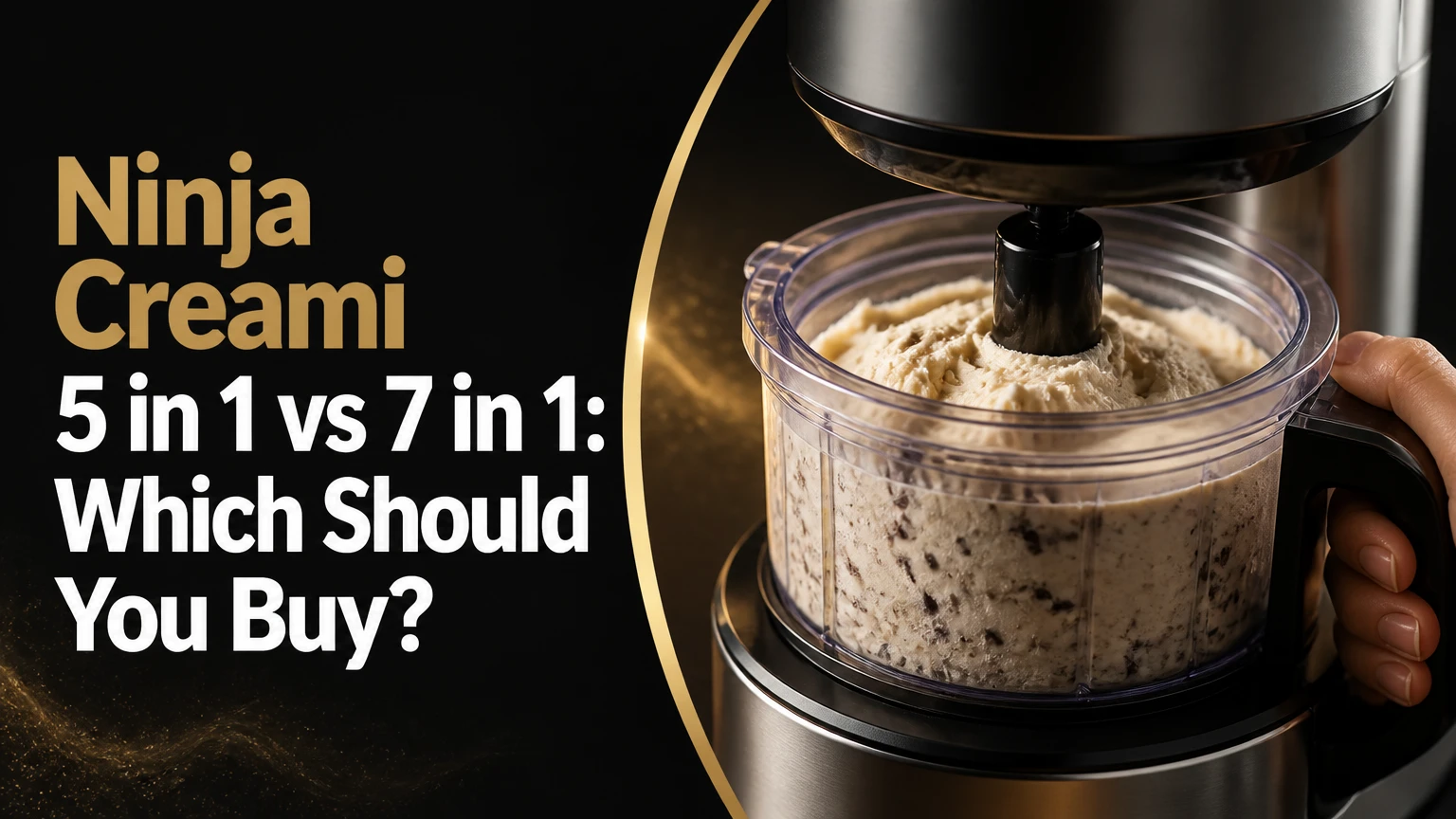
The Ninja Creami 5 in 1 and 7 in 1 are standard-size frozen dessert machines that use the same Creamerizer processing concept and 16-ounce pint format. The main difference is program selection: the 7-in-1 adds Gelato and Smoothie Bowl buttons, while the 5-in-1 usually costs less and can produce similar results with alternative settings.
Key Facts and Quick Answer
- Both standard models process one 16-ounce pint at a time and require a level freeze for about 24 hours.
- The 7-in-1 adds Gelato and Smoothie Bowl presets to the five core programs.
- A 5-in-1 can usually make gelato-style desserts with Ice Cream and smoothie bowls with Sorbet or Lite Ice Cream, although the automatic program guidance differs.
- Typical street pricing is about $149-$199 for a 5-in-1 and $179-$229 for a 7-in-1, depending on retailer, bundle, and sale timing.
- The two standard machines generally deliver comparable texture because the pint size, blade system, and core processing platform are closely related.
- The Ninja Creami Deluxe is a different size class, with 24-ounce containers and additional programs, so its accessories and capacity should not be confused with standard pints.
The short buying recommendation is simple: choose the 5-in-1 when the price gap is substantial or you are comfortable selecting substitute programs. Choose the 7-in-1 when the price difference is small, you want labeled presets, or several household users need straightforward controls.
How Does the Ninja Creami Work?
The Ninja Creami freezes a prepared mixture into a solid pint, then mills that frozen block into a soft dessert with a rotating blade. Unlike a conventional ice cream maker, the Creami does not freeze and churn liquid at the same time, so the mandatory freezer step comes before processing.
The machine’s motor drives the Creamerizer paddle downward through the pint. The paddle shaves and blends the frozen mixture into a finer structure, which is why the appliance can handle bases with less cream and sugar than many traditional churners. The result depends heavily on the recipe, freezing conditions, and whether a Re-spin is needed.
A typical workflow looks like this:
- Mix ingredients and pour them below the maximum fill line.
- Freeze the pint on a level surface for approximately 24 hours at 0 degrees Fahrenheit, or -18 degrees Celsius.
- Remove the lid and inspect the surface for a raised center or uneven area.
- Install the pint in the outer bowl and select the closest program.
- Run Re-spin if the first result is crumbly, chalky, or visibly powdery.
- Add mix-ins only after the base reaches the desired consistency.
- Serve immediately or return the finished dessert to the freezer.
Ninja’s owner guidance warns users not to process a pint that froze at an angle or developed a pronounced mound. That instruction matters because a tilted frozen block puts uneven resistance against the paddle and drive system.
What the Processing Method Changes
The Creami method gives users more control over texture after freezing. A conventional churner needs a liquid base that freezes gradually, while a blender needs enough liquid to move frozen ingredients around the blade. The Creami starts with a frozen block and mechanically changes its texture afterward.
The trade-off is planning. A Creami cannot produce a fresh batch from room-temperature ingredients in five minutes because the base must freeze first. Active processing often takes about 2 minutes, but the full cycle from mixing to serving spans at least one day.
Ninja Creami 5 in 1 vs 7 in 1 Programs
The defining difference in the Ninja Creami 5 in 1 vs 7 in 1 comparison is the number of labeled automatic programs. The 5-in-1 generally includes Ice Cream, Lite Ice Cream, Sorbet, Milkshake, and Mix-In; the 7-in-1 adds Gelato and Smoothie Bowl.
| Program | 5-in-1 | 7-in-1 | Typical use |
|---|---|---|---|
| Ice Cream | Yes | Yes | Dairy or dairy-free creamy bases |
| Lite Ice Cream | Yes | Yes | Lower-fat or lower-sugar mixtures |
| Sorbet | Yes | Yes | Fruit-forward, usually dairy-free desserts |
| Milkshake | Yes | Yes | Drinkable frozen dairy mixtures |
| Mix-In | Yes | Yes | Folding cookies, candy, nuts, or chocolate |
| Gelato | No | Yes | Denser, lower-air dessert style |
| Smoothie Bowl | No | Yes | Very thick fruit or yogurt bowls |
The additional buttons are useful because they package a preset duration and processing profile into a named choice. They do not automatically give the 7-in-1 a larger motor, larger pint, or fundamentally different serving capacity.
What Do Gelato and Smoothie Bowl Buttons Add?
The Gelato button provides a dedicated control for a dense frozen dessert style, while Smoothie Bowl is intended for a mixture thick enough to eat with a spoon. On closely related standard models, the physical processing hardware is highly similar, so the practical difference is mainly convenience and preset programming.
A 5-in-1 owner can make a gelato-style batch by starting with a balanced, relatively dense base and using Ice Cream or Lite Ice Cream, then adjusting with Re-spin if needed. A smoothie bowl can usually be made with Sorbet or Lite Ice Cream, but the mixture must contain enough frozen fruit or thick ingredients to avoid becoming a drink.
These substitutions are not identical in every recipe. A button cannot correct an overly watery base, a freezer burn problem, or an incorrectly filled pint.
Are the Presets Completely Equivalent?
The presets should be treated as recipe-oriented operating choices, not as seven independent machines inside one housing. Community testing frequently reports similar blade behavior across paired programs, but exact motor timing and control logic can vary by model revision and firmware.
The safest conclusion is that the 7-in-1 offers greater convenience rather than a guaranteed texture advantage. If you already understand how to adjust a base and use Re-spin, the 5-in-1 gives you most of the same practical range.
Core Specifications and Compatibility
Standard 5-in-1 and 7-in-1 units typically share a countertop footprint, an 800-watt motor rating, and 16-ounce containers. Retail model numbers can vary, so the product label and included accessories matter more than the program count alone.
| Attribute | Standard 5-in-1 | Standard 7-in-1 | Buying significance |
|---|---|---|---|
| Nominal container size | 16 ounces | 16 ounces | One pint per batch |
| Motor rating commonly listed | 800 watts | 800 watts | Shared standard platform |
| Core programs | 5 | 7 | Preset convenience |
| Added controls | None beyond core five | Gelato, Smoothie Bowl | Useful for frequent preset users |
| Batch workflow | Freeze about 24 hours | Freeze about 24 hours | No time advantage from extra buttons |
| Typical active processing | 1.5-2.5 minutes | 1.5-2.5 minutes | Recipe and program dependent |
Standard Pints Versus Deluxe Containers
Standard Creami pints and Deluxe 24-ounce containers are not interchangeable by assumption. The Deluxe machine uses a larger container system and has a different outer-bowl configuration, so a standard 16-ounce pint should not be forced into a Deluxe unit unless Ninja identifies it as compatible.
Before buying replacement containers, verify the exact model number, lid shape, outer bowl, and paddle design. Marketplace listings often use “Creami pint” as a broad phrase even when the accessory belongs to another generation.
Does the 7-in-1 Have More Capacity?
The 7-in-1 does not normally have more capacity than the standard 5-in-1. Both make approximately 2 cups per pint, although the maximum usable fill depends on the marked line and the recipe’s expansion during freezing.
A household serving four people may find one pint small, especially when the dessert is the only sweet course. Extra compatible pints improve scheduling, but they do not increase the amount one machine processes in a single cycle.
Price, Ownership Cost, and Value
The 5-in-1 is usually the better value when it costs at least $30-$50 less than the 7-in-1. The 7-in-1 becomes easier to justify when its premium is below about $20, because the added programs provide simpler operation and may improve resale appeal.
| Purchase factor | 5-in-1 typical range | 7-in-1 typical range | Practical effect |
|---|---|---|---|
| Machine price | $149-$199 | $179-$229 | Main upfront difference |
| Additional compatible pint | $15-$30 | $15-$30 | Reduces waiting between flavors |
| Typical freeze requirement | 24 hours | 24 hours | Ongoing planning cost |
| Active spin cycle | 1.5-2.5 minutes | 1.5-2.5 minutes | Similar electricity and labor |
| Common sale threshold | Under $170 | Under $200 | Stronger value zone |
These are typical USD retail ranges, not fixed manufacturer prices. Bundles may include two or three pints, recipe books, or retailer-specific colors, while clearance pricing can temporarily move either model below the usual range.
Ownership cost also includes freezer space and ingredients. A 16-ounce pint occupies roughly the space of a standard food-storage container, but the lid and height can make shelf placement awkward. If your freezer cannot hold two or three level pints, extra containers will not solve the 24-hour scheduling constraint.
Which Model Has the Better Payback?
The lower-cost model has the faster payback if you make repeatable recipes and do not need dedicated program names. The higher-priced model has better convenience value when multiple people use the machine, because “Gelato” and “Smoothie Bowl” require less memorized substitution.
A practical rule is to compare the final bundle price, not the sticker price. A 5-in-1 at $169 with one pint may be less attractive than a 7-in-1 at $189 with three pints if you plan to prepare several flavors each week.
What Can Each Model Make?
Both machines can make ice cream, lower-fat frozen desserts, fruit sorbet, milkshakes, and mix-in recipes. The 7-in-1 gives those uses more explicit control labels, while the 5-in-1 depends more on recipe selection and manual adjustment.
| Dessert goal | Recommended 5-in-1 program | Recommended 7-in-1 program | Useful adjustment |
|---|---|---|---|
| Full-fat ice cream | Ice Cream | Ice Cream | Re-spin only if crumbly |
| Protein dessert | Lite Ice Cream | Lite Ice Cream | Add liquid before Re-spin |
| Fruit sorbet | Sorbet | Sorbet | Use ripe fruit for body |
| Thick fruit bowl | Sorbet or Lite Ice Cream | Smoothie Bowl | Keep liquid low |
| Dense gelato style | Ice Cream | Gelato | Chill base thoroughly before freezing |
| Drinkable dessert | Milkshake | Milkshake | Add liquid after processing if needed |
High-Protein and Low-Sugar Bases
High-protein and low-sugar mixtures commonly emerge powdery after the first cycle because they contain more water and less fat or dissolved sugar to control ice crystals. A Re-spin with 1-2 tablespoons of milk, a dairy-free beverage, or another suitable liquid often restores a smoother consistency.
A small amount of xanthan gum or guar gum can improve body, but excessive stabilizer creates a gummy texture. A reasonable starting point is approximately 1/8 to 1/4 teaspoon per pint, followed by careful blending before freezing.
Dairy-Free and Fruit-Based Recipes
Dairy-free bases work well when they include enough solids, such as coconut cream, soy yogurt, nut butter, banana, or blended fruit. A thin mixture made primarily from water and juice tends to freeze hard and may require several processing cycles.
The machine is not a replacement for recipe balance. It can reduce ice-crystal perception after processing, but it cannot add fat, sugar, protein, or soluble fiber that the base does not contain.
Preparation Rules That Prevent Failures
Correct preparation has more influence on the final texture than the difference between five and seven programs. Level freezing, correct fill height, and a suitable base prevent more problems than selecting the theoretically perfect button.
Use these operating criteria:
- Freeze the pint upright on a level shelf.
- Keep the mixture below the maximum fill line.
- Avoid large solid inclusions before the first spin.
- Inspect and flatten a raised frozen center before processing.
- Allow very hard mixtures a few minutes outside the freezer if the manual permits it.
- Use Re-spin before adding large mix-ins.
- Wash the paddle, outer bowl, and pint according to the model’s cleaning instructions.
- Stop processing if the machine produces unusual resistance, scraping, or repeated error behavior.
Why Level Freezing Matters
Liquids expand and can freeze into a dome, especially when the pint is overfilled or the freezer shelf is uneven. A small surface irregularity is different from a steep mound; the latter places concentrated force on the paddle and can create mechanical stress.
In practice, the center should be scraped flat rather than ignored. The few seconds spent leveling the surface protect the spindle and improve contact between the blade and the frozen mixture.
What Should You Do After a Powdery Spin?
A powdery first spin usually means the base needs more moisture, more processing, or both. Add a small amount of compatible liquid to the center, select Re-spin, and reassess before adding toppings.
Do not immediately add a large volume of liquid. Too much can turn a spoonable dessert into a loose shake, particularly when the original base already contained fruit or yogurt.
Noise, Cleanup, and Honest Limitations
The standard Creami is louder and more abrupt than a countertop blender during its active cycle. Typical operation lasts only a few minutes, but the sound can be intrusive in a small kitchen or during early-morning use.
Cleanup is manageable because the food-contact components detach, but the paddle and lid should be checked for residue around seals and grooves. Sticky ingredients such as nut butter, dates, and melted chocolate demand more attention than a plain milk-and-fruit base.
The main limitations are significant:
- It requires advance freezing, so spontaneous dessert preparation is limited.
- One standard pint serves about two large portions or four small portions.
- The machine can be loud during milling.
- Poorly balanced low-calorie recipes may need multiple cycles.
- It does not carbonate drinks or replace a high-speed blender for ordinary smoothies.
- It cannot safely compensate for an overfilled or badly frozen container.
An expert ownership insight is that freezer organization often determines satisfaction. Buyers who prepare four flavors weekly usually benefit more from three compatible pints than from two additional buttons.
5-in-1, 7-in-1, or Deluxe: Which Fits?
The 5-in-1 is the strongest choice for budget-conscious users who mainly want ice cream, sorbet, protein desserts, and milkshakes. The 7-in-1 suits households that want labeled gelato and smoothie-bowl controls without moving to the larger Deluxe platform.
The Deluxe model is preferable when serving size matters more than compactness. Its 24-ounce containers provide roughly 50% more nominal volume than a 16-ounce pint, and its program set includes functions associated with larger-format frozen desserts and drinks.
| Buyer situation | Best choice | Reason | Main compromise |
|---|---|---|---|
| Lowest purchase price | 5-in-1 | Core desserts cost less | Manual program substitution |
| Several first-time users | 7-in-1 | Clearer labeled controls | Higher typical price |
| Frequent smoothie bowls | 7-in-1 | Dedicated preset | Same standard pint capacity |
| Larger family portions | Deluxe | 24-ounce container | Larger machine and different accessories |
| High-protein meal prep | 5-in-1 or 7-in-1 | Both support Lite Ice Cream | Requires freezer rotation |
| Occasional dessert making | 5-in-1 | Lowest entry cost | Extra programs may go unused |
When Is the 7-in-1 Worth the Premium?
The 7-in-1 is worth paying more for when the premium is modest and the two added presets match your routine. It is less compelling when the price difference reaches $50 and you already know how to use Ice Cream, Lite Ice Cream, or Sorbet as substitutes.
The 7-in-1 also reduces decision friction for guests and children. A dedicated button communicates the intended use, but it does not guarantee a better recipe or eliminate the need to freeze correctly.
When Should You Choose an Alternative?
Choose a traditional churner if you want to eat dessert immediately after mixing and can accept 20-40 minutes of churning. Choose a blender if you primarily make smoothies, frozen cocktails, or soft fruit mixtures that need added liquid.
| Alternative | Typical active time | Typical capacity | Best use |
|---|---|---|---|
| Ninja standard Creami | 1.5-2.5 minutes after freezing | 16 ounces | Dense frozen desserts |
| Traditional compressor churner | 20-40 minutes | 1-2 quarts | Fresh churned ice cream |
| Non-compressor churner | 20-30 minutes after bowl freezing | 1-1.5 quarts | Occasional conventional ice cream |
| High-speed blender | 1-5 minutes | 32-64 ounces | Smoothies and liquid-based blends |
| Ninja Creami Deluxe | 1.5-2.5 minutes after freezing | 24 ounces | Larger dessert batches |
The Creami’s advantage is texture transformation from a frozen block. Its weakness is that it does not provide the speed of a blender from unfrozen ingredients or the immediate batch size of a larger churner.
Troubleshooting Common Texture Problems
Texture problems usually originate in the base or freezer rather than the program label. The first corrective step should identify whether the mixture is icy, powdery, melted, hard, or uneven before selecting another setting.
| Symptom | Likely cause | First correction | Avoid |
|---|---|---|---|
| Powdery or crumbly | Low fat, low sugar, or too little liquid | Add 1-2 tablespoons liquid and Re-spin | Pouring in a full cup |
| Icy crystals | Watery base or freezer fluctuation | Improve solids and freeze level | Repeatedly changing programs |
| Liquid edges, hard center | Uneven freezing or partial thawing | Refreeze level and solid | Processing a slushy pint |
| Paddle resistance | Dome, overfill, or dense frozen mass | Flatten or correct the pint | Forcing another cycle |
| Runny milkshake | Excess liquid or warm ingredients | Chill and process briefly | Adding more liquid immediately |
| Mix-ins disappear | Pieces added too early or too small | Add after base processing | Processing candy during first spin |
If the machine repeatedly stops, makes a grinding sound, or shows an error after the pint has been prepared correctly, discontinue use and consult the model’s support documentation. A recipe adjustment cannot repair a damaged drive component.
Final Recommendation
The Ninja Creami 5 in 1 vs 7 in 1 decision is primarily a preset and price decision, not a fundamental texture decision. Buy the 5-in-1 when it saves $30-$50 and you are comfortable using Ice Cream, Lite Ice Cream, or Sorbet for recipes associated with the extra buttons.
Buy the 7-in-1 when its price is close to the 5-in-1, several people will operate it, or Gelato and Smoothie Bowl are frequent menu choices. Buy the Deluxe only when its 24-ounce capacity and separate accessory ecosystem solve a real serving problem.
Whichever model you select, budget for compatible extra pints, reserve level freezer space, and treat the recipe as part of the appliance. Those decisions affect daily usefulness more than two additional program labels.
Frequently Asked Questions About ninja creami 5 in 1 vs 7 in 1
Can the 5-in-1 make gelato?
The 5-in-1 can make a gelato-style dessert by using the Ice Cream or Lite Ice Cream program with a dense, properly balanced base. The dedicated Gelato button on the 7-in-1 simplifies program selection, but the 5-in-1 does not become incapable of producing a dense frozen dessert.
Can standard Creami pints be reused?
Standard Creami pints can generally be washed and reused when they remain free from cracks, warping, and damaged lids. Replacement containers must match the machine generation and model because standard 16-ounce accessories are not automatically compatible with Deluxe 24-ounce equipment.
How many people does one pint serve?
One 16-ounce pint usually provides two generous servings or four small dessert portions. Serving size changes with toppings, mix-ins, and whether the pint is used as a meal replacement, so families may need multiple prepared containers for one occasion.
Can the machine process a pint before 24 hours?
A pint should normally freeze for about 24 hours before processing so the mixture becomes a uniform solid block. Processing a partially frozen or slushy base can produce poor texture and may place abnormal load on the paddle, so shortening the freeze time is not a reliable shortcut.
Is a Creami good for weight-loss recipes?
A Creami is useful for high-protein or lower-calorie recipes because its milling process can make lean, low-sugar mixtures feel smoother than they would after ordinary freezing. The appliance does not reduce calories by itself, and ingredients such as sweeteners, protein powder, stabilizers, and milk still determine the final nutrition.
Does the 7-in-1 make dessert faster?
The 7-in-1 does not remove the approximately 24-hour freezing requirement or create a major active-processing time advantage. Its additional presets may reduce setup decisions, but both standard machines commonly require about 1.5-2.5 minutes for the main cycle and another minute for Re-spin or mix-in work.