

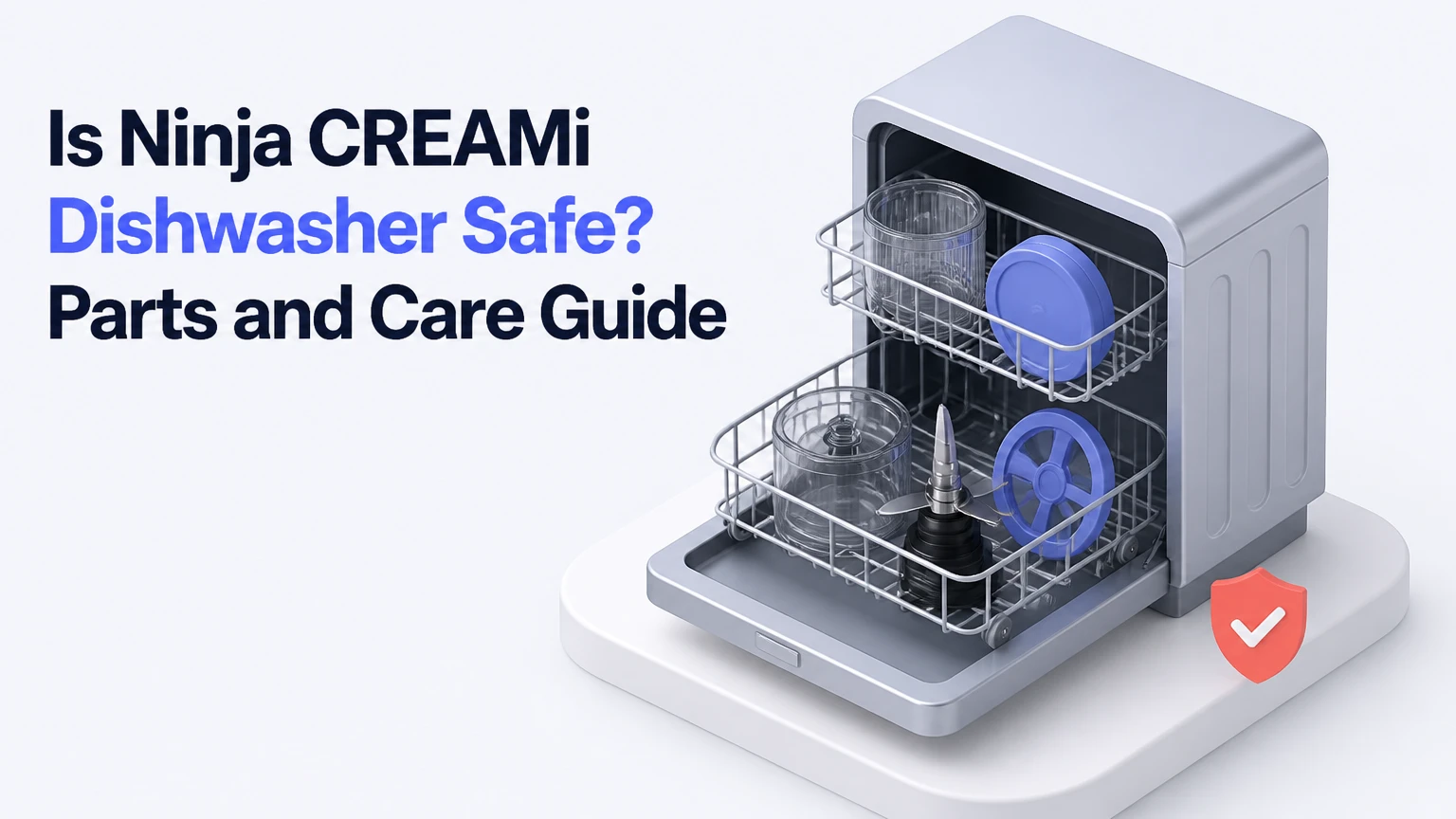
The Ninja CREAMi is a countertop frozen-dessert appliance with several removable, top-rack dishwasher-safe parts, including the pint, pint lid, outer bowl, outer lid, and Creamerizer paddle. The motor base is never dishwasher safe. Hand-washing removable components is usually gentler because high heat, heated drying, and strong detergent can warp plastic or shorten seal life.
Is Ninja CREAMi Dishwasher Safe?
Yes, most removable Ninja CREAMi components can go on the top rack, but the electrical motor base cannot. The safest routine is to rinse food residue promptly, remove the paddle and gasket where applicable, wash removable parts on a normal or low-heat cycle, and inspect them before the next use.
Ninja’s product-care guidance for CREAMi-family appliances identifies the motor base as a wipe-clean component rather than a washable attachment. The exact wording and permitted parts can vary by model and region, so the owner’s manual for the product number on your machine remains the controlling instruction.
Dishwasher-Safety Checklist
| Component | Dishwasher status | Best placement or method | Main risk |
|---|---|---|---|
| 16-ounce or 24-ounce pint | Usually top-rack safe | Place upright or securely angled | Heat deformation |
| Pint lid | Usually top-rack safe | Top rack away from heating element | Shrinking or poor fit |
| Creamerizer paddle | Usually top-rack safe | Basket or top rack, protected from impact | Dried food around shaft |
| Outer bowl and outer lid | Usually top-rack safe | Top rack after immediate rinsing | Trapped residue and odor |
| Motor base | Never dishwasher safe | Wipe with a damp, non-abrasive cloth | Electrical damage |
The word “dishwasher safe” does not mean every cycle is equally gentle. A top-rack-safe plastic part can still suffer from a sanitize program, heated drying, direct exposure to the lower heating element, or repeated contact with abrasive detergent.
Expert insight: The most common practical failure is not a dramatic melt. It is a lid or pint that slowly changes shape enough to fit poorly, leak, or become difficult to attach. A normal wash cycle may work for years, while high-heat drying accelerates that failure.
Why the Motor Base Must Stay Out
The Ninja CREAMi motor base contains electrical and mechanical components, so water immersion can create shock, corrosion, or short-circuit hazards. Unplug the appliance before cleaning, wipe the housing with a slightly damp cloth, and dry it completely before reconnecting power.
Never spray cleaner directly into the controls, drive opening, ventilation slots, or underside of the base. If a liquid base spills onto the machine, unplug it immediately, remove the container, blot the exterior, and allow the appliance to dry fully. Do not operate a wet base to “test” whether it still works.
| Motor-base situation | Correct response | Do not do this |
|---|---|---|
| Small drip on the exterior | Unplug and wipe dry | Pour water over the housing |
| Liquid near the paddle drive | Unplug, blot, and inspect | Insert a wet attachment |
| Spill into vents or controls | Disconnect power and contact Ninja support if needed | Run a cycle immediately |
| Sticky residue on housing | Use a damp cloth, then dry | Use abrasive pads or immerse it |
A damp cloth is sufficient for ordinary exterior cleaning. Isopropyl alcohol, bleach, and strong degreasers can damage finishes or leave residues, so use only a cleaner that the manufacturer permits for the surface.
Which Removable Parts Can Go in a Dishwasher?
The removable food-contact parts are generally the pint container, pint lid, outer bowl, outer lid, and processing paddle. Put these parts on the top rack unless the manual for your specific CREAMi model says otherwise.
The Original CREAMi commonly uses a 16-ounce pint, while Deluxe models commonly use a 24-ounce container. The larger tub does not make the motor base washable, and it does not remove the need to check the model-specific care instructions.
Pint Containers and Lids
Pints and lids collect dairy fat, sugar, fruit acids, and protein residues. Rinse them soon after use, because dried ingredients around the rim can make lids difficult to remove and may prevent a clean seal.
Load the pint so it cannot contact the lower heating element. Keep the lid separated from the container when possible, and avoid stacking heavy dishes on top of either part. Inspect the rim after washing, especially if the lid feels unusually tight or loose.
Outer Bowl and Lid
The outer bowl holds the pint during processing, while the outer lid carries the paddle on compatible models. The outer lid has grooves, locking areas, and moving interfaces where melted dessert can remain after a cycle.
Rinse the outer lid before residue dries. If food is trapped inside a recess, soak the removable lid in warm water rather than forcing a brush into a narrow opening. Some CREAMi variants use different lid designs, so do not disassemble a component unless the manual describes that procedure.
Creamerizer Paddle
The Creamerizer paddle is usually top-rack dishwasher safe, but hand-washing makes it easier to check the blade area and drive shaft. Remove the paddle from the processing lid according to the model’s release mechanism, then rinse both components separately.
Do not scrape frozen residue with a metal utensil. A bent paddle, chipped edge, or cracked plastic hub should be replaced rather than reused, because the component rotates under load against a dense frozen mixture.
Why Hand-Washing Often Lasts Longer
Hand-washing is usually the better long-term choice for Ninja CREAMi plastics because it reduces exposure to high temperature, heated drying, alkaline detergent, and collisions with other dishes. Dishwasher use is convenient and generally permitted for removable parts, but convenience and maximum service life are different goals.
Typical residential dishwasher conditions vary widely. A normal cycle may expose parts to roughly 120-150°F wash water, while sanitize programs can operate substantially hotter, and heated drying adds another period of thermal stress. Exact temperatures depend on the appliance and cycle.
| Cleaning method | Typical time | Heat exposure | Effect on parts | Best use |
|---|---|---|---|---|
| Hand-wash in warm water | 3-6 minutes | Low to moderate | Lowest distortion risk | Daily cleaning |
| Top-rack normal cycle | 90-180 minutes | Moderate | Convenient, usually acceptable | Several parts together |
| Heated-dry cycle | 90-240 minutes | High | Greater warping risk | Use sparingly |
| Sanitize cycle | 120-240 minutes | Very high | Highest plastic stress | Generally avoid |
| Soak before hand-washing | 10-20 minutes | Low | Loosens dried residue | Sticky or protein-rich bases |
Detergent can also matter. Highly alkaline powders and aggressive pods remove grease effectively, but repeated use may cloud plastic, fade markings, or affect soft seals. Cloudiness alone does not prove a part is unsafe, while cracks, sharp edges, distortion, and an unreliable lock are reasons to stop using it.
Expert insight: Heated drying is often more damaging than the wash phase because a lightweight lid can sit close to hot air or a heating element after the water has drained. Selecting “air dry” or removing parts before heated drying reduces that exposure without giving up dishwasher convenience.
How to Clean a Ninja CREAMi Correctly
Clean the appliance after every use, with extra attention to the outer lid, processing paddle, pint rim, and gasket. A five-step routine prevents most odor and residue problems without requiring a full appliance teardown.
- Unplug the motor base. Wait until the processing cycle has stopped and remove the outer bowl according to the model’s release instructions.
- Separate the food-contact parts. Remove the pint, pint lid, outer lid, paddle, and any removable gasket that the manual identifies.
- Rinse immediately. Use warm water to remove melted dessert before sugar, dairy fat, nut butter, or protein powder dries.
- Wash and inspect. Hand-wash with mild dish soap or use the approved top-rack cycle. Check the paddle shaft, lid channels, gasket seat, pint rim, and locking tabs.
- Dry completely before storage. Leave parts separated so trapped moisture does not create odor, mildew, or a sticky film.
Do not run the motor base under a faucet. Do not use the CREAMi as a dishwasher for frozen ingredients, and do not reinstall a wet paddle into a powered appliance.
How to Clean the Processing-Lid Gasket
The gray rubber gasket on compatible processing lids can retain dairy, fruit, cocoa, and nut residues underneath its edge. Remove it only as the manual directs, wash the gasket and its channel separately, rinse thoroughly, and reinstall it evenly without twisting.
A gasket that is stretched, cracked, permanently flattened, or unable to remain seated should be replaced. An uneven gasket can permit leaks or make the outer lid harder to attach, and forcing the lid can damage the locking mechanism.
Cleaning Advice for Sticky or Sensitive Ingredients
Ninja CREAMi recipes containing nut butter, collagen, whey protein, dates, caramel, or melted chocolate need more attention than a plain milk-and-sugar base. These ingredients can form a water-resistant film that survives a quick rinse and later contributes to odor or cross-contact.
| Residue or situation | First action | Deeper cleaning step | Inspection point |
|---|---|---|---|
| Peanut or almond butter | Wipe excess with a paper towel | Soak in warm soapy water for 10-15 minutes | Lid channel and gasket |
| Whey or collagen powder | Rinse before it dries | Use a soft bottle brush | Paddle shaft and rim |
| Berry or citrus base | Rinse immediately | Wash with mild detergent | Staining and odor |
| Melted chocolate | Remove excess while soft | Warm soak, then soft sponge | Scratches from scraping |
| Allergen-sensitive household | Use separate tools if possible | Wash and air-dry fully | Hidden gasket residue |
A dishwasher cycle can sanitize ordinary food residue, but it does not guarantee removal from every crevice if the component was loaded with dried material. Mechanical rinsing and inspection remain necessary.
For allergy management, follow the household’s established food-safety procedure. A separate pint may reduce cross-contact risk, but a separate pint does not help if the paddle, outer lid, or gasket still carries residue.
How the Ninja CREAMi Works
The Ninja CREAMi processes a solid, pre-frozen base rather than freezing liquid during operation. Most recipes require at least 24 hours in a level freezer at about 0°F or colder, after which the paddle mills the frozen block from the top down.
The appliance’s Creamify Technology creates a dense frozen texture by shaving and refining ice crystals. Processing commonly takes about 1.5-4 minutes, depending on the program, model, recipe, and starting condition.
| Operating factor | Typical requirement | What happens if ignored |
|---|---|---|
| Pre-freezing time | At least 24 hours | Soft or uneven processing |
| Freezer temperature | About 0°F or colder | Center may remain too soft |
| Container fill | Below the MAX FILL line | Uneven processing or attachment stress |
| Surface | Flat and level | Paddle can process at an angle |
| Re-spin | One additional cycle when needed | Crumbly texture may remain |
A crumbly result does not automatically indicate a defective machine. The base may need a Re-Spin cycle, sometimes with a small amount of compatible liquid, provided the recipe and manual allow it.
Overfilling is a separate issue. Expansion, frozen ridges, and an uneven surface can interfere with the paddle, so scrape or level the base before freezing and stay below the marked limit.
Expert insight: Cleaning and processing are connected. A pint that freezes with a raised ridge can force the paddle to work unevenly, while an overfilled container can push residue into the lid and gasket. Level freezing reduces both texture problems and cleanup time.
Do CREAMi Models Have the Same Dishwasher Instructions?
Ninja CREAMi models share a basic removable-part design, but container capacity, processing lids, programs, and care instructions vary. Original NC300-family appliances commonly use 16-ounce pints, while Deluxe NC500-family appliances commonly use 24-ounce tubs.
Check the rating label, manual, or Ninja support page for the precise model number before using a dishwasher. Replacement accessories are not automatically interchangeable merely because they look similar.
| CREAMi family | Common model examples | Typical container | Typical programs or feature | Care caution |
|---|---|---|---|---|
| Original | NC300 series | 16 ounces | 7 programs | Confirm attachment instructions |
| Breeze | NC100 or NC200 series | Model dependent | Compact program set | Parts may differ by region |
| Deluxe | NC500 series | 24 ounces | 11 programs | Larger lid and tub design |
| Swirl | Swirl family | Model dependent | Soft-serve dispensing | Follow dedicated manual |
The 7-in-1, 11-in-1, and Swirl labels describe functions, not a universal dishwasher certification. A replacement lid from another family may fit poorly or have a different gasket arrangement.
CREAMi Versus Other Frozen-Dessert Machines
The Ninja CREAMi is closer to a home version of the processing concept used by Pacojet than to a conventional churner. The base freezes first, then a blade mills it; a Cuisinart freezer-bowl machine generally churns liquid while the bowl removes heat.
That difference affects texture, preparation, noise, cleanup, and freezer requirements. It also means a CREAMi is not the best choice for someone who wants a batch made immediately from unfrozen liquid.
| Appliance type | Typical USD price | Freeze requirement | Processing time | Texture or limitation |
|---|---|---|---|---|
| Ninja CREAMi Original | $180-$230 | 24 hours | 1.5-4 minutes | Dense, mix-in-friendly texture |
| Ninja CREAMi Deluxe | $220-$300 | 24 hours | 1.5-4 minutes | Larger 24-ounce batch |
| Cuisinart freezer-bowl maker | $70-$150 | Bowl pre-freeze, often 12-24 hours | 20-30 minutes | More aerated churned texture |
| Compressor ice-cream maker | $250-$700 | No mandatory bowl freeze | 25-60 minutes | Immediate batch, larger footprint |
| Pacojet | More than $6,500 typical commercial pricing | 24-hour container freeze | About 4-8 minutes | Professional high-cost system |
Prices are typical US retail ranges and change with sales, bundles, and model availability. A CREAMi’s lower purchase price does not eliminate the freezer-space cost or the need to keep spare pints if you prepare several flavors.
When Another Machine Makes More Sense
Choose a compressor machine when same-day processing matters more than compact storage. Choose a freezer-bowl churner when you prefer lighter, aerated ice cream and do not need the CREAMi’s ability to process small frozen portions.
A CREAMi is less suitable for large gatherings if you own only one or two containers. Each base still needs a full pre-freeze, and the appliance processes one container at a time.
What to Do If a Part Warps or Cracks
Stop using a pint, lid, bowl, or paddle if it has a crack, sharp edge, severe distortion, damaged locking tab, or a lid that no longer fits securely. Cosmetic whitening or light clouding is less serious, but any deformation that affects attachment or sealing warrants replacement.
| Observed condition | Likely meaning | Action |
|---|---|---|
| Light cloudy plastic | Surface or detergent wear | Continue only if shape remains correct |
| Lid no longer fits evenly | Heat distortion | Replace the lid |
| Hairline crack | Structural damage | Stop using and replace |
| Bent paddle | Impact or heat damage | Do not process frozen food |
| Loose locking tab | Attachment failure risk | Replace affected component |
Do not try to reshape a warped pint with boiling water or a heat gun. That can create additional distortion and may weaken the plastic.
Record the model number before ordering a replacement. The safest replacement is the component listed for that exact CREAMi family, not a visually similar third-party part with uncertain dimensions or material specifications.
Common Mistakes That Cause Poor Results or Hard Cleanup
Several operating errors create both dessert-quality problems and extra residue. Correcting the preparation step is often more effective than adding detergent or running a hotter dishwasher cycle.
- Freezing for less than 24 hours.
- Freezing the base on an uneven shelf.
- Filling above the MAX FILL line.
- Processing a base with a large frozen hump.
- Leaving the pint open to freezer odors.
- Allowing dairy, nut butter, or protein residue to dry.
- Using a sanitize cycle on heat-sensitive plastic.
- Forcing a lid or paddle that is not correctly aligned.
- Storing parts nested together while damp.
- Reusing a damaged paddle or cracked container.
The most useful rule is simple: rinse food-contact parts immediately, use the top rack when choosing a dishwasher, avoid heated drying when possible, and keep the motor base completely dry.
Frequently Asked Questions About is ninja creami dishwasher safe
Can I put the Ninja CREAMi pint in the bottom rack?
The pint should be placed on the top rack, not the bottom rack. The lower rack is closer to the heating element and usually exposes plastic to stronger heat and more direct spray. Keep the container stable, avoid contact with metal cookware, and use the model manual if its instructions differ.
Can Ninja CREAMi parts go through a sanitize cycle?
Ninja CREAMi removable parts may be dishwasher safe, but a sanitize cycle is a poor default because its elevated heat can deform plastic components or affect lids and seals. Use a normal cycle with heated drying disabled when available, or hand-wash parts that you want to preserve longest.
How often should the CREAMi gasket be cleaned?
Clean the processing-lid gasket whenever residue reaches its edge, after allergen-containing recipes, and during every periodic deep clean. Weekly inspection is a practical rule for frequent users. Remove and reinstall the gasket only according to the manual, because stretching or misseating it can cause leaks.
Why does my Ninja CREAMi smell after washing?
Odor usually comes from residue trapped in the outer lid, paddle shaft, gasket channel, or pint rim rather than from the motor base. Separate removable components, soak them in warm soapy water, rinse thoroughly, and air-dry them completely before storage.
Are third-party replacement pints safe to use?
A third-party pint is safe only when its dimensions, material, lid interface, and processing compatibility are explicitly suitable for the exact CREAMi model. A container that fits loosely or changes the paddle clearance can create leaks, poor processing, or attachment stress. Use Ninja replacement parts when compatibility is uncertain.
Can I use the appliance commercially?
The Ninja CREAMi is generally designed for household use, not continuous commercial production. Frequent commercial cycles can increase wear on the drive system and removable components, while local food-service rules may require equipment with different sanitation and certification standards.
Conclusion
The answer to is ninja creami dishwasher safe is yes for most removable parts, with important limits: use the top rack, avoid sanitize and excessive heat, rinse residue promptly, and hand-wash when preserving plastic shape and seals matters most. Never place the motor base in water or a dishwasher. Confirm the care instructions for your exact model before cleaning, replacing accessories, or using an unfamiliar cycle.