

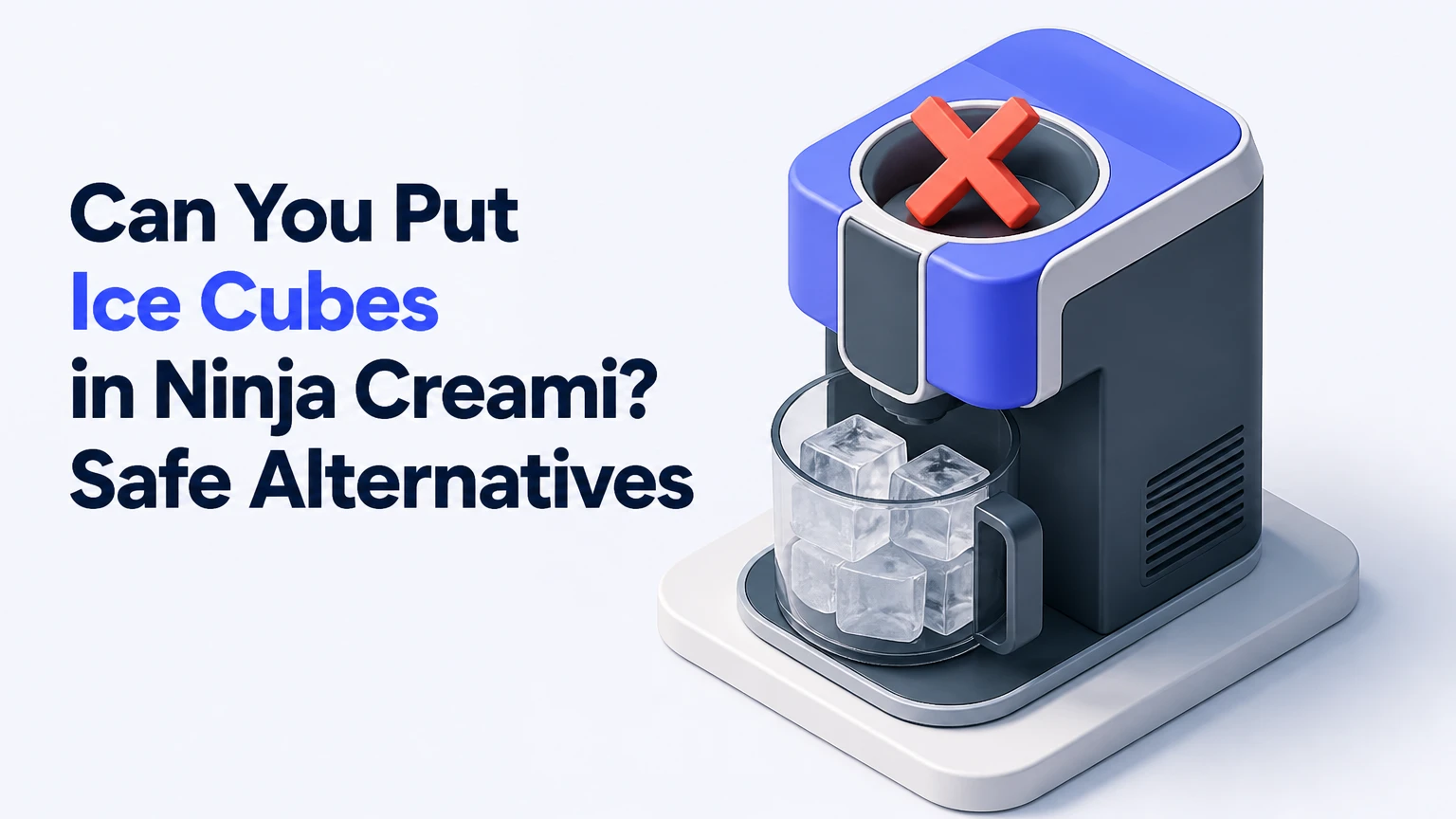
No, you should not put loose ice cubes, crushed ice, or a solid block of plain frozen water into a Ninja Creami. The appliance is designed to process a level, frozen mixture in its pint, and loose ice can create uneven resistance that stresses the Creamerizer paddle, drive shaft, and motor. Use a formulated frozen base or a blender for ice instead.
Key Facts at a Glance
- A Ninja Creami is a frozen-dessert processor, not an ice-crushing blender.
- Loose ice cubes and crushed ice should not go into the Creami pint or processing bowl.
- A Creami pint normally needs to freeze level for about 24 hours before processing.
- The original Ninja Creami pint holds about 16 fluid ounces, while Deluxe containers hold about 24 fluid ounces.
- Plain frozen water produces a hard, crystalline block that can strain the paddle and produce poor texture.
- Water is usable when dissolved sugars, fruit solids, dairy, or an appropriate stabilizer form part of the frozen recipe.
Can You Put Ice Cubes in a Ninja Creami?
You cannot safely use ice cubes in a Ninja Creami, whether the cubes are whole, crushed, or partially melted. Ninja Creami owner guidance warns against processing solid ingredients and instructs users to freeze a prepared mixture flat and level, rather than loading loose frozen pieces into the container.
The distinction matters because a Creami does not pulverize ice through a high-speed vortex. Its Creamerizer paddle moves through a frozen mass and shaves material from the surface downward. A uniform recipe gives the paddle predictable resistance. Loose cubes leave voids, shift under pressure, and can make the paddle strike isolated hard pieces.
The result may be a noisy cycle, a stalled machine, a damaged paddle, or a bent drive shaft. The machine may survive one mistake, but survival does not make the practice safe. The correct rule is simple: freeze a smooth recipe base in the approved pint, and use a blender when the goal is crushed ice.
What counts as unsafe ice?
| Ingredient or load | Safe in a Creami? | Reason |
|---|---|---|
| Three whole ice cubes | No | Separate hard pieces can shift under the paddle |
| Crushed ice with juice | No | Irregular pieces create gaps and uneven load |
| Plain frozen water block | No | Dense ice creates poor texture and high resistance |
| Smooth sorbet base, frozen level | Yes, when recipe and model instructions permit | Uniform frozen matrix supports downward processing |
Ninja’s published owner manuals are the controlling source for model-specific restrictions. Third-party recipes, social videos, and claims that a Creami can “blend” ice do not override the appliance instructions.
Why Ice Cubes Can Damage the Machine
Ice cubes can damage a Ninja Creami because the Creamerizer paddle is built to shave a prepared frozen mixture, not to catch and crush independent ice pieces. A blender blade rotates rapidly through a liquid-supported vortex; a Creami paddle travels vertically through a container of frozen food, so concentrated resistance can transfer directly to the paddle assembly and shaft.
The paddle needs consistent contact across the surface. An ice cube can move away from the paddle, wedge against the sidewall, or force the paddle to encounter a small, extremely hard point. Air pockets create similar problems because the shaft can lose balanced support and then meet resistance abruptly.
The manufacturer’s warning is more useful than a generic statement that ice is “too hard.” A properly formulated ice cream base also becomes very hard in a domestic freezer, yet the Creami is designed for that frozen block. The difference is the structure of the block, its ingredients, its level surface, and the way those ingredients freeze together.
Creami versus blender mechanics
| Appliance | Working motion | Intended frozen input | Ice-cube capability |
|---|---|---|---|
| Ninja Creami | Vertical shaving and micro-processing | Level frozen dessert base | Not recommended |
| High-speed blender | Rotating blades and liquid vortex | Ice with sufficient liquid | Often supported by model instructions |
| Food processor | Horizontal pulsing blade | Small pieces with liquid or food mass | Model-dependent, commonly limited |
| Traditional churner | Rotating dasher in a cold bowl | Refrigerated liquid ice cream base | Does not crush loose ice |
A counterintuitive practitioner rule is that “frozen” does not mean “equivalent.” A smooth frozen custard base and a handful of loose ice cubes may have the same temperature, but they present entirely different mechanical loads.
How Should You Freeze a Creami Pint?
Freeze a Ninja Creami pint upright on a flat shelf for approximately 24 hours, with the mixture below the maximum-fill line and the surface as level as possible. The most important preparation factor is a uniform frozen top, because an angled or raised surface causes the paddle to enter unevenly.
Use this sequence:
- Prepare a smooth mixture. Dissolve sugar, protein powder, cocoa, or other dry ingredients completely. Puree fruit rather than dropping in large frozen chunks.
- Pour below the fill line. Leave the required headspace shown on the pint. Never compensate for a low volume by adding loose ice.
- Freeze upright and level. Place the container on a flat freezer shelf, not in a door rack or on a tilted package.
- Freeze completely. Allow about 24 hours in a freezer operating near 0°F to 5°F, or follow the time in your model’s manual.
- Inspect the surface. Do not process a pint with a deep slope, a large hump, exposed loose pieces, or a lid frozen into an unsafe position.
- Install the pint correctly. Lock the pint and paddle into the outer bowl according to the model instructions.
- Select the matching program. Ice Cream, Sorbet, Lite Ice Cream, Gelato, and other programs use different processing patterns.
- Re-spin only when appropriate. A dry texture after the first cycle often needs a Re-Spin with a small amount of liquid, not an additional handful of ice.
You will know the preparation is suitable when the frozen surface is horizontal, continuous, and made from one cohesive mixture. A common mistake is freezing a container at an angle and then trying to level the top with a spoon after freezing.
How long does a pint need to freeze?
| Stage | Typical time | Practical condition |
|---|---|---|
| Refrigerate mixed base | 2-4 hours | Base reaches about 40°F or below |
| Freeze Creami pint | About 24 hours | Pint remains upright and level |
| Standard processing cycle | About 1-3 minutes | Program completes without stalling |
| Counter rest before processing | 5-15 minutes | Surface softens slightly, if needed |
The 24-hour figure is a practical minimum used across many Ninja Creami instructions and recipes, but freezer temperature, fill volume, sugar concentration, and container placement affect the result. A pint that feels frozen at the edge can still contain a softer center.
Can Water Go in a Ninja Creami Recipe?
Water can go into a Ninja Creami recipe when it is part of a balanced mixture, but plain water frozen into a solid block is a poor and potentially unsafe load. Dissolved sugar, fruit puree, dairy solids, protein, or a recipe-tested stabilizer interrupts the large ice-crystal structure that plain water forms during freezing.
A water-based sorbet may include fruit puree, sugar syrup, citrus juice, and a small quantity of stabilizer. The exact formula depends on the fruit and the model program. A simple mixture of water and unsweetened flavoring, however, can freeze into a dense, brittle block that is hard to process and unpleasantly icy.
Do not assume that adding a liquid after freezing makes an ice block safe. Pouring water over loose cubes still leaves separate hard pieces. Formulation must happen before freezing so the entire pint becomes one cohesive frozen matrix.
Safer water-based examples
| Recipe direction | Main liquid | Structure-building ingredients | Suitable approach |
|---|---|---|---|
| Strawberry sorbet | 1 cup water | Strawberry puree and dissolved sugar | Blend smooth, then freeze level |
| Lemon sorbet | 3/4 cup water | Sugar syrup and lemon juice | Dissolve sugar before freezing |
| Protein ice dessert | 1 cup milk or water | Protein powder and sweetener | Mix fully, chill, then freeze |
| Fruit slush-style base | 1 cup juice | Pureed fruit and dissolved sugar | Use the model’s appropriate program |
There is no universal requirement that every Creami base contain 10%-20% fat. Fat contributes richness and softness, but sugar, dissolved solids, fruit fiber, dairy solids, and stabilizers also affect freezing behavior. A low-fat base can process successfully, while a low-sugar, fat-free block may remain powdery or hard.
Do Model Differences Change the Ice Rule?
Model differences do not make loose ice safe. The original 7-in-1 Ninja Creami, the 11-in-1 Deluxe, and newer Scoop & Swirl systems differ in container design, capacity, programs, and accessories, but those differences do not turn a Creami into an ice crusher.
| Ninja Creami family | Approximate container size | Example programs or functions | Effect on ice use |
|---|---|---|---|
| Original 7-in-1 | 16 fluid ounces | Ice Cream, Sorbet, Gelato, Mix-In | Loose ice remains unsuitable |
| Deluxe 11-in-1 | 24 fluid ounces | Italian Ice, Slushi, Frozen Yogurt, Creamiccino | Loose ice remains unsuitable |
| Scoop & Swirl | Model-specific containers | Dispensing and swirl functions | Follow its own manual, not blender advice |
| NC-series variants | Usually 16 or 24 fluid ounces | Program set varies by region | Check the exact manual before substituting containers |
A larger Deluxe pint does not provide more tolerance for ice cubes. It changes batch capacity and program selection, not the paddle’s basic operating principle. Accessories also need to match the model, because containers and outer bowls are not automatically interchangeable.
Typical US retail pricing ranges from about $150 to $350 depending on the model, retailer, promotions, and included containers. That price range is a reason to follow the manual, not a guarantee that every frozen ingredient is acceptable.
What Frozen Ingredients Are Safe?
Frozen ingredients are safest when they are fully incorporated into a liquid or semi-liquid base before the pint is frozen. Smooth purees, dairy mixtures, prepared protein bases, and dissolved sweeteners create a continuous block that the Creamerizer paddle can process more predictably than loose fruit or ice.
Do not add frozen berries, mango chunks, ice packs, or chocolate pieces to a frozen pint before processing. Mix-ins belong after the main program, using the Mix-In function where the model provides it. Large inclusions can also damage texture even when they do not damage the machine.
A useful rule is to separate base ingredients from mix-in ingredients. Base ingredients freeze together and go through the main cycle. Mix-ins remain discrete and are added after the base has become scoopable.
| Ingredient situation | Preparation before freezing | Recommended timing |
|---|---|---|
| Fresh strawberries | Puree and strain large seeds if desired | Add to base before freezing |
| Frozen blueberries | Thaw and blend into liquid | Add to base before freezing |
| Chocolate chips | Keep whole and portioned | Add after processing as a mix-in |
| Mango cubes | Blend with liquid until smooth | Add puree before freezing |
The same principle applies to protein powder. Dry powder pockets create brittle zones and can make a pint look sandy after processing. Whisk or blend the powder into the liquid, refrigerate the mixture, then freeze it level.
What Should You Use Instead for Ice?
Use a high-speed blender with a manufacturer-approved ice function when you want crushed ice, shaved ice, or a frozen drink made from ice cubes. Use the Ninja Creami when you want a spoonable frozen dessert made from a prepared, frozen base.
| Desired result | Best appliance | Starting input | Typical preparation time |
|---|---|---|---|
| Crushed ice for drinks | High-speed blender | 1-3 cups ice plus liquid | 30-90 seconds |
| Snow-cone texture | Ice shaver or approved blender | Frozen ice block or cubes | 1-5 minutes |
| Spoonable protein dessert | Ninja Creami | Level frozen protein base | 25 hours including freezing |
| Traditional churned ice cream | Ice cream maker | Chilled liquid custard | 30-60 minutes after chilling |
A blender still needs enough liquid and an appropriate blade design. Check the blender manual before processing ice, because a personal smoothie blender, immersion blender, and high-powered countertop blender have different limits.
The Creami is also a poor choice when you need an immediate drink. Its freeze-first workflow takes roughly a day, whereas a blender can produce a crushed-ice beverage in minutes. The Creami wins when texture, low-fat formulation, or high-protein frozen desserts matter more than speed.
Common Mistakes and How to Fix Them
Processing an angled pint
An angled pint creates an uneven frozen surface, so the paddle enters one side before the other. If the surface is visibly sloped, allow the pint to soften enough to level safely, or refreeze a correctly prepared mixture rather than forcing a cycle.
Adding loose frozen fruit
Loose fruit leaves gaps and concentrated hard spots. Thaw and puree the fruit, or use fresh fruit in the base, then freeze the blended mixture below the line.
Filling above the maximum line
Overfilling reduces headspace and can interfere with paddle movement. Transfer excess mixture to another approved container instead of pressing it down or adding ice to change the volume.
Processing a plain water block
Plain water freezes into large crystals and may produce a dry, powdery, or unusually resistant block. Reformulate the recipe with dissolved sugar, fruit solids, or another suitable ingredient, then freeze a new pint.
Running repeated cycles on a powdery texture
Repeated processing does not always solve dryness. Add 1-2 tablespoons of milk, cream, juice, or another compatible liquid, make a small well in the center if the recipe instructions allow it, and use Re-Spin once.
Ignoring unusual noise
A grinding sound, repeated clicking, burning odor, stalled paddle, or visible wobble is a stop signal. Cancel the cycle, unplug the appliance, wait for moving parts to stop, and inspect the paddle and shaft before further use.
How Do You Fix a Dry or Crumbly Pint?
A dry or crumbly Ninja Creami pint usually needs a small amount of compatible liquid and one Re-Spin cycle, not ice cubes. Low sugar, low fat, high protein, insufficient freezing uniformity, or a recipe with too little free liquid can all produce a powdery first result.
Use this correction sequence:
- Remove the processed pint from the machine.
- Check that no hard chunks, metal fragments, or damaged paddle parts are present.
- Add 1-2 tablespoons of the recipe’s matching liquid.
- Make a narrow depression in the center if your model instructions permit it.
- Run Re-Spin once.
- Stop if the mixture remains unusually hard or the machine makes abnormal sounds.
| Symptom | Likely cause | Safe correction |
|---|---|---|
| Powdery surface | Low free liquid or low sugar | Add 1-2 tablespoons liquid, then Re-Spin |
| Wet outer ring | Partial thawing | Refreeze level or process promptly |
| Large icy shards | Poorly dissolved sugar or fruit | Blend a new base until smooth |
| Paddle stops or clicks | Hard isolated material | Stop, unplug, inspect paddle and shaft |
A Re-Spin improves texture; it does not convert an unsafe ingredient into a safe one. Do not use Re-Spin to break down ice cubes, frozen candy, or a solid plain-water block.
What If Ice Has Already Gone Through the Machine?
If ice has already gone through a Ninja Creami, stop the appliance and inspect the paddle, paddle shaft, pint, and outer bowl before using it again. A single short cycle may leave no visible damage, but grinding noise, bent components, plastic shavings, an odor, or a paddle that no longer locks correctly requires the machine to remain out of service.
Follow these steps:
- Press the stop or cancel control.
- Disconnect power after the moving parts stop.
- Remove the outer bowl and pint without forcing the paddle.
- Look for cracks, bends, scoring, loose plastic, or metal dust.
- Rotate or move parts only as the manual permits.
- Contact Ninja support if the shaft is bent, the paddle is damaged, or the motor behavior changed.
Do not test a questionable machine with another full pint. A short empty cycle can also be inappropriate for some models, so use the troubleshooting procedure in the exact owner guide.
Is the Ninja Creami Worth Using Instead of a Blender?
The Ninja Creami is worth using instead of a blender for spoonable frozen desserts that begin as a level, fully frozen base. A blender is better for crushed ice, frozen cocktails, smoothies, and immediate preparation, while a Creami is better for dense protein desserts, sorbets, and low-fat recipes that need a smooth serving texture.
| Decision factor | Ninja Creami | High-speed blender | Traditional ice cream maker |
|---|---|---|---|
| Ice cubes | Not recommended | Often supported, model-dependent | Not recommended |
| First serving time | About 24 hours | About 1-5 minutes | About 30-60 minutes after chilling |
| Main input | Frozen pint | Liquid plus ice or frozen produce | Chilled liquid base |
| Texture target | Spoonable, micro-processed | Drinkable, crushed, or slushy | Churned and aerated |
| Best batch size | 16 or 24 fluid ounces | 16-64 fluid ounces | Commonly 1-2 quarts |
| Main limitation | Requires advance freezing | Needs liquid for hard ingredients | Requires cold bowl or compressor |
The honest limitation is preparation time. A Creami cannot replace a blender for an afternoon drink, and it cannot safely be treated as a compact ice crusher simply because its paddle processes frozen food.
Frequently Asked Questions
Can I put ice cubes in a Ninja Creami Deluxe?
No. The Ninja Creami Deluxe has a larger 24-fluid-ounce container and additional programs, but its paddle mechanism still expects a cohesive frozen recipe base. Use a blender for ice cubes and reserve the Deluxe for a level frozen mixture.
Can I make a slushie without ice cubes?
Yes, depending on the model and program. Freeze a properly formulated juice, fruit, sugar, or water-based mixture in the approved container, then use the program specified by the owner guide. Do not substitute loose ice for the frozen base.
Can I use frozen bananas in a Creami?
Use frozen bananas after blending them into a smooth base with suitable liquid, or follow a recipe designed for the specific model. Loose banana pieces can create gaps and hard contact points. Add small banana pieces as a post-processing mix-in when the recipe calls for discrete fruit.
Why does my Creami pint look like snow?
A snowy or crumbly pint commonly results from low sugar, low fat, high protein, or insufficient liquid. Add 1-2 tablespoons of compatible liquid and run Re-Spin once. If the pint contains hard chunks or the machine sounds abnormal, stop instead of processing again.
Can I use an ice pack or frozen water bottle in the Creami?
No. Ice packs, frozen water bottles, and other solid objects are not recipe bases and can obstruct the paddle or overload the drive system. They should never be placed in the pint, outer bowl, or processing path.
How much does a Ninja Creami cost?
Typical US pricing is about $150-$350, with the final amount depending on the model, retailer, sale price, and number of included containers. Extra pints and replacement paddles add cost, so using the machine within its manual limits protects the original investment.
The Bottom Line
Can you put ice cubes in Ninja Creami? No. The Ninja Creami should process a smooth, level, fully frozen dessert base, not loose ice cubes, crushed ice, or a plain frozen-water block. Formulate water with dissolved sugar, fruit solids, dairy, protein, or another suitable recipe structure, freeze the pint upright for about 24 hours, and use a blender when the goal is crushed ice.