

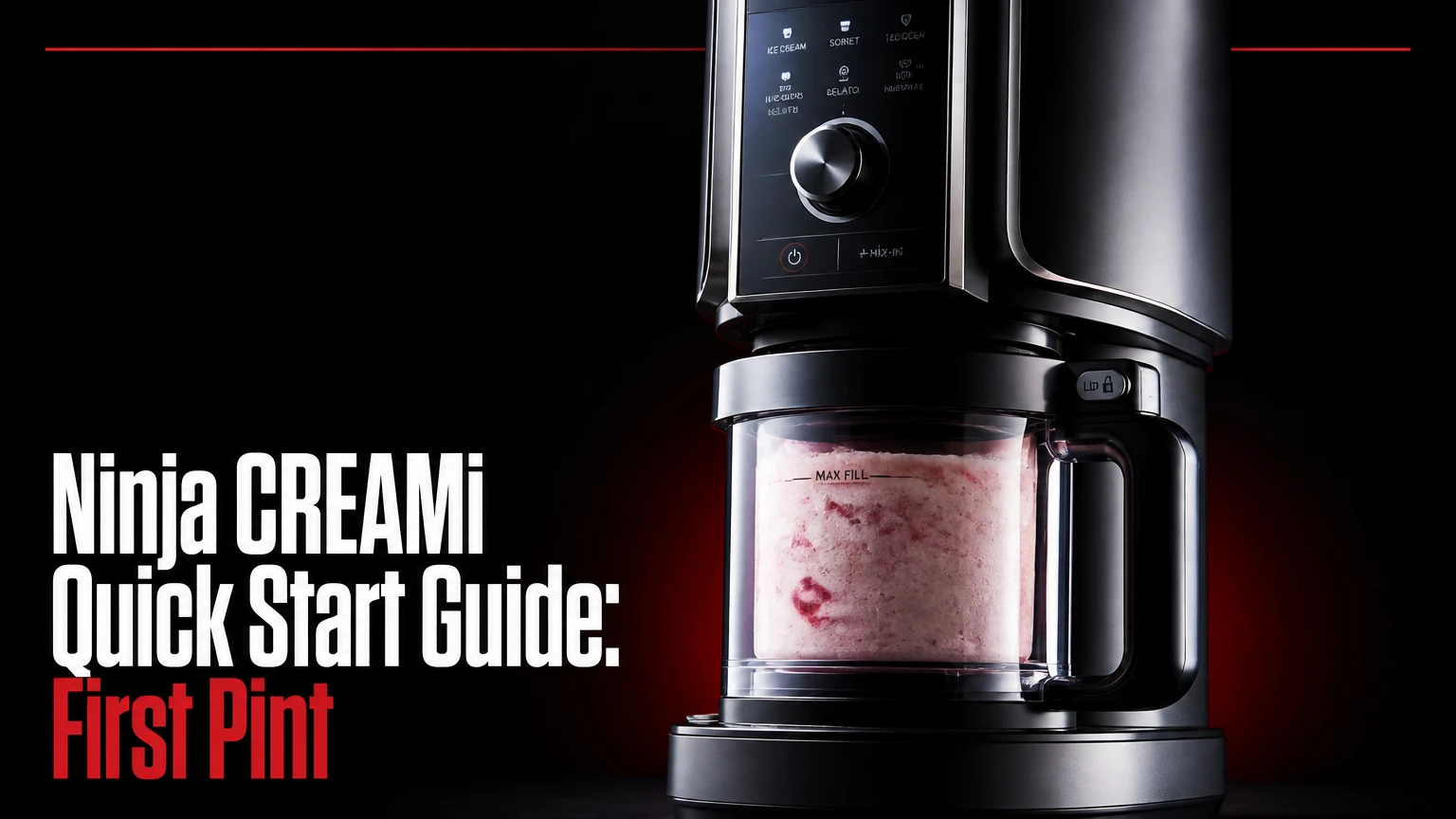
A Ninja CREAMi is a countertop frozen-dessert appliance that turns a fully frozen pint of prepared ingredients into ice cream, gelato, sorbet, a protein treat, or another programmed texture. Unlike a traditional churner, the Ninja CREAMi freezes the base first, then mills the solid block with a rotating Creamerizer blade in roughly 1.5-2.5 minutes.
Quick Answer
Freeze the filled pint level for at least 24 hours before processing.
Keep ingredients at or below the pint’s MAX FILL line.
Use Ice Cream for conventional rich bases and Lite Ice Cream for many low-fat or high-protein bases.
A crumbly first result usually needs 1 tablespoon of liquid and a Re-Spin cycle.
Add cookies, fruit, or candy only after the first spin, using the Mix-In program.
Original pints hold about 16 fluid ounces; Deluxe pints hold about 24 fluid ounces.
What the Ninja CREAMi Does
The Ninja CREAMi converts a frozen ingredient mixture into a scoopable dessert by shaving and compressing ice crystals rather than churning liquid around a cold bowl. The motor drives a metal Creamerizer paddle downward through the pint, reducing the frozen block into smaller particles that combine with the base’s fat, sugar, protein, or stabilizer.
The appliance is useful because the freezing step and texturing step are separate. A traditional ice cream maker must freeze while churning, but a CREAMi can process a base containing less sugar, less fat, fruit, yogurt, or protein powder. That flexibility also means the recipe must supply enough moisture and structure for the selected program.
The result is usually dense rather than highly aerated. A CREAMi can produce a texture between soft-serve and gelato immediately after processing, although a pint stored overnight becomes firmer and may need another short processing cycle.
How the Frozen-Base Process Works
- Mix ingredients in the compatible pint.
- Stop at or below the MAX FILL line.
- Freeze the uncovered or correctly prepared pint level for 24 hours.
- Install the processing lid and paddle according to the model’s manual.
- Select the program that matches the base.
- Add a small amount of liquid and use Re-Spin if the surface looks powdery.
- Make a center well, add solid mix-ins, and run Mix-In.
- Serve immediately or replace the storage lid for later use.
The machine does not make a liquid mixture cold by itself. A base that is merely chilled, partially frozen, or frozen unevenly can produce poor results and place unnecessary stress on the drive system.
Ninja CREAMi Quick Start Guide: First Pint
The safest first run uses a simple, moderate-fat base because it is more forgiving than a sugar-free protein recipe. For an Original pint, combine approximately 1 cup of milk, 1/2 cup of heavy cream, 2 tablespoons of sugar, 1/2 teaspoon of vanilla, and a small pinch of salt, then stop below the MAX FILL line.
Pour the mixture into the pint without introducing a raised peak. Tap the container lightly on the counter to release large bubbles, then freeze it on a level shelf. The base must be solid throughout, not merely firm around the edges.
After freezing, install the pint in the outer bowl and lock the paddle into the processing lid. Secure the bowl in the machine before selecting a program. Keep hands away from the moving paddle and do not lift the bowl while the motor operates.
First-Pint Workflow
| Stage | Typical time | Required condition | Common error |
|---|---|---|---|
| Ingredient mixing | 5-10 minutes | Smooth, dissolved base | Undissolved sugar or powder |
| Initial freezing | 24 hours | Level pint, solid center | Freezing for only 8-12 hours |
| Processing | 1.5-2.5 minutes | Correct program selected | Using Ice Cream for a very lean base |
| Re-Spin | About 1 minute | Dry or crumbly surface | Adding too much liquid |
| Mix-In cycle | About 1 minute | Center well filled below top | Processing chunks during the first cycle |
Remove the storage lid before fitting the processing lid. The storage lid belongs on the pint during storage, not during machine processing. Follow the exact assembly diagrams for your model because Original, Deluxe, and Swirl components are not universally interchangeable.
Which CREAMi Model Do You Have?
The Original CREAMi generally uses 16-ounce pints and offers five to seven programs, depending on the specific model number. The Deluxe uses larger 24-ounce XL pints and adds programs such as Italian Ice, Slush, Creamiccino, and Frozen Yogurt. The Swirl combines CREAMi processing with a soft-serve dispensing system.
Model names are not enough to establish compatibility. Check the model number printed on the machine or packaging, then match replacement pints, lids, and paddles to the manufacturer’s compatibility chart. A pint that appears to have the same volume may still have a different locking geometry.
| Model family | Pint capacity | Typical programs | Distinguishing feature |
|---|---|---|---|
| Original 5-in-1 | 16 oz | Ice Cream, Sorbet, Milkshake, Mix-In | Basic frozen-dessert workflow |
| Original 7-in-1 | 16 oz | Adds Lite Ice Cream and Smoothie Bowl | More low-fat and bowl options |
| Deluxe 11-in-1 | 24 oz | Adds Slush, Italian Ice, Frozen Yogurt | Top-half and bottom-half processing |
| Swirl 13-in-1 | Model-specific XL size | Adds soft-serve-oriented functions | Integrated dispensing nozzle |
The Deluxe’s dual-processing feature is practical when two flavors occupy one pint or when only half a container remains. The Swirl is a poor fit for a small kitchen if its dispensing function will rarely be used, because the extra hardware adds cost and cleaning steps.
Capacity, Programs, and Typical Cost
A CREAMi typically costs about USD 169-199 for an Original model, around USD 249 for a Deluxe model, and approximately USD 349 for a Swirl model. Sale prices, bundles, retailer inventory, and included pints can change those figures, so compare the full package rather than the appliance price alone.
Two extra pints commonly cost more than a single pint, while replacement paddles and outer bowls can represent a meaningful portion of the appliance’s long-term cost. A household making several flavors each week benefits more from additional compatible containers than from a higher program count.
| Purchase consideration | Original | Deluxe | Swirl |
|---|---|---|---|
| Typical appliance price | USD 169-199 | About USD 249 | About USD 349 |
| Nominal pint volume | 16 oz | 24 oz | Model-specific |
| Typical household yield | 2 small servings | 3 small servings | 2-3 servings |
| Main upgrade | Lower entry cost | Larger batch | Soft-serve dispensing |
The wattage of many standard CREAMi models is around 800 watts, although specifications vary by market and model. The machine is also loud, with typical measured or reported operating levels around 75-85 decibels near the appliance. Run it when household noise is acceptable, and place it on a stable, level counter.
Time, Temperature, and Freezer Requirements
A CREAMi base normally needs a full 24 hours of freezing, while processing takes less than three minutes. The manufacturer’s commonly stated operating range is approximately 9°F to -7°F, or -13°C to -22°C, for the freezer, but the owner’s manual for the exact model takes precedence.
A freezer that cycles above the recommended range can leave a soft center even when the outside looks solid. A pint placed near the freezer door also experiences more temperature fluctuation than one kept on a stable interior shelf.
| Variable | Recommended target | What happens outside the target |
|---|---|---|
| Freeze duration | At least 24 hours | Soft center and uneven processing |
| Freezer temperature | 9°F to -7°F | Hardness and texture become inconsistent |
| Fill level | At or below MAX FILL | Overflow and lid interference |
| Pint position | Flat and level | Raised hump or angled frozen block |
| Counter softening | About 5-10 minutes, if needed | Excessive melting and thin texture |
Do not process a pint with a large frozen hump. Liquid expands during freezing, and an uneven top can make the paddle engage the block at an angle. Level the base before freezing, and do not attempt to scrape or cut a frozen hump with a knife.
Build a Base That Spins Smoothly
A CREAMi recipe needs enough free water to process and enough dissolved solids to limit large ice crystals. Fat contributes richness, sugar lowers the freezing point, dairy proteins add body, and ingredients such as instant pudding mix or xanthan gum can bind water in small quantities.
Low-fat and high-protein bases freeze harder than rich dairy mixtures. That is why a protein shake often needs the Lite Ice Cream program, a modest amount of stabilizer, and a Re-Spin rather than the standard Ice Cream setting.
| Base type | Useful structure | Suitable starting program | Typical adjustment |
|---|---|---|---|
| Whole-milk ice cream | Milk, cream, sugar | Ice Cream | Freeze 24 hours |
| Protein dessert | Milk or shake, protein powder | Lite Ice Cream | Add 1/4 teaspoon xanthan gum |
| Fruit sorbet | Fruit purée, juice, sugar | Sorbet | Blend seeds and fibers thoroughly |
| Dairy-free dessert | Oat, soy, or coconut beverage | Lite Ice Cream | Use a stabilizer or extra solids |
| Smoothie bowl | Frozen fruit, yogurt, liquid | Smoothie Bowl | Keep mixture thick and below fill line |
In practice, 1/4 teaspoon of xanthan gum is often enough for one Original pint. More can create a stretchy or gummy texture, so weigh or measure it rather than adding it by eye.
Instant pudding mix provides starch and stabilizers, but it also adds sweetness and may contain dairy. For dairy-free or allergy-sensitive recipes, inspect the ingredient label and use a compatible alternative.
Program Selection Rules
- Ice Cream: Rich dairy bases with cream, milk, and sugar.
- Lite Ice Cream: Lower-fat, lower-sugar, and many protein-based mixtures.
- Sorbet: Fruit-forward bases with little or no dairy.
- Gelato: Dense dairy mixtures with less air and a smoother, softer profile.
- Milkshake: Bases intended to remain pourable.
- Smoothie Bowl: Thick fruit and yogurt mixtures eaten with a spoon.
- Mix-In: A finishing cycle for solid ingredients after the first spin.
The program does not measure the nutritional quality of a recipe. “Lite” refers to the processing profile, not an automatic claim about calories, sugar, or fat.
Mix-Ins, Re-Spin, and Serving
A Re-Spin corrects a dry first pass by redistributing moisture through the processed base. If the pint looks like fine crumbs, add about 1 tablespoon of milk or another suitable liquid, then run Re-Spin once.
For cookies, chopped chocolate, nuts, or candy, create a vertical hole approximately 1-1.5 inches wide in the center of the spun pint. Add the pieces into that well and select Mix-In. The dedicated cycle folds chunks through the dessert without grinding them as aggressively as the initial processing pass.
Ingredient Size and Timing
| Mix-in | Recommended preparation | When to add | Texture result |
|---|---|---|---|
| Chocolate sandwich cookies | Break into 1/2-inch pieces | After first spin | Noticeable cookie pieces |
| Chocolate chips | Use mini or regular chips | Mix-In cycle | Firm chocolate pockets |
| Fresh fruit | Dice and drain excess juice | Immediately before serving | Soft fruit pieces |
| Nuts | Chop to 1/4-inch pieces | Mix-In cycle | Crunch with reduced jamming risk |
| Caramel sauce | Drizzle into center well | After first spin | Swirled pockets |
Do not fill the center well to the rim. Overloading the pint can make the mixture rise into the paddle area or produce an uneven distribution.
A processed pint is best immediately after spinning. For later service, smooth the surface, fit the storage lid, and return the container to the freezer. A fully refrozen pint may need a fresh processing cycle because the texture will harden again.
Troubleshooting Texture Problems
Most CREAMi texture problems come from base composition, freezing conditions, or program selection rather than a defective machine. The appearance of the first spin provides useful diagnostic information.
| Symptom | Likely cause | First correction | Avoid next time |
|---|---|---|---|
| Dry, powdery crumbs | Lean base or low moisture | Add 1 tablespoon liquid and Re-Spin | Add stabilizer or use Lite Ice Cream |
| Liquid center | Less than 24 hours frozen | Refreeze until fully solid | Use a colder, level freezer shelf |
| Hard frozen ring | Surface dehydration or very cold pint | Rest 5-10 minutes, then process | Reduce prolonged uncovered storage |
| Large icy crystals | High water and low dissolved solids | Rework the base with sugar or stabilizer | Balance fruit and liquid ratios |
| Paddle will not engage | Wrong assembly or incompatible part | Unplug and reassemble | Match parts to model number |
| Mixture leaks upward | Overfilled pint | Stop, clean, and reduce fill | Stay below MAX FILL |
A crumbly result does not mean the dessert is ruined. The most reliable recovery sequence is one tablespoon of liquid, one Re-Spin, and a texture check before adding more liquid.
If the mixture remains hard after Re-Spin, allow a short counter rest and process again only if the manual permits it. Never force the bowl into place, operate with a damaged paddle, or continue if unusual grinding persists.
Non-Negotiable Rules for Safe Operation
The CREAMi’s rotating paddle and drive system require correct assembly and a level frozen surface. The manufacturer’s owner manuals, rather than recipe blogs or social-media demonstrations, should control questions about cleaning, dishwasher placement, and damaged components.
Follow these rules every time:
- Never process a warm, liquid, or partially frozen base.
- Never exceed the MAX FILL line.
- Never process a pint with a raised hump.
- Never use a pint from another CREAMi family without confirmed compatibility.
- Never put hard, unprocessed chunks into the base unless the recipe and manual allow them.
- Never run the appliance without the outer bowl and processing lid locked.
- Unplug the unit before removing a jammed paddle or cleaning the drive area.
- Stop using the appliance if the paddle is bent, cracked, or unusually loose.
The most expensive mistake is treating the pint like a normal food-storage container. The pint must fit the machine’s locking system and present a relatively even frozen surface to the paddle.
Cleaning, Noise, and Storage
The processing lid, paddle, pint, and outer bowl should be cleaned after each use because dairy, fruit acids, and protein mixtures dry inside seams quickly. Many removable parts are dishwasher-safe on specific models, but the machine base and motor housing must remain out of water.
A narrow brush helps clear the paddle cavity and the underside of the processing lid. Inspect the paddle before the next cycle, since dried residue can prevent it from locking or alter the blade’s movement.
| Cleaning task | Timing | Method | Risk if skipped |
|---|---|---|---|
| Rinse paddle | Immediately | Warm water and soft brush | Dried protein residue |
| Wash pint | After every use | Hand wash or approved dishwasher rack | Odor and staining |
| Clean outer bowl | After drips or leaks | Damp cloth, then dry | Sticky locking mechanism |
| Wipe machine base | Weekly or after spills | Unplugged damp cloth | Contamination near controls |
| Inspect paddle | Before every spin | Check cracks and fit | Poor engagement or damage |
Operating noise around 75-85 decibels is typical for a high-powered countertop appliance. Place the machine on a firm surface with clearance around the motor vents, and do not process beside unstable objects that could vibrate off the counter.
Ninja CREAMi Compared With Alternatives
A CREAMi is the better choice for make-ahead bases, protein desserts, fruit sorbets, and low-sugar experiments. A compressor machine is better when you want to pour in a liquid base and eat dessert without a 24-hour freezing schedule.
Freezer-bowl churners occupy the middle ground. They also require a frozen bowl, but they churn liquid for roughly 20-30 minutes and are more dependent on a traditional fat-and-sugar ice cream formula.
| Feature | Ninja CREAMi | Compressor maker | Freezer-bowl churner |
|---|---|---|---|
| Starting material | Frozen pint | Chilled liquid | Chilled liquid |
| Preparation delay | 24-hour freeze | About 5-10 minutes | Bowl freeze for 12-24 hours |
| Processing time | 1.5-2.5 minutes | About 30-45 minutes | About 20-30 minutes |
| Low-sugar flexibility | High | Moderate to low | Moderate to low |
| Typical texture | Dense, finely milled | Aerated, scoop-shop style | Soft-serve to firm |
| Typical equipment cost | USD 169-349 | USD 300-700 | USD 50-150 |
The CREAMi is not ideal for large parties because Original pints yield limited quantities and each unused flavor occupies freezer space. It also cannot replace a blender for smooth liquid drinks, and its processed texture may disappoint people who prefer highly aerated, traditional ice cream.
Expert Rules That Prevent Most Failures
Freeze level, not simply frozen. A pint can be solid enough to lift while still having an angled surface or a soft center. Place the container on a stable shelf, verify the top is flat, and allow the full 24-hour period.
Lean recipes need structure. Protein powder alone does not imitate the water-binding behavior of cream and sugar. A small amount of xanthan gum, pudding mix, yogurt, or another recipe-appropriate stabilizer can improve body, but excess stabilizer creates gumminess.
Use liquid sparingly during recovery. One tablespoon changes a pint’s texture noticeably. Adding several tablespoons at once often turns a crumbly dessert into a thin, icy mixture that needs another freeze.
The first spin is a diagnostic cycle. If the surface is smooth but too firm, the base may simply need brief softening. If the surface is powdery throughout, change the formula or program instead of repeatedly forcing the same frozen mixture through the paddle.
Frequently Asked Questions About ninja creami quick start guide
Can I freeze a CREAMi pint for less than 24 hours?
A shorter freeze is unreliable because the center may remain softer than the outer layer. The pint can look frozen while still processing unevenly. Freeze the base for at least 24 hours, and extend the time when the freezer is frequently opened or the container is unusually full.
Should I thaw a Ninja CREAMi pint before spinning?
A fully frozen pint usually does not need thawing, but a five-to-ten-minute counter rest can improve a very hard or icy surface. Avoid hot water unless the model’s instructions specifically permit that method, because excessive warming can melt the outside while the center remains solid.
Can I use almond milk or oat milk?
Almond milk and oat milk can work, but their low fat and low protein content often produce an icy or crumbly result. Add suitable solids, a small stabilizer amount, or yogurt if compatible with the recipe, then select Lite Ice Cream rather than assuming a dairy program will give the same texture.
Why does my protein ice cream taste chalky?
Protein powder can taste chalky when the base contains insufficient liquid, too much powder, or no balancing flavor. Blend the powder thoroughly, keep the amount moderate, add a compatible stabilizer, and use Re-Spin with one tablespoon of milk after the first cycle.
Can I refreeze a processed dessert?
You can refreeze a processed pint in its storage container, but the texture generally becomes firmer and icier. When serving it later, process the refrozen pint again using the appropriate setting. Do not refreeze food that has remained at unsafe room temperature for an extended period.
Are Ninja CREAMi pints interchangeable?
CREAMi pints are not automatically interchangeable across Original, Deluxe, and Swirl families. Confirm the model number and the manufacturer’s compatibility information before buying replacements. Matching the ounce capacity alone does not prove that the pint will lock safely into the outer bowl.
Final Recommendation
The Ninja CREAMi quick start guide boils down to four controls: use a compatible pint, freeze a level base for 24 hours, select the program that matches the recipe, and correct dry texture with a small amount of liquid plus Re-Spin. The appliance is especially effective for protein treats, sorbet, and customized single-pint desserts, but it demands freezer space and careful assembly.