

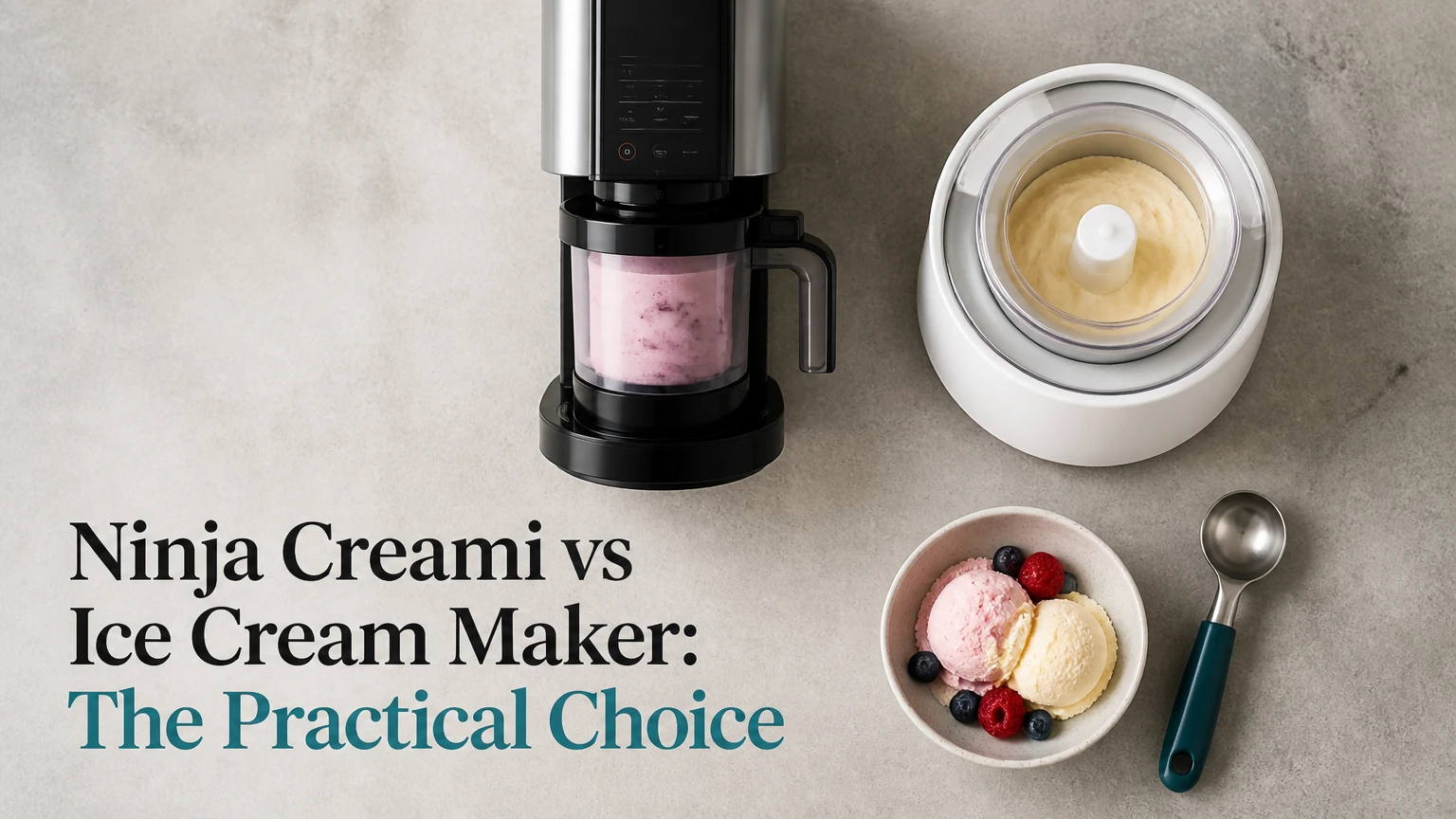
Ninja Creami vs ice cream maker is fundamentally a comparison between two different processes. A traditional ice cream maker freezes a liquid mixture while a paddle churns it, while a Ninja Creami freezes the base first and then cuts through the solid pint to create a dense, smooth texture.
Key Facts and Quick Answer
- A Ninja Creami processes one pre-frozen pint in roughly 2-5 minutes, but the base usually needs at least 24 hours in a level freezer.
- A traditional frozen-bowl machine churns a liquid base for about 20-30 minutes after its bowl freezes for 12-24 hours.
- A compressor ice cream maker can begin processing without a pre-frozen bowl and usually produces 1.5-2 quarts per batch.
- Creami texture is denser and generally contains less incorporated air than churned ice cream.
- Traditional machines are better for large batches and classic full-fat ice cream; Creami is better for small portions, high-protein recipes, and frequent flavor changes.
- Typical purchase prices range from about $60 for a basic canister machine to $600 or more for a compressor model, while many Creami units cost approximately $150-$250.
The right choice depends less on brand preference than on workflow. Choose a Creami when you can freeze several individual containers ahead of time and value recipe flexibility; choose a churner when you want a larger batch with a traditional scoop-shop texture.
How Do the Two Machines Work?
A Ninja Creami pulverizes a fully frozen mixture, while a traditional ice cream machine freezes and agitates a liquid mixture at the same time. That change in sequence affects ice-crystal size, air content, serving texture, and the kinds of recipes each appliance handles well.
Traditional Ice Cream Makers
A traditional machine uses a dasher, which is a paddle that scrapes and stirs the mixture against a cold vessel. The scraping prevents large ice crystals from growing while agitation incorporates air, a property called overrun.
Frozen-bowl models use a coolant-filled bowl that must be frozen before use. Compressor models contain a refrigeration system, so the machine cools its own vessel during processing. Both styles churn a liquid base, which means the mixture becomes semi-frozen during the cycle rather than starting as a solid block.
The International Dairy Foods Association describes overrun as the amount of air incorporated into frozen dessert. A home batch may have moderate overrun, while commercial products can vary widely by style and labeling rules. More air produces a lighter product, but excessive air can make flavor seem less concentrated.
Ninja Creami Processing
The Creami’s motor lowers a rotating processing blade through a frozen pint. The blade breaks the frozen base into fine particles and blends those particles until the mixture resembles soft serve.
Ninja’s product documentation describes the appliance as processing a frozen base into ice cream, sorbet, milkshake, and related textures. The manufacturer’s central distinction is functional: the unit does not freeze liquid during the cycle. The freezer performs the hard-freezing stage, and the Creami performs the texture-forming stage.
A Creami therefore cannot compensate for a base that is warm, partially frozen, tilted, or frozen with a large air pocket. The mechanical load depends on the condition of the pint.
What Are the Main Machine Types?
Home frozen-dessert machines fall into three practical categories: frozen-bowl churners, compressor churners, and blade-style processors. The first two freeze and churn liquid, while the third processes a previously frozen solid.
| Machine type | Typical purchase price | Pre-freeze requirement | Typical batch size |
|---|---|---|---|
| Basic frozen-bowl churner | $50-$100 | Bowl frozen 12-24 hours | 1.5-2 quarts |
| Premium frozen-bowl churner | $100-$180 | Bowl frozen 12-24 hours | 1.5-2 quarts |
| Compressor churner | $200-$600+ | No bowl pre-freeze | 1.5-2 quarts |
| Ninja Creami-style processor | $150-$250 | Base frozen about 24 hours | 1 pint, or model-specific container |
Frozen-Bowl Machines
Frozen-bowl machines have the lowest entry price, but the bowl occupies freezer space and must be completely frozen. A bowl that feels cold but still contains liquid coolant will not remove heat quickly enough for a firm batch.
The practical limitation is sequencing. After one batch, the bowl may need another 12-24 hours before it can churn again. A household making two flavors for a weekend needs either multiple bowls or advance planning.
Compressor Machines
Compressor units are the most flexible traditional machines because they refrigerate their own canister. They support consecutive batches, although the compressor may require a short cooling interval between cycles depending on the model and room temperature.
These machines are heavy, often weighing 20-35 pounds, and need ventilation around the housing. Their capacity suits entertaining, but their footprint and price make them excessive for someone who prepares one pint twice a month.
Blade-Style Creami Machines
Creami models use narrow containers rather than a large churn vessel. The container freezes for approximately 24 hours, then the machine processes it in a few minutes.
The container system supports flavor variety. A user can freeze vanilla, coffee, mango, and protein bases separately, then process only the flavor needed. That convenience comes with a capacity trade-off because each standard container produces about one pint.
Creami Versus Churner: Specifications That Matter
Capacity and calendar time often matter more than motor power. A machine that finishes in two minutes is not faster for a household that forgot to freeze the base, and a two-quart churner is not more convenient when only one serving is needed.
| Attribute | Ninja Creami | Frozen-bowl churner | Compressor churner |
|---|---|---|---|
| Liquid processing time | 2-5 minutes | 20-30 minutes | 25-50 minutes |
| Required freezer planning | About 24 hours | About 12-24 hours for bowl | Ingredients may be chilled |
| Typical output | 16 fluid ounces | 48-64 fluid ounces | 48-64 fluid ounces |
| Consecutive batches | One container per cycle | Usually limited by bowl | Usually possible |
| Typical appliance weight | 13-16 pounds | 5-12 pounds | 20-35 pounds |
| Typical noise profile | High motor noise for a short cycle | Moderate noise for a longer cycle | Compressor and paddle noise |
| Texture | Dense, low-to-moderate overrun | Light to moderately airy | Light to moderately airy |
| Cleanup | Container, paddle, lid, and outer bowl | Dasher, bowl, lid | Dasher, bowl, lid, compressor area |
Calendar Time Versus Active Time
Creami advertisements often emphasize a two-minute processing cycle, but that figure excludes freezing. For a fair comparison, count preparation, chilling, freezing, processing, and cleanup.
A Creami base may take 5-10 minutes to mix, 24 hours to freeze, 2-5 minutes to process, and 3-5 minutes to wash. A frozen-bowl batch may take 10-20 minutes to prepare, 12-24 hours to freeze the bowl, 20-30 minutes to churn, and 5-10 minutes to clean.
A compressor machine has the shortest lead time when the ingredients are already cold. It still requires around 30-60 minutes for chilling, churning, and firming, depending on recipe temperature and desired texture.
Expert insight: Active time and waiting time produce different buying decisions. Creami reduces hands-on processing but increases dependence on freezer inventory; a compressor reduces freezer dependence but increases counter space, weight, and purchase cost.
Which Makes Better Ice Cream?
A traditional churner usually makes lighter, more aerated ice cream, while a Creami usually makes a denser dessert with intense flavor and a soft-serve-like finish. “Better” depends on whether the desired result is scoop-shop airiness, thick protein dessert, or rapid single-serving customization.
Texture and Overrun
Traditional churning introduces air as the dasher moves through the liquid. The result often feels lighter on the tongue and may expand in volume during processing. A Creami does not rely on whisking air into the base, so the finished product tends to be compact.
The Creami can produce an exceptionally smooth texture from a base that would freeze hard in a conventional churner. It can also expose weaknesses in the formulation. A low-sugar base may emerge powdery or crumbly because sugar normally lowers the freezing point and limits ice formation.
If the first Creami cycle looks dry, the manufacturer’s re-spin function may restore smoothness. Re-spinning is a correction step, not a substitute for adequate fat, sugar, dissolved solids, or liquid.
Serving Temperature and Melt
A Creami pint straight from a typical home freezer is much colder and harder than freshly churned ice cream. The blade softens it mechanically, which is why the serving texture can be smooth immediately after processing.
Freshly churned ice cream from a traditional machine is usually semi-soft and can be served at once, although a one-to-four-hour hardening period improves scoopability. Creami leftovers often refreeze more firmly and may require another processing cycle.
| Desired result | Better appliance | Reason | Typical adjustment |
|---|---|---|---|
| Light vanilla ice cream | Traditional churner | Paddle incorporates more air | Chill base 4-12 hours |
| Dense chocolate dessert | Either machine | Cocoa and solids work in both systems | Use measured sugar |
| High-protein pint | Ninja Creami | Blade processing handles lean frozen bases | Add enough liquid |
| Large party batch | Compressor churner | 1.5-2 quart capacity | Run consecutive batches |
| Fruit sorbet | Either machine | Fruit puree freezes effectively | Balance sugar and water |
| Low-sugar dessert | Ninja Creami with formulation care | Re-spin can improve hard bases | Consider allulose or fruit solids |
| Frequent mix-ins | Ninja Creami | Mix-ins are added after the main cycle | Use a dedicated mix-in cycle |
Which Machine Handles Special Diets Best?
The Ninja Creami is usually more forgiving for low-fat, high-protein, and reduced-sugar formulas because its blade can break down a hard frozen matrix after freezing. A conventional churner may struggle when the same formula lacks enough fat, sugar, or dissolved solids to remain scoopable.
| Recipe goal | Creami suitability | Traditional suitability | Main formulation issue |
|---|---|---|---|
| Whey protein ice cream | High | Moderate to low | Protein can create chalkiness |
| Dairy-free oat base | High | Moderate | Starch and water can become icy |
| Reduced-sugar fruit dessert | Moderate to high | Moderate | Low sugar raises freezing hardness |
| Full-fat custard | High | High | Egg and dairy need proper heating |
| Vegan coconut dessert | High | High | Fat separation and coconut flavor |
| Sugar-free stevia-only base | Low | Low | Stevia adds sweetness without bulk |
| Sorbet with ripe fruit | High | High | Water-to-sugar balance controls ice |
Stevia presents a specific problem. It is intensely sweet but contributes almost no mass or freezing-point depression, so a stevia-only base may taste sweet while freezing like an ice block. Allulose, erythritol blends, fruit puree, soluble fiber, or a small amount of conventional sugar can change body, but each affects sweetness and texture differently.
Protein powders also require restraint. A large scoop can produce a thick, dry mixture that needs additional milk or another liquid. In practice, a base with approximately 20-30 grams of protein per pint is easier to balance than an aggressively concentrated formula.
Expert insight: “Healthy” is not a texture category. Removing fat and sugar removes two structural tools, so the recipe must replace their functions with water control, soluble solids, protein management, or stabilizers.
What Does Each Option Cost?
Purchase price favors a basic frozen-bowl churner, while value per serving depends on how much dessert a household actually eats. A Creami can be economical for one-person portions but inefficient for parties because four pints equal only about two quarts and require four separate containers.
| Cost category | Ninja Creami | Frozen-bowl churner | Compressor churner |
|---|---|---|---|
| Typical appliance price | $150-$250 | $60-$180 | $200-$600+ |
| Typical usable batch | 1 pint | 1.5-2 quarts | 1.5-2 quarts |
| Containers or bowl | $15-$30 per extra pint set | $30-$80 per spare bowl | Usually built in |
| Ingredient cost per batch | $2-$8 typical | $4-$14 typical | $4-$14 typical |
| Typical output from 4 pints | 4 pints | 3-4 pints | 3-4 pints |
| Replacement wear point | Paddle and pint lids | Dasher or frozen bowl | Dasher or compressor system |
Extra Creami containers can improve flavor rotation, but they raise the effective ownership cost. A buyer who wants six ready-to-process flavors may spend another $60-$120 on containers, depending on model and accessory pricing.
Electricity usually has less influence than ingredients and purchase price. A compressor consumes power for a longer refrigeration cycle, while a Creami uses a high-power motor briefly. The exact utility cost varies by local electricity rate and model, so energy alone should not determine the purchase.
Which Machine Fits Your Household?
A Creami is the stronger choice for single portions, dietary experimentation, and freezer-based meal planning. A traditional machine is stronger for families, dinner parties, and people who prefer to make one base and serve it immediately.
Use this decision sequence:
- Choose the required batch size. If one pint is enough, Creami capacity is practical; if six or more servings are routine, favor a 1.5-2 quart churner.
- Decide whether a 24-hour freeze is acceptable. If not, choose a compressor model.
- Identify the usual recipe. High-protein, low-fat, and fruit-based experiments favor Creami; classic custard and airy dairy ice cream favor a churner.
- Measure freezer and counter space. A Creami needs upright pint storage, while a compressor needs a permanent ventilated counter position.
- Price the workflow, including extra containers, ingredients, and the number of batches needed for guests.
- Prioritize texture. Choose Creami for density and customization, or a churner for aeration and traditional scoopability.
Best Choice for One Person
For one or two servings, a Creami avoids producing a large tub that slowly develops freezer crystals. Individual pints also make portion control and flavor separation easier.
The limitation is leftovers. A pint processed today may become hard again tomorrow, and the user may need to run another cycle. That repeat processing takes little time but creates additional noise and wear.
Best Choice for Families
Families generally benefit from a traditional 1.5-2 quart machine because one batch serves several people. A compressor model is especially useful when multiple flavors are needed on the same day.
A frozen-bowl model can still work well if the family owns a spare bowl or prepares the dessert the day before. Without that planning, the bowl becomes the bottleneck.
Best Choice for High-Protein Recipes
Creami wins for protein recipes because the blade can transform a very cold, relatively lean base into a spoonable dessert. A traditional machine can churn the same mixture, but the result may be icy, thin, or difficult to scoop after hardening.
The Creami does not make protein powder disappear. Whey, casein, and plant proteins still affect viscosity, hydration, flavor, and chalkiness. Blend the base thoroughly, refrigerate it before freezing, and leave enough headroom below the maximum fill line.
How Should You Use a Ninja Creami Safely?
A successful Creami workflow requires a level freeze, correct fill volume, and a base that contains enough liquid for the blade to move through it. The most damaging mistakes occur before the machine is switched on.
- Blend or whisk the base until powders, sweeteners, and flavorings are dispersed.
- Pour only to the model’s maximum fill line, leaving the specified headspace.
- Freeze the container upright on a level shelf for about 24 hours.
- Inspect the surface before processing. A tilted or ridged surface should be leveled according to the model’s instructions.
- Install the container, select the program suited to the recipe, and stop if the machine repeatedly strains or produces unusual noise.
- Use the re-spin function only after checking whether the base is too dry, too cold, or poorly formulated.
- Add chocolate chips, nuts, cookie pieces, or fruit after the main texture cycle when the model provides a mix-in program.
- Wash the blade, lid, pint, and outer bowl after use, following the manufacturer’s dishwasher and hand-washing guidance.
The exact programs and container limits differ among the original Creami, Creami Deluxe, and newer variants. The owner’s manual overrides generic recipes, particularly for fill lines, blade assembly, and dishwasher use.
What Happens If the Pint Freezes Unevenly?
An unevenly frozen pint can create an unbalanced load because the blade encounters hard and soft sections at different depths. A tilted surface may also place unusual pressure on the processing assembly.
Freeze containers on a flat shelf, not in a crowded door compartment. Do not process a pint that has thawed and refrozen with a deep liquid pocket, severe freezer burn, or a visibly damaged container.
Common Failure Modes and Fixes
Most disappointing results have a recognizable cause. The table below connects the visible symptom with the likely mechanism and the practical correction.
| Symptom | Likely cause | Immediate response | Prevention |
|---|---|---|---|
| Powdery Creami texture | Low liquid or low sugar | Add a small liquid amount and re-spin | Balance water and solids |
| Large ice crystals | Unbalanced watery base | Re-spin if safe, then reformulate | Add fruit solids or suitable sugar |
| Motor strains | Overfill or unusually hard base | Stop and inspect fill level | Respect maximum line |
| Thin churned ice cream | Base or bowl too warm | Chill longer before churning | Refrigerate base 4-12 hours |
| Mix-ins disappear | Pieces added too early | Use mix-in cycle | Add firm pieces after main cycle |
| Ice cream melts quickly | High water or warm serving vessel | Harden briefly in freezer | Balance recipe and pre-chill bowls |
| Creami blade will not engage | Incorrect assembly | Remove and reinstall parts | Check locking alignment |
| Frozen bowl fails to churn | Bowl was not fully frozen | Refreeze 12-24 hours | Store bowl at the coldest freezer area |
Expert insight: Re-spin is often misunderstood. It repairs texture created by an under-hydrated or unevenly frozen base, but repeated re-spins cannot reliably turn a fundamentally unbalanced water-and-sweetener formula into traditional ice cream.
Can a Creami Replace a Traditional Ice Cream Maker?
A Creami can replace a traditional machine for small portions, protein desserts, reduced-sugar experiments, and flavor-by-flavor preparation. It cannot fully replace a large-capacity churner for parties, continuous batch production, or people who specifically want airy, freshly churned ice cream.
The replacement is therefore conditional rather than universal. A household that normally makes one pint at a time may regard Creami as a complete substitute. A household that serves twelve guests needs several containers, several freeze cycles, or a separate large-batch machine.
Creami also changes recipe development. Instead of optimizing a liquid mixture for simultaneous freezing and churning, the cook optimizes the frozen matrix for mechanical processing. That makes some unconventional recipes possible, but it makes freezer organization part of the dessert workflow.
Frequently Asked Questions About ninja creami vs ice cream maker
Does a Ninja Creami make real ice cream?
A Ninja Creami makes an ice-cream-style frozen dessert by processing a frozen base, and the final classification depends on the ingredients and applicable food-labeling standards. A dairy base containing cream, milk, sugar, and sometimes egg can produce a conventional ice cream recipe, while fruit or protein bases may fit other frozen-dessert categories.
Can I use a Creami without freezing the mixture overnight?
A Creami generally requires a completely frozen base, commonly about 24 hours in a level freezer. Processing a partially frozen mixture can produce poor texture and may place abnormal stress on the blade and motor. The required time varies with freezer temperature, container size, and the specific Ninja model.
Is a Creami cheaper to run than an ice cream maker?
A Creami may cost less per serving when it prevents unused leftovers, but a traditional churner produces more dessert per cycle. The most important costs are the appliance, extra Creami containers, ingredients, and the number of batches required. Electricity is usually a smaller factor than those purchase and ingredient costs.
Can I make gelato in either appliance?
Both appliances can produce gelato-style desserts, but the process differs. A traditional machine churns the chilled liquid base and can create a dense result with limited overrun, while a Creami processes a frozen gelato base. Neither appliance automatically guarantees authentic gelato formulation or serving temperature.
Which machine is easier to clean?
A Creami usually has more removable food-contact components, including the pint, paddle, lid, and outer bowl, while a churner typically has a dasher, lid, and freezing vessel. Cleanup time is often about 3-5 minutes for a Creami and 5-10 minutes for a traditional machine, depending on residue and dishwasher compatibility.
How many Creami pints do I need for a family?
One pint serves approximately two to four modest portions, depending on serving size and mix-ins. A family of four may need two pints for a dessert course, while a gathering of eight may need four or more. Extra containers help with flavor variety, but every pint still needs its own freeze cycle.
Final Recommendation
The best answer to ninja creami vs ice cream maker depends on the dessert pattern you will repeat. Buy a Ninja Creami for dense single-pint desserts, high-protein formulas, low-sugar experimentation, and multiple flavors stored in advance. Buy a traditional frozen-bowl machine for low upfront cost and larger batches, or choose a compressor churner when same-day, back-to-back production matters most.
The decisive trade-off is simple: Creami moves the work into the freezer and delivers rapid processing, while a traditional machine freezes and churns a larger liquid batch in one session. Choose the workflow that matches your portions, freezer space, desired texture, and tolerance for planning.