

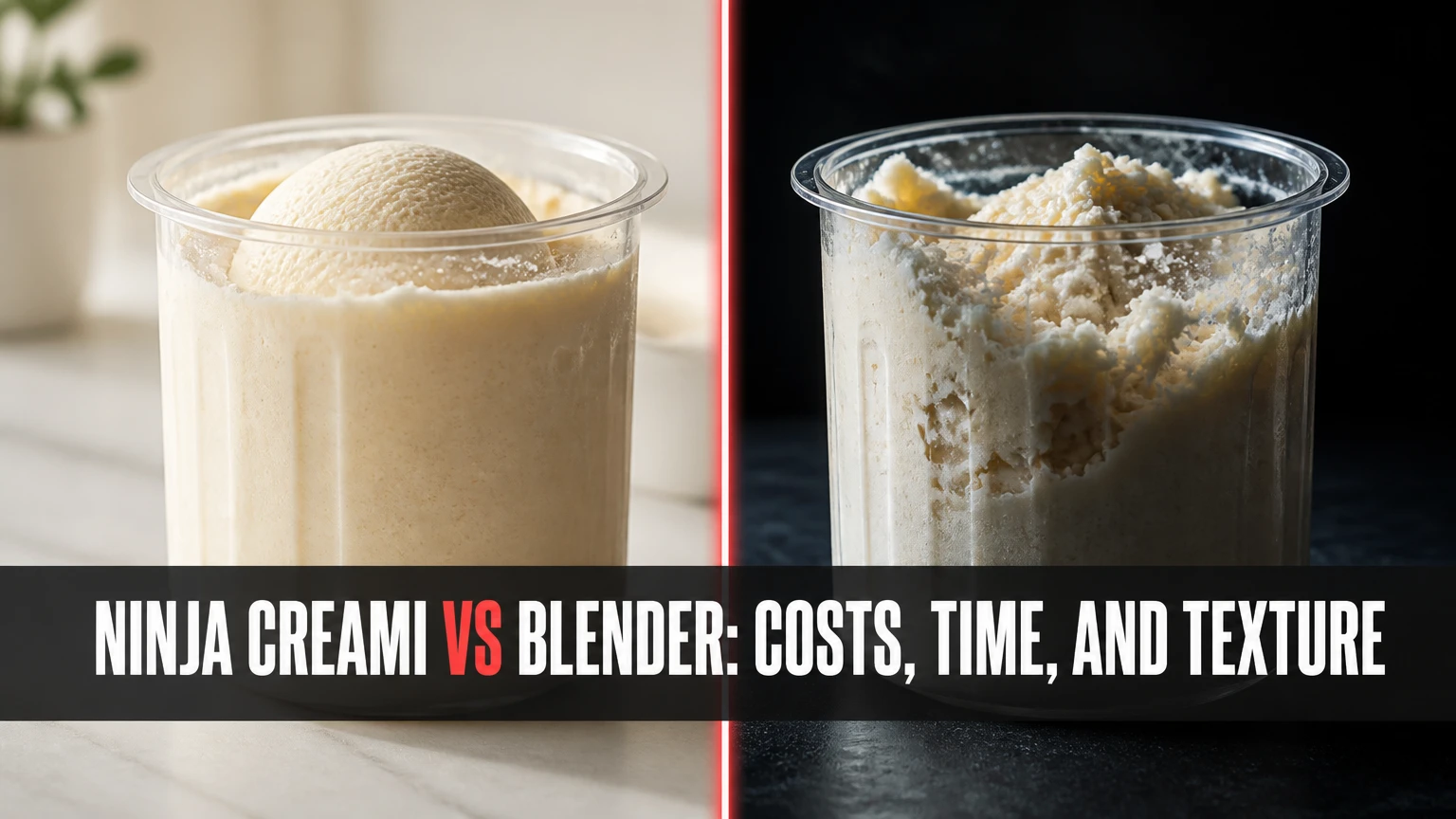
Ninja Creami is a frozen-dessert appliance that processes a fully frozen base into ice cream, sorbet, or smoothie bowls, while a blender uses high-speed blades and liquid to mix ingredients immediately. The Creami generally wins for low-fat, high-protein frozen texture; a blender wins for smoothies, soups, sauces, crushing ice, and larger batches.
Key Facts / Quick Answer
Choose a Ninja Creami when frozen desserts are the main goal and you can freeze a pint for about 24 hours at 0°F (-18°C).
Choose a blender when you need smoothies, hot soups, sauces, batters, nut butter, or multi-serving recipes.
A Creami typically processes 16-ounce or 24-ounce frozen containers in about 1-4 minutes after freezing.
A blender usually finishes a smoothie in 30 seconds-2 minutes, but it needs enough liquid to maintain a vortex.
Creami ownership commonly costs about $180-$250 for Deluxe models, while high-performance blenders commonly cost $350-$650.
Neither appliance replaces the other completely: one specializes in frozen texture, and the other handles a wider range of ingredients and temperatures.
How Each Appliance Works
The Ninja Creami and a blender create texture through different physical processes. The Creami moves a blade vertically through a frozen base, while a blender rotates blades at the bottom of a jar and uses liquid circulation to bring ingredients into the cutting zone.
How does a Ninja Creami make ice cream?
A Ninja Creami processes a frozen pint from the top down. Its motor lowers a rotating paddle through the solid base, removing and recombining thin frozen layers until the mixture becomes scoopable.
The base must be frozen level and solid. Unlike a traditional churner, the appliance does not freeze liquid while it runs, so preparation shifts from machine chilling to freezer planning. The result is usually dense and compact because the process adds less air than conventional churning.
The recipe still matters. Sugar, fat, dissolved protein, gums, and fruit solids affect hardness and re-spin requirements. A very low-sugar, low-fat base freezes harder than a standard custard, so it may need one or more re-spin cycles.
How does a blender create a smooth mixture?
A blender spins a fixed blade assembly at the bottom of its jar. The blades create a circulation pattern that pulls ingredients downward, cuts them, and pushes the mixture upward along the container walls.
Liquid is the operating requirement. Water, milk, juice, yogurt, or another pourable ingredient allows the vortex to move food through the blades. Too little liquid leaves unmixed pockets, increases motor load, and can produce a coarse result even when the blender has a powerful motor.
Blade speed also does not guarantee a frozen-dessert texture. A blender can crush ice and frozen fruit, but the mixture generally becomes a thick smoothie, slush, or soft-serve-like paste rather than the dense, uniform texture produced from a frozen Creami pint.
What Each Appliance Can Make
The Ninja Creami is specialized, while the blender is multifunctional. Recipe range, serving size, and ingredient temperature provide a better buying framework than motor wattage alone.
| Recipe or task | Ninja Creami result | Blender result | Better fit |
|---|---|---|---|
| Protein ice cream | Dense frozen dessert after freezing | Drinkable shake or soft frozen mixture | Creami |
| Fruit sorbet | Smooth sorbet from a frozen base | Slushy purée unless liquid is added | Creami |
| Morning smoothie | Poor fit because the base must be frozen | Finished drink in 30 seconds-2 minutes | Blender |
| Hot soup | Not designed for hot ingredients | Suitable only in a heat-rated jar | Blender |
| Frozen cocktail | Limited pint workflow | Fast, adjustable batch size | Blender |
| Nut butter | Not designed for the task | Possible in high-performance models | Blender |
| Mix-in dessert | Chocolate, nuts, and cookies added after processing | Mix-ins become chopped or puréed | Creami |
| Pancake batter | Not practical | Finished in about 30-90 seconds | Blender |
Creami models and frozen-container sizes
Ninja Creami models differ mainly in container capacity, program selection, and how much of a pint can be processed at once. Standard and Breeze-style units typically use 16-ounce containers, while Deluxe models commonly use 24-ounce containers and support separate top and bottom processing.
| Creami category | Typical container | Typical retail price | Best use |
|---|---|---|---|
| Standard 7-in-1 | 16 oz | $150-$200 | One-person desserts |
| Breeze-style model | 16 oz | $150-$220 | Compact frozen treats |
| Deluxe 11-in-1 | 24 oz | $180-$250 | Larger servings and split processing |
| Extra pint pack | 16 or 24 oz | $15-$30 | Freezing several flavors |
| Replacement paddle | Model-dependent | $20-$40 | Wear or damage replacement |
Container capacity is not the same as finished serving capacity. A 24-ounce Deluxe pint may produce several servings, but processing a large frozen container still takes one cycle at a time. Extra pints help households rotate flavors through the freezer, although they also consume vertical freezer space.
Blender categories and practical capacity
Blenders fall into three useful groups. Personal units suit one drink, full-size countertop models handle family batches, and high-performance machines provide stronger processing for fibrous produce, nut butter, and difficult frozen mixtures.
| Blender category | Typical jar or cup | Typical price | Practical strength |
|---|---|---|---|
| Personal bullet blender | 12-24 oz | $30-$100 | Single smoothies |
| Standard countertop blender | 48-72 oz | $50-$150 | Family drinks and sauces |
| High-performance blender | 48-64 oz | $350-$650 | Fibrous foods and thick mixtures |
| Immersion blender | No fixed vessel | $30-$150 | Soups in a cooking pot |
| Food processor | 8-14 cups | $80-$300 | Chopping, dough, and coarse frozen fruit |
A large jar does not mean every recipe should fill it. Many blenders circulate poorly with small quantities, while personal cups handle one serving efficiently. High-performance models can process thick mixtures more effectively, but they remain dependent on recipe moisture and safe operating temperatures.
Texture, Nutrition, and Recipe Performance
The biggest difference is not speed. It is how each machine responds to a recipe with little free liquid.
Why does the Creami produce a different texture?
The Ninja Creami starts with a frozen solid and repeatedly processes it into a finer, more cohesive mixture. That method lets a user make a low-fat or high-protein dessert without adding the volume of milk or cream that a blender would need to circulate ingredients.
A blender must first create movement. If a frozen banana and protein powder contain too little liquid, the blade may spin beneath the ingredients while the upper mass remains stationary. Adding milk solves circulation, but it also changes the recipe from a dense scoop to a thicker beverage or soft mixture.
The distinction matters for dietary recipes. A Creami can turn a protein shake base into a spoonable dessert after freezing. A blender can make the same base quickly, but normally as a drink.
Which recipes favor each appliance?
| Recipe type | Typical liquid requirement | Preparation time | Preferred appliance |
|---|---|---|---|
| High-protein frozen dessert | 0-8 oz added liquid per pint | 24 hours plus 1-4 minutes | Creami |
| Banana nice cream | 0-2 oz added liquid | 3-6 minutes | Food processor or Creami |
| Green smoothie | 8-16 oz liquid | 1-2 minutes | Blender |
| Creamy tomato soup | 24-48 oz broth or stock | 5-10 minutes | Blender |
| Fruit sorbet | 0-6 oz liquid, recipe-dependent | 24 hours plus 1-4 minutes | Creami |
| Frozen margarita | 8-16 oz liquid | 30-90 seconds | Blender |
A Creami is especially useful for bases containing Greek yogurt, milk, protein powder, fruit purée, or sugar substitutes. A blender is more efficient for ingredients that are already liquid or need chopping before they become pourable.
Does either appliance change nutrition?
Neither appliance automatically makes a recipe healthier. The ingredient list determines calories, sugar, protein, fat, fiber, and sodium, while processing mainly changes physical form.
The Creami may make a lower-fat dessert feel richer because its process reduces the perception of coarse ice crystals. That sensory advantage can help a user replace cream with yogurt or milk, but it does not remove the need to balance sweetness and solids.
Blending can expose more fruit tissue and produce a uniform drink, but the appliance does not eliminate calories or convert added sugar into a nutrient. Whole-fruit smoothies also retain more dietary fiber than strained juice, although portion size still controls total carbohydrate intake.
Cost, Time, and Capacity
The purchase price understates the Creami’s operating commitment. A blender costs more or less depending on performance, while the Creami adds freezer time, containers, and advance planning.
| Cost or time factor | Ninja Creami | Standard blender | High-performance blender |
|---|---|---|---|
| Appliance purchase | $150-$250 | $50-$150 | $350-$650 |
| Preparation before processing | 5-15 minutes | 2-10 minutes | 2-10 minutes |
| Required freezing | About 24 hours | 0 hours | 0 hours |
| Active processing | 1-4 minutes per pint | 30 seconds-2 minutes | 30 seconds-3 minutes |
| Typical batch volume | 16-24 oz | 32-64 oz practical | 32-64 oz practical |
| Extra container cost | $15-$30 per pack | $0-$50 | $0-$150 |
Typical ingredient cost also differs by recipe rather than appliance. A homemade Creami pint using yogurt, milk, fruit, and protein powder might cost $2-$5. A blender smoothie may cost $1.50-$6, depending on fresh berries, supplements, nut butter, and liquid.
Which appliance is faster in real use?
A blender is faster for food consumed immediately. Measuring ingredients, adding liquid, blending, and washing the jar can fit within 5-15 minutes.
The Creami is faster at the final transformation but slower across the whole workflow. The 24-hour freeze is mandatory for a solid base, and a dense or unevenly frozen pint may require a re-spin. Users who maintain two or more prepared pints can make the delay nearly invisible after the initial setup.
Freezer capacity is a hidden cost. A standard pint occupies roughly the footprint of a 16-ounce container but needs headroom for a level surface and room around the lid. A small freezer may make the blender the more practical choice even when frozen desserts are the preferred recipe.
How to Use Each Appliance Correctly
Correct loading and temperature control prevent most failures. The two workflows are fundamentally different.
Ninja Creami workflow
- Mix the base until powders, sweeteners, and stabilizers are fully dispersed.
- Pour below the marked maximum fill line and leave the surface level.
- Freeze the container upright for about 24 hours at 0°F (-18°C) or colder.
- Inspect the surface and remove any raised dome before processing.
- Select the program that matches the recipe, such as ice cream, sorbet, or smoothie bowl.
- Use a re-spin when the first result is powdery, crumbly, or visibly dry.
- Add cookies, nuts, chocolate, or fruit after the initial cycle through the mix-in function.
- Serve immediately or refreeze briefly, recognizing that the texture may become firmer.
The most important operational rule is to freeze flat. A domed surface can contact the paddle unevenly, increasing mechanical stress on the spindle and container assembly.
Blender loading workflow
- Add liquid first so the blades can establish circulation.
- Add soft ingredients such as yogurt, ripe banana, or cooked vegetables.
- Add powders, leafy greens, and small pieces of firm produce.
- Place ice or frozen fruit near the top.
- Start at low speed, then increase speed as the mixture begins circulating.
- Stop to scrape the sides only after the blades have stopped completely.
- Stay below the manufacturer’s fill line, especially with hot liquids.
- Serve promptly because melted ice changes viscosity and flavor concentration.
Blender manufacturers vary in loading recommendations, so the user manual overrides generic advice. Vitamix, Blendtec, and other high-performance brands also specify different limits for hot ingredients, tamper use, and container type.
What happens if the base or load is wrong?
| Mistake | Likely symptom | Mechanical or recipe cause | Correction |
|---|---|---|---|
| Creami pint has a dome | Loud vibration or uneven processing | Paddle meets an angled frozen surface | Level the base before freezing |
| Creami base is powdery | Dry, crumbly first result | Low moisture, low sugar, or uneven freezing | Use one re-spin and review solids |
| Creami pint is partly thawed | Soupy or streaky texture | Temperature varies across the base | Refreeze fully before processing |
| Blender has too little liquid | Cavitation and unmixed chunks | Vortex cannot reach the blade | Add liquid in small increments |
| Blender is overfilled | Leaks, poor circulation, or lid pressure | Contents exceed jar capacity | Reduce batch size |
| Ice is loaded first | Blade spins without drawing ingredients | Frozen mass blocks circulation | Load liquid and soft food first |
Plain frozen water is a poor Creami base because it creates an extremely hard, low-solids block and does not provide the dissolved ingredients that support a smooth result. The manufacturer’s manual should be followed for prohibited ingredients and container limits.
Cleaning, Noise, and Counter Space
The better appliance depends partly on how often cleanup and storage interrupt the cooking routine. A specialized machine can reduce recipe complexity while adding another motor base and dedicated containers.
| Household factor | Ninja Creami | Personal blender | Full-size blender |
|---|---|---|---|
| Main parts to wash | Paddle, lid, pint, outer bowl | Cup, blade lid | Jar, lid, blade assembly |
| Typical cleanup time | 3-6 minutes | 2-4 minutes | 3-8 minutes |
| Storage requirement | Base plus upright pints | Cup and compact base | Jar plus broad base |
| Noise duration | About 1-4 minutes | About 30-120 seconds | About 30-180 seconds |
| Best counter location | Near freezer access | Near daily drink station | Near food-preparation area |
The Creami’s noise can seem intense because the paddle works against a solid frozen mass. A blender often sounds louder at peak speed, but the cycle is usually shorter. Neither figure is a universal decibel rating, because container shape, recipe hardness, speed setting, and model generation alter the result.
In practice, cleanup is simpler when mix-ins remain coarse and are added after processing. Blending chocolate chips, nuts, or cookie pieces from the start produces more residue and removes the textural contrast many users wanted.
When Should You Choose Each Appliance?
The right choice follows the dominant recipe and scheduling pattern, not the appliance with the higher wattage.
Choose a Ninja Creami if you need:
- High-protein ice cream, frozen yogurt, or smoothie bowls.
- Dairy-free, low-fat, or reduced-sugar frozen desserts.
- Single-pint experimentation with several flavors.
- Distinct mix-ins such as cookie pieces or chopped chocolate.
- A dense texture that a standard blender cannot achieve with little liquid.
- A freezer routine that allows 24-hour preparation.
Choose a blender if you need:
- Smoothies made and consumed immediately.
- Hot soups, sauces, dressings, dips, or purées.
- Large batches for two or more people.
- Crushed ice, frozen cocktails, batters, or nut butter.
- A compact personal appliance for daily drinks.
- One machine that covers many cooking tasks.
Which is better for common households?
| Household situation | Better first purchase | Reason |
|---|---|---|
| One person making protein desserts daily | Ninja Creami | Pint control and low-liquid texture |
| Family making breakfast smoothies | Full-size blender | 48-64 oz batch capacity |
| Small apartment with limited freezer space | Personal blender | No 24-hour container rotation |
| Vegan dessert enthusiast | Ninja Creami | Works well with selected plant-based bases |
| Home cook making soups and sauces | Blender | Handles liquid and hot-food workflows |
| Occasional frozen treat maker | Blender | Lower commitment and immediate use |
| Athlete meal-prepping frozen portions | Ninja Creami | Repeatable single-pint portions |
| Baker or dough maker | Food processor or blender | Creami lacks chopping and dough functions |
A household can reasonably own both. The combination makes sense when smoothies or soups occur several times per week and frozen desserts are prepared often enough to justify freezer rotation.
Alternatives to Consider
The Ninja Creami is not the only route to frozen desserts, and a blender is not always the best general-purpose option.
| Alternative | Typical price | Required preparation | Texture or capability |
|---|---|---|---|
| Compressor ice cream maker | $250-$700 | 20-45 minutes active | Traditional churned ice cream |
| Freezer-bowl ice cream maker | $50-$150 | Bowl frozen 12-24 hours | Airier churned texture |
| Food processor | $80-$300 | Frozen fruit, 3-8 minutes | Fast banana-based desserts |
| High-speed blender | $350-$650 | Liquid plus frozen ingredients | Smooth drinks and thick blends |
| Immersion blender | $30-$150 | Ingredients in a pot or bowl | Soups, sauces, and small purées |
A compressor machine is preferable when serving a churned, airy texture immediately to several people. A freezer-bowl model shares the advance-freezing constraint but churns liquid while freezing, so its texture and workflow differ from the Creami.
A food processor handles frozen bananas and berries well because its wide bowl and S-blade can break down dense fruit. It usually produces a softer, warmer, or more fibrous result than a Creami, especially when the fruit contains seeds or has partially thawed.
Limitations and Safety Rules
The specialized frozen-dessert workflow has real limits. Treating the Creami as a blender can damage equipment, and treating a blender as a Creami can create poor texture.
Do not process hot ingredients in a Creami container. Do not exceed fill lines, process a visibly domed frozen base, or use ingredients prohibited by the model’s manual. The FDA’s food-safety guidance uses the phrase “When in doubt, throw it out,” which is a sensible rule for dairy, egg, and protein bases left warm for extended periods.
Blended soups require special caution. Steam expands inside a sealed jar, so hot liquids should be handled only in a container rated for hot blending, with the manufacturer’s venting instructions followed. An immersion blender is often safer for soup because it avoids transferring a full, steaming vessel.
Expert insight: re-spin is not a universal repair cycle. It can improve a powdery, low-moisture base, but it cannot correct a recipe that froze unevenly, contains large hard inclusions, or was processed while partly thawed.
Expert insight: wattage is a weak standalone buying metric. A 1,200-watt blender can outperform a higher-rated machine if its jar geometry creates better circulation, while the Creami’s value comes from its vertical frozen-base process rather than raw motor output.
Expert insight: the most common ownership failure is workflow mismatch. People buy a Creami for occasional dessert cravings, then resent the 24-hour freeze; other buyers purchase a blender for smoothies and expect restaurant-style low-liquid ice cream.
Frequently Asked Questions About ninja creami vs blender
Can a blender make ice cream without an ice cream maker?
A blender can make a frozen dessert from frozen bananas, berries, ice, yogurt, or cream, but it usually needs some liquid to circulate. The result is commonly a smoothie bowl, soft “nice cream,” or frozen purée. A Creami generally produces a denser, more uniform scoop from a fully frozen base.
Can you make smoothies in a Ninja Creami?
A Ninja Creami is poorly suited to ordinary drinkable smoothies because its container must generally be frozen before processing. The appliance can make smoothie bowls or frozen smoothie-style desserts, but a blender is faster for a pourable breakfast smoothie and can process it immediately.
Is the Ninja Creami worth buying for one person?
The Ninja Creami can be worth buying for one person who prepares frozen desserts at least weekly and has freezer space for multiple pints. It is less compelling for occasional use, especially when the buyer also needs soups, sauces, large smoothies, or other liquid recipes.
Which appliance is easier to clean?
A personal blender usually cleans fastest because it has one cup and a blade lid. A Creami requires washing the pint, paddle, outer bowl, and lid, so cleanup takes longer, although the food remains contained in a small serving vessel rather than spreading across a large jar.
Does a Creami replace a high-performance blender?
A Creami does not replace a high-performance blender. It cannot match a blender’s ability to make hot soup, nut butter, large smoothies, sauces, batters, or fibrous vegetable purées. The Creami replaces a specialized frozen-dessert workflow, not a general kitchen motor appliance.
Can you refreeze a Creami dessert after processing?
You can refreeze a processed Creami dessert, but the texture may become harder and require another re-spin. For best quality, process only the amount needed for immediate serving, then store leftovers sealed and use safe refrigeration and freezing practices for the ingredients involved.
Final Recommendation
The choice in ninja creami vs blender is straightforward when the primary recipe is clear. Buy the Ninja Creami for dense, customizable frozen desserts made from high-protein, dairy-free, low-fat, or reduced-sugar bases, provided a 24-hour freeze fits your routine. Buy a blender for immediate smoothies, hot soups, sauces, crushed ice, batters, and larger batches.
A Creami is a specialist with unusually strong frozen-texture performance. A blender is the broader kitchen tool. Choose the appliance that matches the food you will prepare most often, then budget for its real constraint: freezer rotation for the Creami, or sufficient liquid and jar capacity for the blender.