

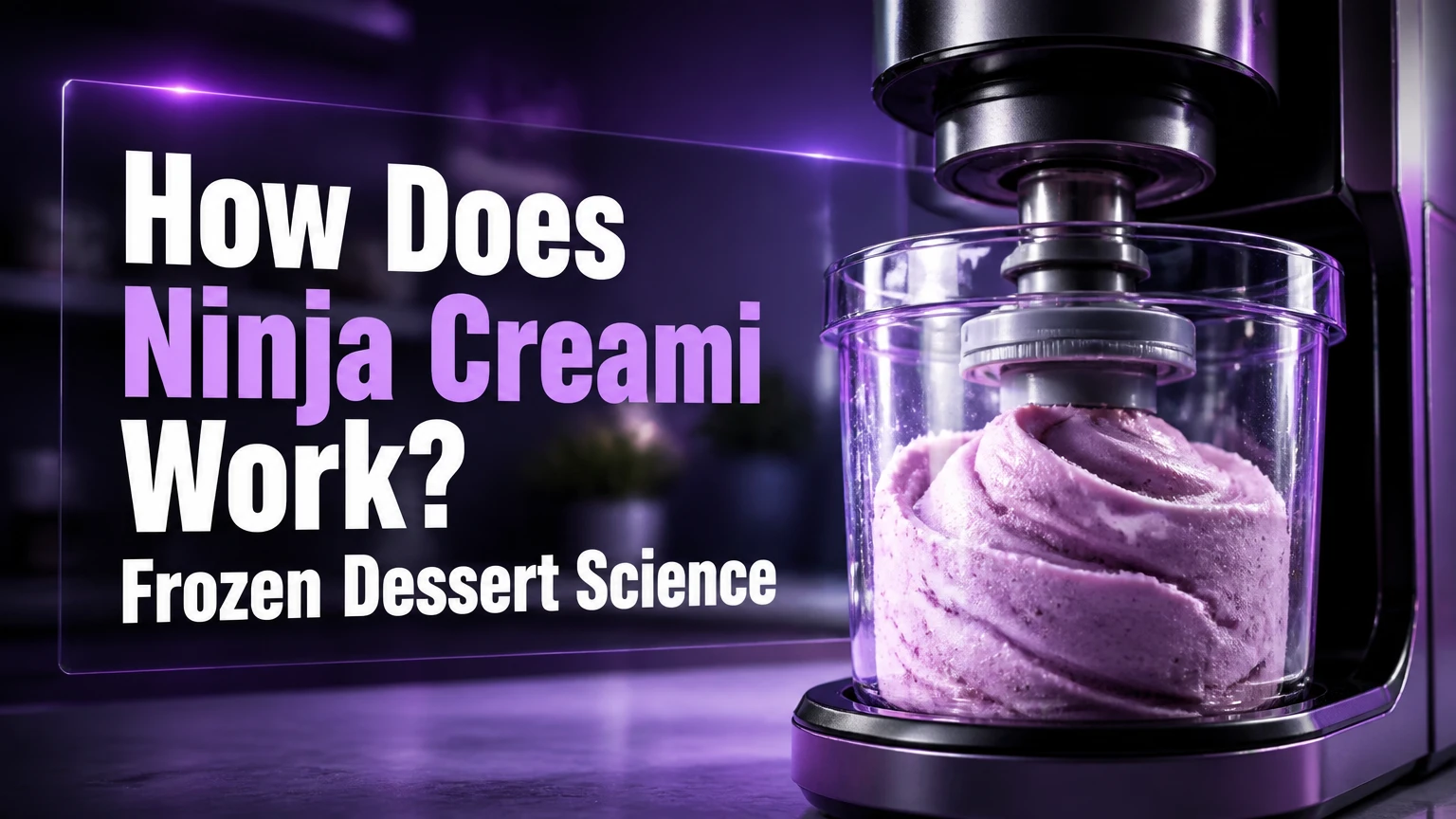
The Ninja Creami is a countertop frozen-dessert appliance that turns a fully frozen ingredient base into ice cream, gelato, sorbet, milkshakes, and mix-in desserts. Instead of freezing and churning liquid continuously, the machine drives a Creamerizer paddle downward through a solid pint, reducing the frozen mass into a smooth, spoonable texture.
Key facts
A prepared base usually needs about 24 hours in a freezer at 0°F (-18°C) or colder.
The appliance processes a solid pint in roughly 1-3 minutes, depending on model and program.
The paddle works downward through the frozen base rather than spinning a liquid in a chilled bowl.
A crumbly first result usually indicates low moisture, low sugar, low fat, or uneven freezing, not immediate machine failure.
Mix-ins belong after the main program, because chocolate, nuts, and candy can be pulverized during the first cycle.
Original pints and Deluxe pints are different sizes and should not be treated as interchangeable.
How Does the Ninja Creami Work?
The Ninja Creami works by mechanically shaving and compressing a frozen base until its ice crystals become small enough to produce a creamy mouthfeel. The base freezes first, then the motor lowers a rotating paddle through the pint; the process resembles the portioning action of a Pacojet more than the continuous churn of a conventional ice-cream maker.
The important distinction is timing. A traditional churner freezes the mixture while incorporating air, whereas the Creami begins with a frozen block and changes its texture afterward. The result can feel unusually dense because the machine does not depend on large amounts of overrun, the air incorporated into frozen dessert during churning.
Food writer Harold McGee describes ice cream as “a frozen foam” in On Food and Cooking, a useful way to understand the difference. Fat, sugar, water, air, proteins, and stabilizers determine how the frozen structure breaks down. The Creami can improve a lean mixture, but it cannot make missing fat or sugar behave exactly like a traditional premium ice cream.
The Core Mechanism in Plain Language
The spindle transfers motor force to the Creamerizer paddle. As the paddle travels downward, its edge encounters the frozen base in successive layers and pushes the loosened material against the pint wall. That mechanical work reduces large ice structures and blends liquid ingredients into the particles.
The paddle is not a conventional sharp knife, and the machine is not literally shaving the pint into paper-thin flakes. “Precision shaving” is a useful consumer description, but the actual texture change combines scraping, shearing, compression, and mixing. This distinction matters when diagnosing a result that is icy, wet, or powdery.
What Is the Creamerizer Paddle Doing?
The Creamerizer paddle rotates while the motor assembly moves down the pint. Its job is to break apart the frozen base and redistribute the resulting particles, while the outer bowl and lid hold the pint in the correct position.
A Creamerizer paddle should be clean, correctly installed, and free of dried ingredients around its hub. A damaged or misaligned paddle can create vibration, incomplete processing, or unusual noise. The paddle is not interchangeable across every Ninja Creami family, so replacement parts should match the model number.
The Complete Processing Sequence
The Ninja Creami process has five practical stages: formulate the base, freeze it solid, inspect the surface, run a program, and adjust the texture. The machine performs the fast stage, but the freezer determines whether the pint is ready for processing.
- Prepare the base. Blend or whisk the liquid, dairy or plant ingredients, sweetener, flavoring, and optional stabilizer until evenly distributed.
- Fill the correct pint. Stop at the model’s maximum fill line, leaving headspace for expansion and paddle clearance.
- Freeze the pint upright. Use a level freezer shelf for approximately 24 hours at 0°F (-18°C) or colder.
- Inspect the frozen surface. A raised center, often called a hump, should be leveled before processing if the model instructions require it.
- Install the paddle and process. Lock the pint into the outer bowl, select the program matching the base, and allow the cycle to finish.
- Assess the texture. Use Re-Spin for a dry or crumbly result, or use Mix-In after the base is already smooth.
- Serve or refreeze. Freshly processed Creami desserts are often softer than supermarket ice cream and may need several hours to firm.
Why Does the Pint Need 24 Hours?
The pint needs about 24 hours because the center of a full container freezes more slowly than its exposed edges. A surface that feels hard at 12 or 18 hours does not prove that the middle has reached a stable, solid temperature. Processing a partially frozen base can produce liquid pockets, poor texture, and extra mechanical strain.
The 24-hour figure is a practical operating rule, not a universal physical threshold. A shallow or small-volume base may freeze sooner, while a crowded freezer, warm food load, or frequent frost-free temperature cycle may require longer. A pint should be completely solid, with no visible sloshing or soft center.
Why Must the Surface Be Level?
A level surface reduces uneven loading on the paddle and spindle. Freezing can create a central mound because the outer walls lose heat first, forcing the liquid toward the middle as it solidifies. A pronounced mound can interfere with the paddle’s initial descent.
Do not process a pint with a severe peak simply because the lid closes. Follow the instructions for the model, and remove or level excess frozen material when necessary. A level top also produces more even contact between the paddle and the base.
What Bases Work Best?
The best Creami base matches the selected program and contains enough water, dissolved solids, and structure to process smoothly. Full-fat dairy bases usually become creamy quickly, while low-sugar, low-fat, and high-protein mixtures often need a Re-Spin or a small amount of added liquid.
| Base type | Typical ingredients | First-spin tendency | Useful adjustment |
|---|---|---|---|
| Custard-style ice cream | Milk, cream, sugar, egg yolk | Dense and creamy | Chill mixture before freezing |
| High-protein dessert | Milk or shake, protein powder, yogurt | Powdery or chalky | Add 1-2 tablespoons liquid and Re-Spin |
| Fruit sorbet | Fruit puree, water, sugar, citrus | Icy if sugar is low | Increase dissolved sugar or puree solids |
| Plant-based base | Oat, soy, coconut, or nut milk | Variable, often icy | Use higher-solids milk and a small stabilizer amount |
| Reduced-sugar base | Milk, sweetener, cocoa, flavoring | Hard and crumbly | Add soluble solids, yogurt, or stabilizer |
| Smoothie bowl | Frozen fruit, yogurt, liquid | Thick and spoonable | Stop at the fill line and use the correct program |
High-Protein Mixtures
Protein powder absorbs water and can leave a dry, sandy structure after freezing. Whey, casein, and blended powders behave differently, so the recipe cannot be predicted from protein grams alone. A whey and casein blend often gives a softer result than whey isolate by itself.
In practice, begin with the liquid recommended by the powder manufacturer, then add yogurt, fruit puree, or a small amount of xanthan or guar gum if the recipe is still icy. Use stabilizers sparingly. A typical starting point is about 1/8 to 1/4 teaspoon per pint, followed by careful testing, because excess gum creates a gummy or elastic texture.
Low-Sugar and Low-Fat Mixtures
Sugar lowers the freezing point and competes with water for crystallization. Fat coats the tongue and contributes richness, while milk proteins and stabilizers help bind water. Removing all three functions creates a very hard or powdery pint.
A low-calorie recipe can still work, but it needs another source of dissolved solids or structure. Greek yogurt, banana, dates, soluble fiber, cocoa, or a formulated sugar substitute can change the freezing behavior. “Lite” does not mean “ingredient-free”; it means the recipe depends more heavily on formulation.
Fruit and Sorbet Bases
Fruit puree provides water, fiber, acids, and natural sugar. Watermelon and some berries freeze harder than mango or banana because their solids content differs. A sorbet with too much free water forms large crystals and may need several processing cycles.
Strain seeds when a fine texture matters. Citrus juice adds acidity and flavor, but it does not replace sugar or fruit solids. If using canned fruit, drain or account for the syrup because the liquid ratio changes both sweetness and freezing point.
Ninja Creami Models and Capacity
Ninja Creami models differ mainly in pint size, program selection, motor platform, and control layout. The original family commonly uses approximately 16-ounce pints, while Deluxe models use larger 24-ounce pints and may offer separate top and bottom processing controls.
| Model family | Nominal pint size | Typical programs | Primary distinction |
|---|---|---|---|
| Original Creami | 16 oz | 7 programs | Smaller standard pint format |
| Creami Deluxe | 24 oz | Up to 11 programs | Larger pint and top or bottom processing |
| Creami Breeze | 16 oz | Model-dependent | Compact design and model-specific controls |
| Creami variants | Model-dependent | Model-dependent | Program and pint compatibility can vary |
Program names are not universal across every retail version. Ice Cream, Lite Ice Cream, Gelato, Sorbet, Smoothie Bowl, Milkshake, and Mix-In are common categories, while Deluxe models may add Slushi, Italian Ice, Frozen Drink, or Creamiccino functions.
Check the model number before buying extra containers. A 16-ounce pint should not be assumed safe in a 24-ounce Deluxe system, even when the external appliance looks similar.
Time, Cost, and Serving Capacity
The appliance reduces active processing time, but it does not eliminate the overnight freeze. A realistic home workflow is 5-10 minutes for preparation, about 24 hours for freezing, 1-3 minutes for processing, and another 1-2 minutes for Re-Spin or Mix-In when needed.
| Cost or time item | Typical range | What changes it |
|---|---|---|
| Appliance price | $150-$250 USD | Model, retailer, sales period |
| Extra pint pack | $20-$35 USD | Capacity and pack size |
| Base preparation | 5-10 minutes | Blending, cooking, chilling |
| Initial processing | 1-3 minutes | Program and model |
| Re-Spin | About 1 minute | Base composition and temperature |
| Total first-pint workflow | About 24-25 hours | Freezer time and recipe steps |
A 16-ounce pint contains roughly four 4-ounce servings or two larger dessert portions. A 24-ounce Deluxe pint contains six 4-ounce servings, although the practical yield changes when the recipe includes mix-ins or when a user fills below the line.
Ingredient cost varies more than appliance electricity. A basic milk-and-cocoa pint may cost approximately $2-$4 USD, while a protein, nut-based, or specialty sweetener formulation can reach $5-$10 USD. The equipment becomes more economical when several frozen pints are prepared in advance.
How Loud Is the Machine?
The processing cycle is noticeably loud because a high-power motor drives a loaded paddle through a solid mass. A typical cycle lasts only a few minutes, but the sound can resemble a powerful blender and may travel through a countertop.
Place the appliance on a stable, dry surface and avoid operating it beside sleeping areas. Do not press down on the machine or interrupt the bowl while the motor runs. Excessive rattling, scraping, or movement after correct assembly indicates a setup or part problem that deserves inspection.
Ninja Creami Compared With Alternatives
The Ninja Creami is best for fast processing of prepared frozen pints and flexible low-fat recipes. A traditional churner is better when you want to freeze a liquid mixture continuously, while a compressor machine is better for same-day batches without reserving freezer space.
| Feature | Ninja Creami | Freezer-bowl churner | Compressor machine | Pacojet |
|---|---|---|---|---|
| Base state at processing | Fully frozen | Liquid and chilled | Liquid and chilled | Fully frozen |
| Typical waiting period | About 24 hours | Bowl about 12-24 hours | None | About 24 hours |
| Active cycle | 1-3 minutes | 20-30 minutes | 30-60 minutes | 1-2 minutes |
| Typical price | $150-$250 USD | $50-$150 USD | $400-$800 USD | $5,000 USD or more |
| Best use | Individual pints | Traditional churned batches | Repeated same-day batches | Professional frozen portions |
The texture is not identical across these methods. Churners incorporate air while freezing, which can produce a lighter structure. The Creami can produce a dense, freshly processed texture with less apparent overrun, but the result may soften quickly and require refreezing for scoopability.
A Pacojet is the closest conceptual comparison because both systems process a frozen cylinder mechanically. The Ninja Creami is designed for household pint portions and consumer programs; a Pacojet is a professional appliance with different containers, pressure systems, service expectations, and cost.
Common Problems and Safe Fixes
Most poor Creami results come from the base or freezing conditions rather than a defective motor. The following table separates symptoms from likely causes and controlled fixes.
| Symptom | Likely cause | First fix | Avoid |
|---|---|---|---|
| Powdery, crumbly texture | Low moisture, sugar, or fat | Add 1-2 tablespoons liquid and Re-Spin | Adding large liquid volumes at once |
| Wet or slushy center | Under-freezing or warm pint | Refreeze for a full cycle | Processing a partially frozen base |
| Icy flakes | High free water or freezer fluctuation | Re-Spin, then adjust recipe solids | Expecting extra spinning to add fat |
| Loud vibration | Uneven surface or poor assembly | Level surface and reseat bowl | Holding the bowl during operation |
| Pulverized mix-ins | Added before main spin | Add after smooth processing | Processing hard candy on the first cycle |
| Overflow or jam | Filled above max line | Discard excess before freezing | Sealing an overfilled pint |
Why Is the Result Powdery?
A powdery result occurs when the paddle breaks a hard, low-moisture structure into fine particles without enough free liquid to bind them. Protein powders, low-sugar milks, and reduced-fat recipes produce this outcome more often because they provide less softening and lubrication.
Let the pint sit at room temperature for about 5 minutes, or use the manufacturer’s permitted preparation method, then run Re-Spin. If the texture remains dry, add 1-2 tablespoons of milk, coffee, juice, or another compatible liquid. Repeated spinning cannot fully correct a recipe whose water and dissolved-solids balance is wrong.
What Happens If the Pint Is Overfilled?
An overfilled pint leaves too little expansion space and can place excess resistance against the paddle. Frozen liquid expands, and the paddle needs room to travel through the base without forcing material into the lid or drive area.
Measure the liquid before freezing and stay below the maximum fill mark. If a frozen pint has expanded above the line, remove excess material and level the surface according to the applicable model instructions. Do not rely on a tightly closed lid to make an overfill safe.
Can You Add Mix-Ins Before Processing?
Chocolate chips, nuts, cookies, and candy should generally be added after the main texture is smooth. The dedicated Mix-In cycle distributes pieces through the finished base with less pulverization than an initial Ice Cream or Sorbet program.
Soft ingredients such as jam or caramel can be layered into the pint before freezing, but their location affects the final texture. Hard pieces can damage the texture and create uneven resistance, particularly when they sit in a dense frozen cluster.
Cleaning, Storage, and Food Safety
Clean the paddle, pint, outer bowl, and lid after each use, following the specific appliance manual for dishwasher eligibility. Dried dairy, nut butter, and protein powder can obstruct the paddle hub, so rinse those parts before residue hardens.
Do not store the appliance with wet parts assembled. Dry components reduce odor and microbial growth, while a clean paddle makes the next cycle less likely to vibrate. Keep frozen bases covered and label them with the preparation date and ingredients, especially when they contain allergens.
A frozen dessert is not automatically safe indefinitely. Freezing pauses most microbial growth but does not reliably destroy all pathogens. For best quality, use homemade bases within about 1-2 weeks, maintain a freezer near 0°F (-18°C), and discard mixtures that were left warm for extended periods or show contamination.
Limitations and Buying Decision
The appliance is a poor fit for anyone who needs large quantities immediately, dislikes loud equipment, or has no reliable freezer space for upright pint storage. It also cannot turn a warm liquid into a ready-to-eat dessert during the same short cycle.
A freezer-bowl churner may offer better value for family-size batches. A compressor machine costs more but removes the overnight bowl or pint constraint. The Ninja Creami makes the most sense when portion control, recipe experimentation, and rapid processing of pre-frozen servings matter more than instant production.
Before buying, check these criteria:
- Available freezer height for upright pints.
- Required capacity, either 16 ounces or 24 ounces.
- Price and availability of compatible replacement pints.
- Noise tolerance during a 1-3 minute cycle.
- Need for high-protein, dairy-free, or reduced-sugar recipes.
- Access to the correct paddle and outer bowl for the model.
- Whether family servings justify the larger Deluxe format.
An expert rule of thumb is to freeze two or more labeled pints before the first weekend of use. The machine then becomes a portion-processing system rather than a one-pint-per-day experiment. This also reveals whether your freezer maintains a stable temperature and whether your recipes need Re-Spin.
Frequently Asked Questions About how does ninja creami work
Does the Ninja Creami make ice cream immediately?
The Ninja Creami does not make ice cream immediately from a liquid base. The mixture normally freezes for about 24 hours first, after which the appliance processes the solid pint in approximately 1-3 minutes. The total elapsed time is therefore about one day, although active kitchen work may take less than 15 minutes.
Can you use frozen fruit in a Ninja Creami?
You can use fruit as part of a prepared base, but the correct procedure depends on the model and program. Whole frozen fruit can create dense chunks and uneven resistance. For reliable sorbet or smoothie bowls, blend fruit with the required liquid, fill the compatible pint, freeze it level, and process it using the appropriate setting.
Does a Ninja Creami need ice or salt?
The appliance does not require an ice-and-salt bath. The pint itself is frozen in a household freezer, and the Creamerizer paddle processes that solid base inside the outer bowl. Adding loose ice or salt to the pint changes the recipe and can damage texture, so use only ingredients intended for the selected preparation.
Can you refreeze a processed Creami dessert?
You can refreeze a processed dessert, but the texture usually becomes firmer and may need another processing cycle before serving. Store the dessert covered in its compatible pint, keep the freezer near 0°F (-18°C), and avoid repeated warm-to-cold cycles. Refreezing cannot repair a recipe with excessive free water or insufficient structure.
Is the Ninja Creami good for dairy-free recipes?
The Ninja Creami can produce good dairy-free desserts when the base has enough solids and stabilizing structure. Soy milk, coconut milk, oat milk, fruit puree, nut butter, and dairy-free yogurt behave differently. Very thin plant milks often become icy, while coconut-based or blended fruit mixtures usually provide more body.
Why does my Ninja Creami dessert melt so fast?
Freshly processed dessert is often softer because the paddle has warmed and dispersed the frozen particles. Low fat, high sugar, warm ingredients, and repeated Re-Spin cycles also increase softness. Serve it immediately for a soft-serve texture, or refreeze it for several hours if you want firmer scoops.
Conclusion
The simplest answer to how does ninja creami work is that the appliance processes a fully frozen pint rather than churning a liquid mixture while it freezes. Its rotating Creamerizer paddle breaks down the frozen base, then Re-Spin and Mix-In programs refine the texture and distribute ingredients.
The machine rewards accurate freezing, correct fill levels, and deliberate recipe formulation. Expect roughly 24 hours of preparation time, 1-3 minutes of processing, and the best results when the base contains enough moisture and dissolved solids for the paddle to transform it.