

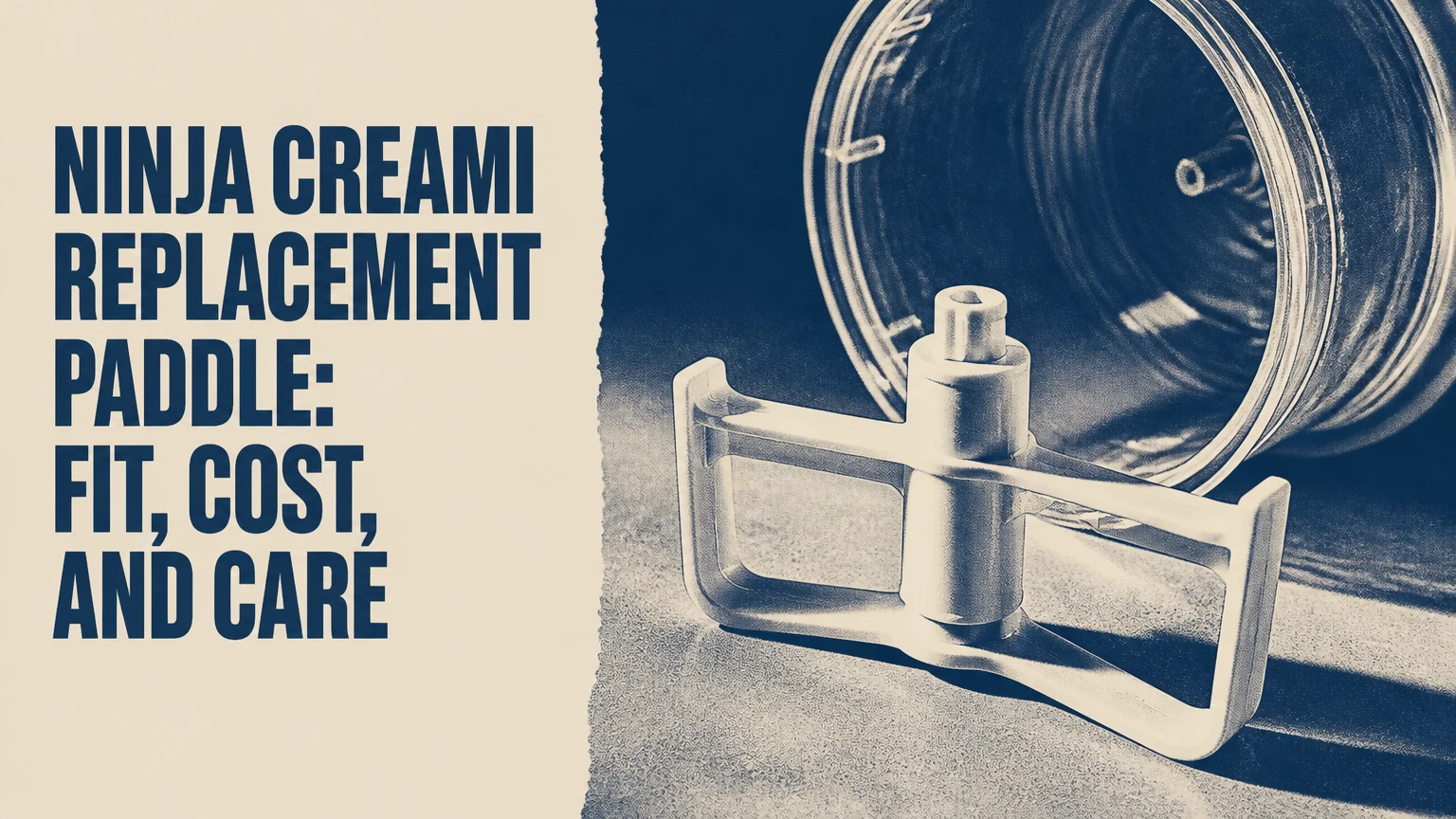
A Ninja Creami replacement paddle, also called a Creamerizer paddle or blade, is the removable food-contact assembly that shaves and processes a fully frozen dessert base into ice cream, sorbet, gelato, or another programmed texture. The correct part depends on the Creami series, pint size, and spindle connection, so model matching matters more than the paddle’s appearance.
Key Facts
Original replacement paddles typically cost about $24-$26 USD before shipping, while compatible third-party parts commonly cost $10-$20.
The NC300 family uses 16-ounce pints, while the NC500 Deluxe family uses larger 24-ounce pints and a different paddle interface.
Breeze and Swirl models require their own compatible assemblies. A paddle that fits an original Creami should not be assumed to fit a Deluxe or Swirl.
Freeze the base for at least 24 hours on a level surface before processing. A flat frozen surface reduces uneven loading.
Replace the assembly when the hub cracks, the blade is bent, the paddle will not lock securely, or abnormal noise continues after cleaning.
Do not process plain frozen water, dry ingredients, or an overfilled pint. Those conditions can overload the blade, spindle, or motor.
What Is a Ninja Creami Replacement Paddle?
The replacement paddle is the rotating processing tool mounted inside the Creamerizer lid. Unlike a traditional ice cream dasher, it enters a solid frozen base from above and removes thin layers while the machine’s motor turns the shaft at high speed.
The paddle does not freeze a liquid mixture. It converts a previously frozen block into a scoopable texture, which is why a Creami can produce a dense result in a few minutes after the base has frozen overnight. The blade assembly normally includes a food-contact paddle, a central hub, and an attachment point that locks into the lid spindle.
Ninja manuals and support instructions warn users not to process unsuitable solid contents without enough liquid. One recurring manufacturer instruction is: “Do not process solid ingredients without adding liquid.” The warning matters because blade geometry cannot compensate for an ice block that is excessively hard, dry, or uneven.
In practice, the paddle is only one part of the system. The pint, lid, spindle, motor, fill level, recipe composition, and freezing surface all affect the load placed on the assembly.
How the Creamerizer Paddle Works
The motor drives the spindle vertically, while the paddle moves through the frozen base from the top downward. Its cutting edge breaks up ice crystals and distributes the softened particles through the mixture rather than whipping a liquid mixture around a stationary freezer bowl.
A level base gives the blade a more predictable first contact. A central hump, tilted pint, or large frozen fruit piece can load one side of the hub before the opposite side engages. That uneven force explains why a machine may rattle, tunnel through one area, or leave a hard ring around the outside.
The result is usually denser than home-churned ice cream because the Creami starts with a frozen block and adds less air during processing. A traditional churner introduces air while freezing, whereas the Creami mainly changes the structure of an already frozen mixture.
Which Paddle Fits Your Ninja Creami?
A paddle is compatible only when its series, spindle attachment, and intended pint system match the machine. The safest identification method is to read the model number on the appliance or rating label, then compare that number with the replacement listing and Ninja’s official parts database.
| Creami family | Common model examples | Typical pint size | Replacement rule |
|---|---|---|---|
| Original | NC299AMZ, NC300, NC301 | 16 oz | Buy an NC300-series paddle |
| Deluxe | NC500, NC501 | 24 oz | Buy the NC500-series Deluxe paddle |
| Breeze | NC100, NC200 | Model-specific | Use a Breeze-design replacement |
| Swirl | NC700 series | Swirl-specific | Use the paddle listed for Scoop & Swirl |
The model examples above describe common North American listings, not every regional suffix. A suffix can identify a retailer bundle or market variation, so the complete model number remains more reliable than a product photograph.
How to Identify the Machine Before Ordering
Use these checks before paying for a part:
- Read the rating label: Look on the rear, underside, or base for an NC-series number.
- Measure the intended pint: Original systems commonly use 16-ounce containers; Deluxe systems use larger 24-ounce containers.
- Inspect the lid: The outer lid and spindle arrangement can reveal whether the appliance is Original, Deluxe, Breeze, or Swirl.
- Compare the hub: The replacement listing should name your exact series, not merely say “fits Ninja Creami.”
- Confirm the return policy: A low-cost part is poor value if an incorrect fit cannot be returned.
- Check regional documentation: Canadian, United Kingdom, Australian, and United States models may have different listings and electrical specifications.
A visual match is not enough. Two paddles can have similar blade profiles but different hub dimensions, locking features, or shaft clearances.
Can an Original Paddle Fit the Deluxe?
An Original NC300 paddle should not be used in an NC500 Deluxe machine, and a Deluxe paddle should not be assumed to fit an Original Creami. The pint capacity and paddle attachment differ between these families, so forcing a near-match can damage the lid spindle or prevent the blade from locking.
The same rule applies to Breeze and Swirl machines. If a listing names several series, verify that the seller explicitly includes your complete model number. “Universal” is a description, not proof of mechanical compatibility.
Original Versus Generic Replacement Parts
An original Ninja paddle generally offers the lowest fit uncertainty because the manufacturer designed its hub, shaft clearance, and locking geometry for a stated machine family. A compatible third-party paddle can cost less, but the buyer assumes more responsibility for dimensions, material claims, quality control, and returns.
| Buying option | Typical price | Main advantage | Main risk |
|---|---|---|---|
| Ninja replacement part | $23.99-$25.99 | Known series compatibility | Higher purchase price |
| Established third-party part | $16-$20 | Moderate savings | Listing may omit model suffixes |
| Budget marketplace part | $10-$15 | Lowest upfront cost | Variable fit and finish |
| Used original assembly | $8-$20 typical | Genuine geometry at less cost | Wear, contamination, missing hub parts |
Prices are typical United States retail ranges and can change with availability, shipping, sales tax, and marketplace fees. A replacement lid containing a paddle can cost more than a paddle-only assembly, but it may be the only practical option when the lid spindle is also damaged.
What to Check on a Generic Paddle
A lower price does not automatically make a compatible part unsafe, but a buyer should require specific product information. Look for:
- The exact model family and model numbers.
- A stated food-contact material, such as stainless steel for the cutting portion.
- Clear photographs of the hub and locking interface.
- A seller return window long enough for a dry fit test.
- Reviews that mention the same machine series, not only another Creami model.
- No visible burrs, cracks, loose rivets, or shaft play.
Do not install a part that rubs against the lid, sits visibly off-center, or requires force to lock. The motor can overcome slight resistance, but that does not make the fit correct.
Expert insight: The most expensive failure is often not the paddle. A poorly fitting replacement can damage the spindle or lid, turning a roughly $25 purchase into a larger repair or appliance replacement.
How Much Does a Replacement Paddle Cost?
A genuine replacement commonly costs about $24-$26 USD, while compatible alternatives usually fall between $10 and $20. The final price depends on whether the listing contains the paddle alone, a complete Creamerizer lid, shipping, taxes, and the model-specific availability.
| Purchase type | Part price range | Typical delivery | Best use |
|---|---|---|---|
| Official Ninja part | $23-$26 | 3-10 business days | Warranty-conscious replacement |
| Major retailer compatible part | $15-$20 | 2-7 business days | Faster non-warranty purchase |
| Marketplace generic | $10-$18 | 5-20 business days | Lowest initial budget |
| Complete replacement lid | $30-$60 typical | 3-10 business days | Damaged spindle or lid |
Check the official SharkNinja parts and support page first if the appliance is still within its one-year limited warranty period. Warranty coverage depends on the defect, purchase documentation, region, and whether damage resulted from misuse, so a worn or bent paddle may not qualify.
A replacement is usually economical when the machine operates normally and only the food-contact assembly is damaged. If the paddle repeatedly falls out after correct cleaning and locking, buying another blade without checking the lid spindle may waste money.
How to Replace and Use the Paddle Safely
Replacing a Creami paddle normally requires removing the processing lid, releasing the old assembly according to the model instructions, and locking the new assembly into the spindle until it is secure. Do not run the machine with the blade held by hand, and do not test an uncertain fit under power.
Follow this practical sequence:
- Unplug the machine and remove the processing lid from the appliance.
- Inspect the lid spindle for dried mixture, cracks, bent sections, or unusual looseness.
- Clean and dry the spindle before installing the new paddle.
- Align the hub with the spindle connection without twisting it sideways.
- Lock the assembly using the release and attachment motion specified for your model.
- Perform a dry hand check: The paddle should remain attached when the lid is gently inverted, without scraping the lid.
- Prepare a level pint: Keep the base at or below the marked maximum fill line.
- Freeze for at least 24 hours on a flat surface so the top is not sloped.
- Inspect the frozen surface: Scrape down a pronounced hump before processing.
- Choose the prescribed program: Stop if the machine shakes violently, smells hot, or produces new grinding sounds.
A frozen base should remain solid enough to process, but a short tempering period can reduce initial shock in some recipes. Typical practice is 5-15 minutes on the counter, not 20-30 minutes until the mixture begins melting. The correct time depends on room temperature, sugar content, fat content, and pint size.
Expert insight: Tempering is not a substitute for a correct recipe. A high-sugar base may soften quickly at the surface while remaining hard below, creating an uneven load that feels easier at first but still stresses the hub.
Why Do Creami Paddles Fail?
Most paddle failures follow a chain of loading problems rather than ordinary blade dullness. Uneven frozen surfaces, overfilling, hard inclusions, incomplete locking, and repeated processing of a poor-texture base can stress the hub, spindle, or blade.
| Failure symptom | Likely cause | First diagnostic action | Replace part when |
|---|---|---|---|
| Paddle falls into pint | Spindle residue or incomplete lock | Clean and reseat the hub | Lock still fails |
| Loud grinding | Misalignment or damaged hub | Stop, unplug, inspect clearance | Contact surfaces are worn |
| Violent shaking | Hump, hard chunk, or overfilled pint | Stop and inspect frozen base | Paddle is bent or cracked |
| Unprocessed center tunnel | Uneven base or recipe texture | Flatten surface and re-spin once | Blade remains visibly damaged |
| Metallic particles or scratches | Contact with lid or spindle | Discontinue use immediately | Any food-contact damage exists |
A blade that appears dull is not automatically defective. The paddle shaves frozen material rather than relying on a knife edge sharp enough for food preparation. Bent metal, cracked plastic, loose fasteners, or excessive hub movement are more meaningful replacement indicators.
What the Hump Problem Does
A raised center or sloped frozen surface makes the blade engage unevenly. One section receives more resistance, which can produce a tunnel, leave unmixed material, or cause the machine to vibrate during the first cycle.
Freeze the pint on a level shelf and keep the surface below the maximum line. If a recipe freezes with a mound, level it carefully before processing. Do not chip aggressively at the frozen surface with a metal utensil, because scratches in the container can complicate cleaning and future inspection.
Why Overfilling Damages the Assembly
Food above the maximum line leaves insufficient clearance for the descending paddle. The mixture can press into the lid, increase resistance, and contaminate the spindle connection.
The maximum line is a mechanical boundary, not a suggested serving size. A pint that looks only slightly overfilled can expand during processing as air and softened ingredients move upward.
Which Ingredients Increase Stress?
Plain water, carbonated drinks, large frozen fruit pieces, hard candy, chocolate chunks, and dry powders can create concentrated resistance. Recipes need enough liquid and a suitable structure before freezing; the paddle is not designed to pulverize arbitrary solid objects.
Do not process frozen soda or plain ice as a shortcut to a slush. Carbonation, pressure, and an extremely hard frozen matrix can create an unpredictable load. Follow the recipe and program instructions supplied for the specific Creami model.
Cleaning and Inspection Schedule
Clean the paddle after every use, and inspect the hub whenever the assembly has contacted a sticky or high-sugar base. A monthly inspection is a reasonable rule for frequent users, while occasional users should inspect the part before each season of use.
| Maintenance task | Frequency | What to inspect | Why it matters |
|---|---|---|---|
| Rinse food residue | After every use | Blade edges and hub recess | Prevents dried buildup |
| Wash per manual | After every use | Whole food-contact assembly | Reduces contamination |
| Check spindle connection | Weekly for frequent use | Locking tabs and shaft | Prevents paddle drop |
| Detailed visual inspection | Monthly | Cracks, bends, play, scratches | Finds mechanical damage |
| Replace damaged assembly | Immediately | Hub, blade, fasteners | Prevents machine contact |
Use the cleaning method approved for the model. Many removable parts can be washed in a dishwasher, but manufacturer instructions can vary by component and region. Avoid abrasive pads that scratch plastic or metal, and dry the hub completely before storage.
Food buildup on the spindle can prevent full engagement. A paddle may appear attached while the lid is upright, then detach when the motor applies torque.
Expert insight: A paddle falling into the pint does not prove that the blade is defective. First remove residue from the spindle and locking cavity, then verify that the lid itself is not cracked.
Alternatives to a Replacement Paddle
A replacement paddle is the most direct solution when the appliance, lid, and spindle work correctly. A complete lid, a service claim, or a different dessert machine becomes more appropriate when the failure involves the machine-side connection or when the Creami workflow does not match the household’s needs.
| Alternative | Typical cost | Batch or workflow | Texture and limitation |
|---|---|---|---|
| Complete Creami lid | $30-$60 | One pint per cycle | Useful when spindle is damaged |
| Traditional churner | $50-$300 typical | 1.5-2 qt batches | Requires liquid freezing during churn |
| Used genuine paddle | $8-$20 | One compatible pint | Condition and hygiene uncertain |
| Pacojet system | $6,500 or more | Professional portion processing | High cost and commercial focus |
Traditional churners suit users who need larger batches and want to freeze while churning. They generally take about 20-30 minutes per batch, excluding pre-freezing when a compressor-free model is used.
A Pacojet is the professional category most closely associated with shaving frozen preparations. Its price, service requirements, and commercial workflow make it an equipment alternative rather than a sensible source of replacement parts for a household Creami.
Why 3D-Printed Paddles Are a Poor Choice
A 3D-printed paddle is not a dependable food-contact replacement. Fused-filament fabrication can leave layer lines, voids, and surface defects that are difficult to sanitize, while printed polymers may not tolerate the mechanical stress, temperature, or repeated washing involved.
A printed part can also be dimensionally inconsistent. A fraction of a millimeter of hub misalignment may create scraping, vibration, or detachment at motor speed. Do not use a printed blade for food processing merely because it fits the pint.
Troubleshooting After Installing a New Paddle
A new paddle should not create new noise, resistance, or vibration. If the machine behaves differently after installation, stop processing and isolate the problem before trying another cycle.
Use this diagnostic table:
| Observation after replacement | Safe next step | Do not do |
|---|---|---|
| Paddle will not lock | Clean, align, and compare hub geometry | Force the attachment |
| Paddle scrapes the lid | Remove and verify series compatibility | Run another cycle |
| Machine vibrates | Inspect pint surface and fill level | Hold the appliance down |
| Paddle detaches | Examine spindle and hub for damage | Reuse a cracked assembly |
| Texture is poor only once | Check recipe and freeze level | Assume the blade is dull |
A single poor cycle can result from an under-stabilized recipe, insufficient freezing, or a frozen hump. Repeated abnormal behavior after a correct setup points more strongly toward a damaged paddle, lid spindle, or drive system.
If you smell burning, see smoke, hear persistent grinding, or experience violent movement, stop the machine immediately and unplug it. Contact Ninja support when the appliance-side spindle appears bent or loose, because replacing the removable blade will not correct a drive or lid defect.
What Not to Do With the Blade
Avoid these practices because they can create mechanical or sanitation problems:
- Do not sharpen the processing edge with a household knife or file.
- Do not bend the paddle back into shape after impact.
- Do not operate with a missing fastener, cracked hub, or loose blade.
- Do not exceed the pint’s maximum fill line.
- Do not process dry ingredients or a frozen block with no suitable liquid.
- Do not use a replacement that requires force to seat.
- Do not store the assembly wet inside the lid.
- Do not assume a part fits because an online photo resembles yours.
A paddle is a precision moving component, not a generic blender blade. Mechanical balance and hub alignment matter as much as the visible cutting surface.
Frequently Asked Questions About ninja creami replacement paddle
How often should the paddle be replaced?
There is no universal replacement interval. A well-maintained assembly can remain usable for years, while one damaged by a hard inclusion may require immediate replacement. Inspect it after cleaning and replace it when the hub cracks, the blade bends, the locking mechanism loosens, or the machine develops persistent contact noise.
Can I buy only the blade instead of the whole lid?
Sometimes. Official and third-party listings may sell a paddle-only assembly, while other listings package the paddle with the processing lid. Buy the complete lid when the spindle, locking socket, or lid housing is damaged, because a new food-contact blade cannot repair those components.
Why is my replacement part cheaper than the Ninja version?
A generic part may cost less because it uses a different supply chain, has limited warranty support, or omits the lid and related components. Low price does not prove poor quality, but verify the exact model, food-contact material, dimensions, return policy, and seller support before installation.
Can I process a pint immediately after freezing it?
Yes, when the base has frozen for at least 24 hours and the surface is level, but the correct program and recipe still matter. A very hard, low-sugar base may process more smoothly after a short 5-15 minute tempering period. Do not let the mixture partially melt.
What should I do if the paddle gets stuck in the pint?
Turn off and unplug the appliance before removing the lid or pint. Do not pull forcefully on the paddle while the spindle remains engaged. Let the frozen contents soften slightly, then inspect the hub and spindle for residue, distortion, or a broken locking component.
Is a Creami paddle the same as a blender blade?
No. A Creami paddle is designed for vertical processing of a frozen pint, while a blender blade spins at the bottom of a container and relies on liquid circulation. Their geometry, attachment method, clearance, and intended load are different, so they are not interchangeable.
Bottom Line
The right ninja creami replacement paddle is the part matched to the machine’s series, pint system, and spindle connection, not simply the cheapest blade with a similar shape. Budget about $24-$26 for an original assembly or $10-$20 for a compatible alternative, then verify fit, inspect the spindle, freeze the base level for at least 24 hours, and replace the part at the first sign of cracking, bending, detachment, or abnormal contact.