

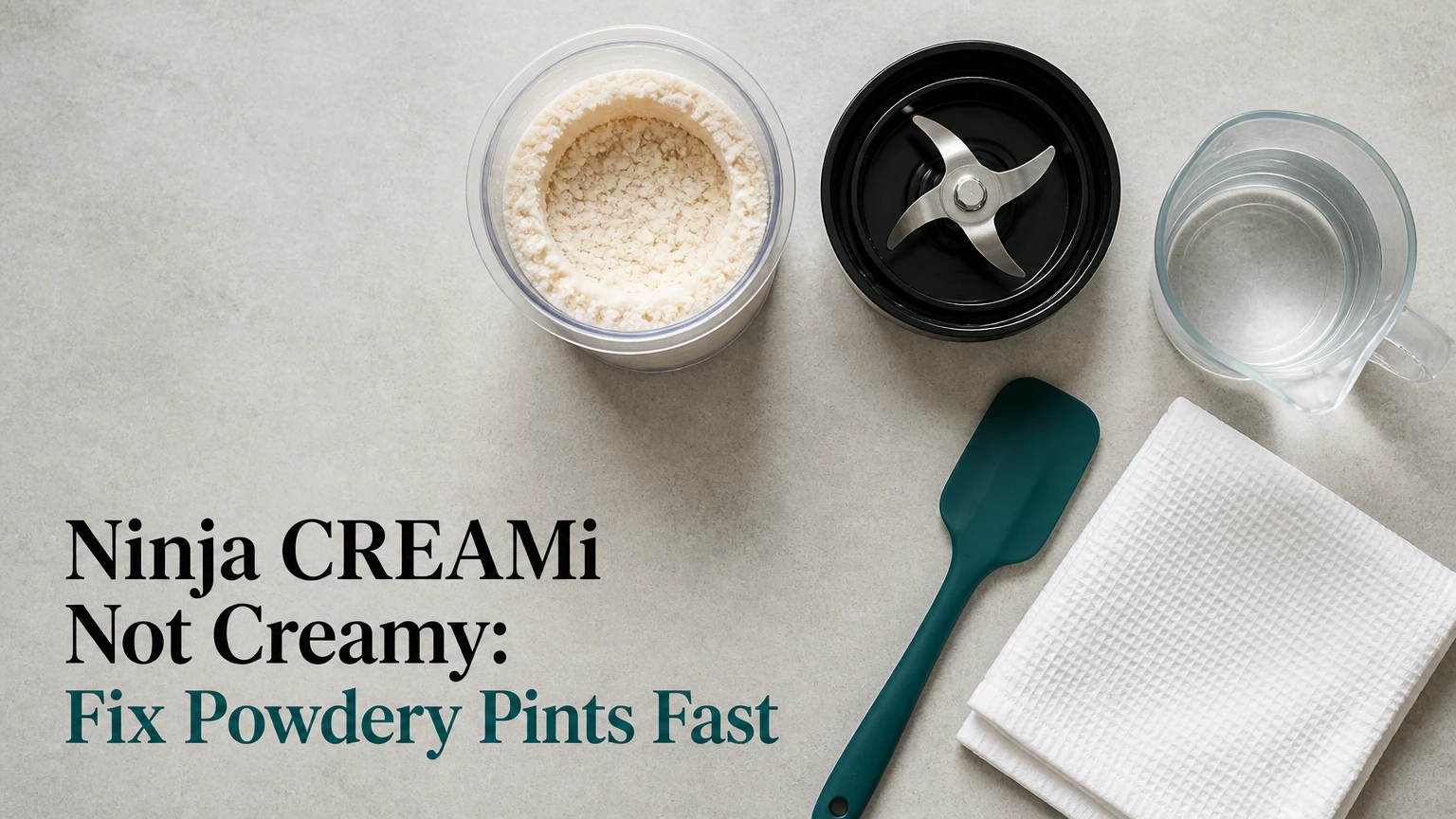
Ninja Creami not creamy results usually come from a frozen base that lacks enough liquid mobility, dissolved sugar, fat, or stabilizing solids to bind after the first pass. The dry snow-like texture is often normal for lean recipes and is usually corrected by adding 1-2 tablespoons of liquid, then running Re-Spin with the correct program.
Key Facts / Quick Answer
A powdery first spin does not usually mean the Ninja CREAMi is broken.
Dig a narrow center well, add 1-2 tablespoons of milk or another compatible liquid, and run Re-Spin.
Freeze the base level for a full 24 hours before processing.
Low-fat, sugar-free, and high-protein recipes need more formulation support than standard ice cream.
Erythritol can create a gritty texture because it recrystallizes; allulose or regular sugar generally produces a smoother result.
Do not process a frozen mound, overfill the pint, or use non-compatible containers.
What Does a Powdery Ninja CREAMi Pint Mean?
A powdery Ninja CREAMi pint contains finely milled frozen particles that have not yet formed a continuous, scoopable structure. The appearance resembles powdered snow or damp chalk, while an icy pint contains larger translucent chunks and a gritty pint contains detectable crystals that remain after processing.
The distinction matters because each texture points to a different correction.
| Texture after first spin | Likely cause | Best first correction | Expected result |
|---|---|---|---|
| Dry powder or crumbs | Lean base, very cold pint, insufficient liquid | Add 1-2 tablespoons liquid and Re-Spin | Dense, spoonable texture |
| Large icy chunks | Uneven freeze, high water content, hard perimeter | Level the base and Re-Spin | Fewer visible ice particles |
| Gritty or sandy texture | Erythritol or undissolved solids | Replace sweetener and blend base fully | Smoother melt |
| Greasy or waxy texture | Excess fat or poorly dispersed chocolate | Reduce fat or improve emulsification | Cleaner mouthfeel |
| Soupy edges with a hard center | Partial thaw or uneven freezer exposure | Refreeze level for 24 hours | More uniform processing |
In practice, many users mistake normal first-pass powder for a failed batch. A second pass changes the particle size and distributes the added moisture, but it cannot completely repair a recipe whose sweetener has crystallized or whose frozen base was never mixed evenly.
Is Powder After the First Spin Normal?
Powder after the first Ninja CREAMi spin is common, especially with protein shakes, skim milk, fruit purées, and low-sugar bases. The machine processes a solid block rather than churning a liquid, so some formulations need Re-Spin to develop their final consistency.
A normal powdery result should be evenly distributed and free of large hard chunks. If the blade stops, the outer bowl will not lock, the pint contains a frozen dome, or the machine produces unusual mechanical noise, stop processing and inspect the setup instead of repeatedly pressing buttons.
How Does the Ninja CREAMi Make a Frozen Base Creamy?
The Ninja CREAMi lowers a rotating processing blade into a completely frozen base and shaves material from the block. Unlike a compressor ice cream maker, it does not freeze and churn liquid ice cream simultaneously, so the recipe must be prepared and frozen before processing.
The practical sequence is:
- Blend or whisk the base until sweetener, protein, cocoa, and stabilizers are dispersed.
- Pour only to the model’s maximum-fill line.
- Freeze the pint on a level surface for at least 24 hours.
- Install the pint in the outer bowl with the paddle correctly seated.
- Select the program that matches the base.
- Run Re-Spin when the first pass remains powdery.
- Add mix-ins only after the base has reached a cohesive texture.
The blade does not create creaminess from water alone. Creaminess comes from a combination of small ice particles, dissolved solids, fat or emulsified ingredients, and enough unfrozen liquid to lubricate the mixture during the second pass. That is why a full-fat custard can become smooth immediately while a protein-and-water base may look like snow.
The exact motor speed and program duration vary by model and firmware. Published claims that assign one universal RPM to every Ninja CREAMi are unreliable because the Original, Deluxe, and Swirl machines use different containers and program systems.
Which Ninja CREAMi Model and Pint Does the Recipe Use?
The Original Ninja CREAMi generally uses a smaller pint than the Deluxe model, while Ninja CREAMi Deluxe uses a larger container and different program controls. Ninja CREAMi Swirl adds soft-serve functions, but model families should be treated as separate systems unless Ninja identifies an accessory as compatible.
| Model family | Typical pint capacity | Common program count | Primary distinction | Compatibility note |
|---|---|---|---|---|
| Original CREAMi | 16 ounces | 7 programs | Standard frozen desserts | Uses Original-series containers |
| CREAMi Deluxe | 24 ounces | 11 programs | Larger batches and split processing | Uses Deluxe-series containers |
| CREAMi Swirl | Model-specific | 13 programs | Soft-serve dispensing system | Uses listed Swirl accessories |
| Replacement pint | 16 or 24 ounces | Not applicable | Storage and batch rotation | Match capacity and model family |
Do not force a Deluxe pint into an Original machine or substitute a container because the dimensions look similar. A wrong bowl, lid, paddle, or outer-container combination can prevent the safety interlocks from engaging and may create an unsafe load.
Capacity also changes recipe proportions. A recipe designed for a 16-ounce pint should not automatically be scaled by volume to fill a 24-ounce container because the sugar, fat, and stabilizer ratios may no longer balance.
What Does a Ninja CREAMi Cost?
Typical United States retail pricing is approximately USD $180-$250 for an Original machine, USD $200-$300 for a Deluxe model, and USD $250-$350 for a Swirl model, depending on retailer, bundle, and promotion. Authentic replacement pints commonly cost about USD $20-$40 for a multipack.
| Ownership item | Typical USD range | Replacement interval | Cost implication |
|---|---|---|---|
| Original machine | $180-$250 | Several years with normal care | Lowest entry cost |
| Deluxe machine | $200-$300 | Several years with normal care | Larger batch capacity |
| Swirl machine | $250-$350 | Several years with normal care | Soft-serve capability |
| Replacement pint multipack | $20-$40 | As containers wear or multiply | Useful for batch rotation |
| Ingredient correction batch | $2-$8 | Per recipe attempt | Cheaper than discarding a pint |
Prices vary by country and retailer. The meaningful ownership cost is often the number of spare pints, because every base usually requires a full freeze before processing.
Why Is the Ninja Creami Not Creamy?
The most common reason a Ninja Creami is not creamy is an imbalanced base, particularly one with too much water and too little sugar, fat, soluble solids, or stabilizer. Freezer temperature, an uneven surface, an unsuitable program, and insufficient processing can amplify the same formulation problem.
Low-Fat and Low-Sugar Bases
Fat softens frozen texture and contributes lubrication, while dissolved sugar lowers the freezing point and limits the size of ice crystals. A skim-milk, water, or unsweetened almond-milk base has less protection against a hard, powdery freeze.
Low-calorie recipes can still work, but they need structure from ingredients such as Greek yogurt, milk powder, pudding mix, banana, allulose, or a measured stabilizer. Adding large quantities of xanthan gum is not a shortcut. More than about 1/4 teaspoon per standard 16-ounce pint can create a gummy or slippery mouthfeel.
High-Protein Recipes
Protein powder absorbs water and can make a base thick before freezing but dry after processing. Whey, casein, and plant proteins also behave differently, so a recipe that works with whey isolate may become pasty or chalky with pea protein.
A practical starting framework for one 16-ounce pint is:
| Base component | Typical quantity | Function | Adjustment signal |
|---|---|---|---|
| Milk or milk alternative | 10-14 fluid ounces | Water and liquid phase | Powder means add 1 tablespoon |
| Protein powder | 20-30 grams | Protein and flavor | Chalkiness means reduce or blend longer |
| Greek yogurt | 1/4-1/2 cup | Solids and acidity | Too tangy means reduce yogurt |
| Sweetener | 2-4 tablespoons sugar equivalent | Freezing-point control | Icy means increase dissolved sweetness |
| Stabilizer | 1/8-1/4 teaspoon xanthan gum | Water management | Gummy means use less |
This is a formulation starting point, not a universal recipe. Protein powders differ in sweetness, particle size, and thickening behavior.
Erythritol and Other Crystallizing Sweeteners
Erythritol may dissolve in a warm liquid yet recrystallize during freezing, producing a sandy or crunchy texture. That texture does not respond as reliably to Re-Spin as ordinary powder because the crystals remain physically present.
Allulose usually stays softer and less crystalline in frozen desserts. Sugar, dextrose, or a compatible monk-fruit blend can also work, but the sweetness and freezing behavior change with each substitution. Replace sweeteners by function, not by equal spoonfuls.
Freezer Temperature and Freeze Time
A pint should freeze level and solid for at least 24 hours. A household freezer commonly operates near 0°F, or -18°C, but actual temperature varies by shelf, door opening, frost buildup, and appliance calibration.
| Freeze condition | Typical time | Visible symptom | Corrective action |
|---|---|---|---|
| Fully level and solid | 24 hours | Uniform hard block | Process normally |
| Partially frozen | 8-16 hours | Soft center or sloshing area | Freeze longer |
| Very cold freezer | Below 0°F, or -18°C | Dense powder after first pass | Use Re-Spin and add liquid |
| Uneven shelf temperature | 24 hours or longer | Hard side, soft side | Move to a stable interior shelf |
| Repeated door exposure | 24 hours may be insufficient | Large crystals or frost | Extend freezing time |
A colder pint is not automatically defective. Colder blocks often need a second pass, especially when the base is lean, but thawing the pint excessively can produce a liquid perimeter and a hard core.
Which Program Should You Choose?
The correct Ninja CREAMi program depends on the base composition, not the flavor name. Standard Ice Cream suits a conventional dairy base, Lite Ice Cream suits many low-fat or reduced-sugar mixtures, and Sorbet suits fruit-forward bases without significant dairy fat.
| Base composition | First program to test | Re-Spin expectation | Common mistake |
|---|---|---|---|
| Cream, milk, sugar, egg or custard | Ice Cream | 0-1 passes | Using Lite for a rich base |
| Milk, yogurt, protein powder | Lite Ice Cream | 1-2 passes | Expecting first-pass scoopability |
| Fruit purée and sugar | Sorbet | 1-2 passes | Using Ice Cream for a water-heavy fruit base |
| Thick frozen yogurt base | Frozen Yogurt | 0-1 passes | Adding too much xanthan gum |
| Coffee or cocoa milk base | Ice Cream or Lite | 1 pass | Leaving cocoa clumps undispersed |
| Liquid cocktail-style mixture | Appropriate model program | Variable | Exceeding alcohol limits |
Program names and availability differ across models. Use the program listed in the manual for the specific machine, particularly for Deluxe and Swirl models.
How Do You Fix a Dry or Crumbly Pint?
The fastest repair is to add a small amount of compatible liquid to the center, then run Re-Spin. Start with 1 tablespoon for a slightly dry pint and use 2 tablespoons when the mixture remains loose powder across the entire surface.
- Remove the pint from the outer bowl after the first cycle.
- Check for large frozen chunks, a central hole, or an uneven frozen dome.
- Make a narrow well from the center toward the bottom using a spoon.
- Add 1-2 tablespoons of milk, cream, plant milk, water, or the original shake.
- Reinstall the pint and outer bowl according to the manual.
- Press Re-Spin once.
- Stop and inspect the texture before adding more liquid.
- If needed, add 1 tablespoon and run a second Re-Spin.
The added liquid should match the recipe. Water works for many fruit or protein bases, while milk, cream, or a plant alternative preserves a dairy-style flavor. Adding too much at once creates a melted ring around a still-frozen center and can make the finished dessert soupy.
Expert insight: A center well is more effective than pouring liquid across the top because the blade’s processing path reaches the added moisture throughout the frozen column. Pouring only around the edge can leave a dry core and a watery perimeter.
Should You Thaw the Pint Before Processing?
A short rest of about 5-15 minutes can soften a very hard pint, but full thawing is not a substitute for correct freezing. The pint should remain substantially frozen so the blade can process a stable block rather than push liquid around the container.
Running warm water over the outside wall for approximately 20-40 seconds may loosen ice attached to the perimeter. Keep water away from the lid, top opening, electrical parts, and machine body. Do not microwave the pint or pour hot liquid directly onto the frozen dessert.
Can You Re-Spin More Than Once?
You can usually run Re-Spin a second time when the dessert remains powdery, provided the bowl is correctly installed and the mixture is not already melted. Each pass adds friction and redistributes moisture, but repeated cycles cannot fix large sweetener crystals, a badly separated base, or an unsafe frozen mound.
How Do You Prevent Icy Edges and Frozen Humps?
A level frozen surface gives the processing blade a predictable starting path. Freeze the pint uncovered or covered according to the manufacturer’s instructions, keep it upright, and avoid creating a raised dome that can impose uneven resistance on the paddle.
| Preparation step | Target condition | Why it matters | Failure consequence |
|---|---|---|---|
| Fill level | Below the maximum line | Leaves expansion space | Overflow or poor circulation |
| Surface | Flat and horizontal | Keeps blade engagement even | Chunky or uneven texture |
| Container position | Upright | Prevents slanted freezing | One-sided hard section |
| Freeze location | Interior shelf | Reduces temperature swings | Larger ice crystals |
| Mix-in size | Small pieces under manual limit | Prevents blade obstruction | Damage or incomplete mixing |
Freeze the base before adding cookies, nuts, chocolate chunks, or candy. Hard inclusions can interfere with the paddle and may damage the machine. Use the Mix-In function only after the main frozen dessert has been processed.
Expert insight: The top surface is not cosmetic. A hump changes the blade’s initial load, while a shallow depression can leave an unprocessed ring. Level the pint before freezing by placing it on a stable shelf and checking the liquid surface from the side.
What Happens If You Refreeze a Processed Pint?
A processed Ninja CREAMi dessert can be refrozen, but it will usually become harder and lose the texture produced during the first processing cycle. Before serving the leftovers, let the pint rest briefly, then run Re-Spin to restore cohesion.
Refreezing works best when the mixture is returned to the pint with the surface leveled. Do not refreeze a pint that has sat at room temperature for an extended period, especially if it contains dairy, egg, or other perishable ingredients.
| Storage situation | Recommended action | Texture expectation | Food-safety concern |
|---|---|---|---|
| Freshly processed leftovers | Level and freeze promptly | Harder after refreezing | Low if handled cleanly |
| Refrigerated overnight | Refreeze or consume soon | May separate slightly | Keep refrigerator at 40°F or below |
| Melted on the counter | Do not repeatedly refreeze | Icy and unstable | Increased bacterial growth risk |
| Partially used pint | Cover and freeze level | Edge frost possible | Avoid contaminated utensils |
| Mix-in-heavy pint | Re-Spin carefully | Uneven pieces possible | Inspect for hard fragments |
The Creami does not create a permanently scoopable product in the way some high-fat commercial ice creams do. Low-sugar recipes especially need reprocessing after storage.
Ninja CREAMi Versus Other Frozen-Dessert Machines
The Ninja CREAMi is strongest when you want to process one frozen pint at a time, customize protein or low-fat recipes, and accept a 24-hour preparation window. Compressor machines are better for immediate batches, while blenders are faster for soft frozen fruit but provide less control over a solid dairy-style base.
| Feature | Ninja CREAMi | Compressor machine | Freezer-bowl churner | High-speed blender |
|---|---|---|---|---|
| Starting state | Frozen base | Liquid base | Chilled liquid base | Frozen fruit or cubes |
| Preparation time | 24-hour freeze | About 20-40 minutes | Bowl freeze, often 12-24 hours | 5-10 minutes |
| Best batch size | 16 or 24 ounces | 1-2 quarts | 1-2 quarts | 1-4 servings |
| Low-calorie performance | Strong after Re-Spin | Often icy | Recipe-dependent | Strong for fruit |
| Leftover texture | Usually hardens | Rich recipes stay softer | Often hardens | Becomes firm and icy |
| Typical USD price | $180-$350 | $250-$700 | $50-$200 | $80-$600 |
The Creami is not ideal when you need several quarts immediately or when you dislike planning a day ahead. Its advantage is processing flexibility: a frozen base can be tailored after preparation with a small liquid correction.
What Are the Most Common Setup Mistakes?
Most failed batches trace to one of five controllable errors:
- Freezing for less than 24 hours.
- Filling above the maximum line.
- Freezing on a slanted or unstable surface.
- Choosing a program unrelated to the base.
- Adding large, hard mix-ins before the main cycle.
A sixth mistake is changing several variables at once. If a protein pint is powdery, first record the program and freeze time, then add 1 tablespoon of liquid and Re-Spin. If the next batch also fails, change the sweetener or protein quantity rather than guessing at multiple ingredients.
Expert insight: Re-Spin is a texture correction, not a recipe correction. It can redistribute moisture and reduce particle size, but it cannot dissolve crystallized erythritol or compensate for an overfilled container.
Why Is the Pint Still Not Creamy After Re-Spin?
If Re-Spin does not produce a creamy texture, identify whether the problem is water, crystals, formulation, or equipment. The symptom after the second pass is more useful than the first-pass appearance.
| After Re-Spin | Most probable diagnosis | Next batch adjustment | Do not do |
|---|---|---|---|
| Still dry powder | Base is too lean or under-hydrated | Add 1-2 tablespoons liquid before freezing | Add a large quantity at once |
| Crunchy grains | Sweetener crystallization | Replace erythritol with allulose or sugar | Keep repeating Re-Spin |
| Large ice shards | Uneven freeze or high free water | Blend base and freeze level | Process a visible frozen dome |
| Thick gumminess | Excess xanthan or pudding mix | Reduce stabilizer by half | Add more liquid blindly |
| Watery melt | Too much correction liquid | Reduce added liquid to 1 tablespoon | Run multiple cycles while soupy |
| Same failure across recipes | Setup or machine issue | Check paddle, bowl, and model instructions | Force an incompatible container |
Inspect the paddle for residue, confirm that the paddle is seated correctly, and check that the outer bowl locks into the machine. If multiple balanced recipes fail with unusual noise, burning odor, blade movement problems, or repeated error messages, stop using the appliance and contact SharkNinja support.
How Can You Build a More Reliable Creami Base?
A reliable base balances water with dissolved solids and texture-forming ingredients. Blend the ingredients completely, taste the liquid before freezing, and make only one deliberate adjustment after the first test pint.
For a conventional dairy pint, use milk or cream, a measured sweetener, and optional yogurt or pudding mix. For a protein pint, combine 10-14 ounces of liquid with 20-30 grams of protein powder and enough sweetener to avoid an ice-block texture. For fruit sorbet, blend fruit with dissolved sugar or allulose and expect one or two processing passes.
Avoid treating every plant milk as interchangeable. Unsweetened almond milk is low in solids, oat milk contains more carbohydrate and body, and canned coconut milk contributes substantial fat. Those differences alter both freezing behavior and the amount of correction liquid required.
A small amount of instant pudding mix can improve body because its starches and stabilizers bind water. Use approximately 1 tablespoon per standard pint as a starting point, then reduce it if the result becomes pasty. Xanthan gum should be weighed or measured carefully because a small excess is noticeable.
Frequently Asked Questions About ninja creami not creamy
Can I use water to fix a powdery Creami pint?
Water can fix a powdery pint when the recipe needs additional free liquid, particularly for fruit or low-calorie bases. Add 1 tablespoon to the center well and run Re-Spin. Milk, cream, or the original shake is usually preferable when flavor, protein, or richness must remain unchanged.
Why is my Creami mixture wet around the edges?
Wet edges usually indicate partial thawing, uneven freezing, or warm water applied too aggressively. A hard center with liquid around the perimeter should not receive repeated processing immediately. Freeze the base level again when necessary, and limit any counter rest to roughly 5-15 minutes.
Can I process a pint without freezing it for 24 hours?
Processing before a full 24-hour freeze can create an uneven block with a soft center and hard exterior. The blade may produce inconsistent texture because it encounters different resistance through the pint. Unless the model’s instructions specify otherwise, freeze the prepared base solid for 24 hours.
Why does protein ice cream taste chalky?
Protein ice cream tastes chalky when the powder concentration is high, the protein is poorly hydrated, or the base lacks enough sweetener and fat to soften its perception. Blend the powder fully, test 20-30 grams per 16-ounce pint, and use a second Re-Spin with 1 tablespoon of liquid.
Can I add cookie pieces before the first spin?
Do not add hard cookie pieces, nuts, candy, or chocolate chunks before the main processing cycle. Process the frozen base first, then make a small well and use the Mix-In function with pieces that fit the model’s instructions. This protects the paddle and distributes inclusions more evenly.
How long does a processed Creami pint stay creamy?
A processed pint is usually creamiest immediately after processing. Once refrozen, it commonly becomes firm and needs Re-Spin before serving, especially when the recipe is low in fat or sugar. Level the surface before storage and return the pint to the freezer promptly.
Conclusion: Fix the Base, Then Re-Spin
When a Ninja Creami not creamy result appears, diagnose the texture before changing the recipe. Add 1-2 tablespoons of compatible liquid to a center well, use Re-Spin, and verify that the pint froze level for 24 hours. If the result remains gritty or chalky, correct the sweetener, protein load, or stabilizer instead of relying on repeated cycles.