

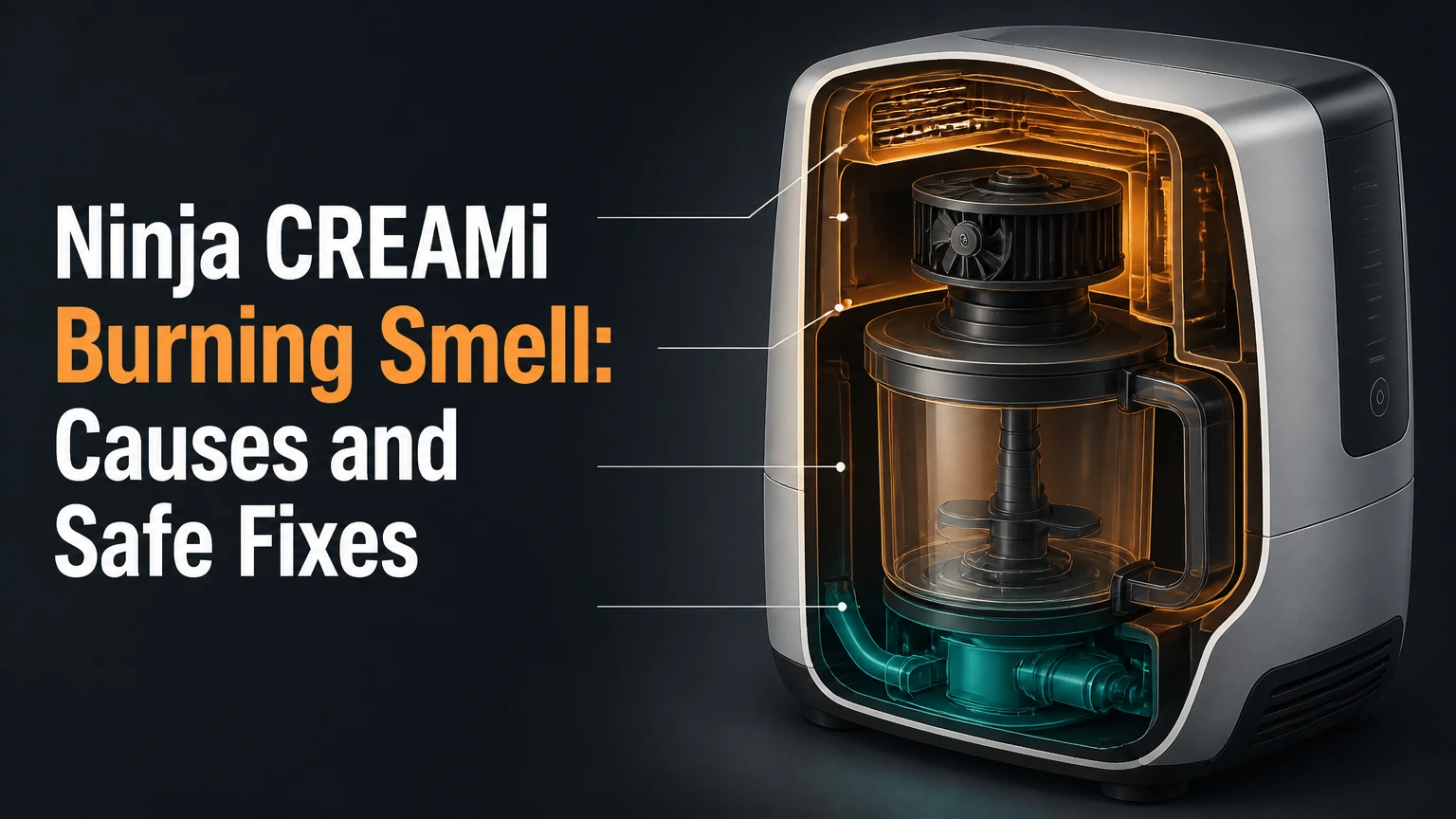
A Ninja CREAMi burning smell usually indicates either a temporary new-motor odor or excessive load, friction, or electrical overheating. The Creamerizer paddle drives downward into a frozen mixture, so a hard, uneven, overfilled, or obstructed pint can strain the drive system. Sparks, smoke, melting plastic, repeated shutdowns, or a strong electrical odor require immediate unplugging and service.
Key Facts / Quick Answer
A faint odor from a new Ninja CREAMi may fade during the first several uses, but smoke, sparks, or a worsening smell is not a normal break-in symptom.
Unplug the base immediately, let it cool for at least 30 minutes, and do not restart it until the paddle, pint, lid, vents, and cord are inspected.
Never process a solid frozen block, exceed the pint’s MAX FILL line, or add hard pieces before the initial program.
A burnt-rubber odor with scraping often points to paddle, lid, or shaft interference rather than the frozen dessert itself.
If the smell returns with a properly prepared pint, stop testing and contact Ninja Support, especially while the one-year limited warranty may apply.
Do not pour water into the motor base or cut the power cord unless Ninja gives model-specific written or recorded instructions.
Why Does a Ninja CREAMi Smell Burnt?
A Ninja CREAMi smells burnt when heat from motor overload, electrical components, or mechanical friction produces an odor stronger than the normal food aroma. The machine’s vertical drive applies force to a semi-solid frozen pint instead of spinning a liquid around a submerged blade, making preparation, alignment, and clearance unusually important.
The appliance contains a motor, drive spindle, paddle, lid assembly, pint container, and electrical controls. During a program, the spindle lowers the paddle through the frozen mixture. Resistance rises sharply when the contents are rock-hard, frozen at an angle, packed above the fill line, or contaminated with hard inclusions.
Ninja’s owner guidance uses a simple safety principle: “Do not process a solid block of ice.” That instruction matters because a frozen dessert base can become functionally solid if it freezes unevenly or contains too little liquid. A normal cycle should not require the motor to force the paddle through an immovable mass.
A brief new-electronics odor can occur as manufacturing residues and motor materials warm during initial operation. However, “new” does not mean unlimited. A smell that becomes stronger, appears with smoke, or returns after the machine has been used normally should be treated as a fault.
Burning Odor Types and Their Likely Meaning
The odor alone cannot identify the failed component. Sound, indicator lights, visible residue, and whether the smell comes from the pint or base provide better diagnostic evidence.
| Smell or symptom | Most likely area | Safe interpretation | Immediate action |
|---|---|---|---|
| Faint plastic or electronics odor, first 1-8 uses | New motor or internal materials | Possible break-in odor if no heat, smoke, or abnormal noise occurs | Ventilate, monitor, stop if it intensifies |
| Burnt rubber or tire-like smell with scraping | Paddle, lid, spindle, or shaft | Mechanical contact or food residue may be creating friction | Unplug, remove assembly, inspect clearance |
| Acrid electrical smell with flashing controls | Motor, control board, or wiring | Overload protection or electrical overheating is possible | Unplug for 30 minutes; do not repeat test if odor returns |
| Burnt metal smell, sparks, smoke, or melted plastic | Drive mechanism or electrical fault | Unsafe failure condition, not routine operation | Disconnect power if safe, leave unplugged, contact support |
What Should You Do When It Smells Like Burning?
When a Ninja CREAMi produces a burning odor, stop the program, unplug the base, and allow at least 30 minutes for cooling before inspection. Do not immediately run another cycle to “see whether the smell clears.” Repeated testing can worsen a damaged motor, drive spindle, connector, or control board.
Follow this order:
- Press the power button and unplug the base. Pull the plug, not the cord. If smoke or flames are present, move away and use an appropriate fire response; never pour water onto an energized appliance.
- Leave the base untouched for 30 minutes. A longer cooling period is sensible if the housing is hot, the motor stopped mid-cycle, or the room is warm.
- Remove the outer bowl and pint only after the machine is safe to handle. Do not force a locked paddle or twist a hot assembly.
- Inspect the paddle and paddle shaft. Look for dried food, cracking, wobble, scraping marks, melted plastic, or a seal that has shifted.
- Check the pint. Confirm that the contents are below MAX FILL, frozen level, and free of large hard pieces.
- Inspect airflow and the power cord. Dust, fabric, countertop clutter, discoloration, or a damaged plug can create additional risk.
- Record evidence. Photograph the model label, error lights, damaged parts, and pint condition before cleaning or disassembly.
- Choose one controlled next step. Clean and prepare a new pint only when there is no visible damage or electrical odor. Otherwise, contact Ninja Support.
The safest diagnostic rule is conservative: a faint odor without symptoms may justify observation, but a strong odor with a symptom justifies service. Cooling is not a repair.
Stop Using the Machine Immediately If
- Smoke, sparks, flame, or visible arcing appears.
- The base, cord, plug, paddle, or lid shows melting or dark electrical marks.
- The smell resembles burning wiring or an acrid circuit-board odor.
- The paddle drops sideways, wobbles, jams, or scrapes the lid.
- The motor hums without turning, repeatedly stops, or produces a new grinding sound.
- The odor returns after a correctly filled, properly prepared pint.
- The housing becomes unusually hot or the power outlet trips.
How Do Frozen Pints Overload the Motor?
Frozen pint hardness is the most common user-controlled load factor. A Ninja CREAMi base must drive the paddle downward through the mixture, so a level, fully frozen base with enough liquid softens more predictably than a tilted or dehydrated block.
The pint should freeze on a level surface for the time specified by the model’s instructions, commonly about 24 hours. Freezing at an angle creates a high ridge that the paddle encounters first. That ridge can increase vibration, leave an unmixed section, and raise the mechanical load.
Do not use a hot tap as a routine softening method. Rapid external heating can create a warm shell around a frozen center, and the manufacturer’s preparation instructions should take priority. If the manual for your model permits tempering, follow its stated time and method. A typical cautious range is 5-15 minutes at room temperature, not prolonged warming.
Overfilling creates a second problem. As the paddle descends, material above the intended level can press into the lid or paddle path. The MAX FILL line is a mechanical clearance limit, not a recipe suggestion.
| Preparation condition | Typical result | Motor effect | Corrective action |
|---|---|---|---|
| Level pint frozen about 24 hours | Even resistance | Normal processing load | Process on the recommended program |
| Pint frozen at an angle | Hard ridge and vibration | Intermittent high load | Re-level and refreeze the base |
| Contents above MAX FILL | Lid or paddle interference | Increased friction and possible jamming | Remove excess before processing |
| Very low-moisture base | Powdery, dense mass | High downward resistance | Use the recipe’s specified liquid and fat |
| Whole hard nuts, candy, or ice pieces | Localized impact resistance | Paddle shock and possible damage | Add approved mix-ins after the first spin |
Why Does the Paddle Need a Properly Prepared Base?
The Creamerizer paddle is designed to shave and mix a frozen base, not break large ice blocks or crush hard candy. A smooth, level surface distributes resistance across the paddle’s path, while a ridge or isolated hard object concentrates force at one point.
In practice, many apparent motor problems begin as preparation problems. A low-sugar, low-fat, high-water mixture can freeze harder than a standard ice-cream base even when the pint looks normal. Protein powders and some dairy-free formulas can also freeze dense or crumbly, so recipe composition affects machine load.
A crumbly result after the first cycle does not automatically mean the machine is defective. Use the prescribed Re-spin function only when the mixture is safe and the machine has not displayed overheating symptoms. Use Mix-In after the base has been processed, not before, unless the model’s recipe instructions explicitly allow the ingredient.
Could Cleaning Cause a Burnt-Rubber Smell?
Food residue around the paddle shaft, lid underside, or spindle can create friction and transfer a rubber-like odor. Cleaning can remove this cause, but the motor base must remain dry because water inside the housing can create an electrical hazard.
Unplug the appliance before cleaning. Wash removable parts according to the model manual, use a soft brush around the paddle shaft, and inspect the underside of the lid for dried mix. Do not use a knife to scrape the spindle, immerse the base, or apply lubricant unless Ninja specifically identifies an approved product.
Pay special attention to the interface where the paddle meets the lid. A small amount of dried mixture can harden into a ring, preventing smooth movement. A damaged O-ring or seal may also produce rubbing, but replacing a seal will not correct a bent spindle or failing motor.
| Inspection point | What to look for | Cleaning method | Replace or service when |
|---|---|---|---|
| Paddle shaft | Dried mixture, wobble, cracks | Warm water and soft brush on removable part | Shaft is bent, loose, or heat-discolored |
| Lid underside | Food ring, scrape marks, warped plastic | Hand wash or approved dishwasher cycle | Lid is warped or paddle contacts it |
| Drive spindle | Residue, lateral movement, dark marks | Dry cloth only on base-side area | Spindle wobbles or shows melted plastic |
| Base vents | Dust, blocked openings, fabric contact | Unplugged dry brush or vacuum exterior | Housing is scorched or airflow remains blocked |
| Power cord and plug | Cuts, discoloration, looseness | Visual inspection only | Any damage, heat mark, or outlet arcing |
Airflow and Countertop Placement
The motor base needs unobstructed ventilation during a demanding cycle. Keep vents away from walls, towels, paper, and appliances that radiate heat. Do not operate the unit inside a cabinet, on a soft mat that covers openings, or beside a sink where splashes can reach the base.
A clean vent cannot compensate for a failing motor. Ventilation is a prevention measure for heat accumulation, not evidence that an electrical odor is harmless.
What Do Flashing Lights, Humming, or Grinding Mean?
Flashing Power and Re-spin indicators can accompany an overload or interrupted cycle, but the exact light pattern depends on the CREAMi model. Indicator behavior should be interpreted with the owner’s manual rather than treated as a universal diagnostic code.
| Observed behavior | Likely category | What it tells you | Next decision |
|---|---|---|---|
| Motor stops and controls flash | Overload or program interruption | Load or assembly may be outside normal conditions | Unplug, cool, inspect pint and paddle |
| Loud hum with little movement | Jam or drive resistance | Motor is energized but cannot move normally | Stop; do not hold the button down |
| Scraping or grinding | Mechanical interference | Paddle, lid, spindle, or frozen ridge may contact | Inspect for marks and misalignment |
| Repeated clicking or power loss | Electrical protection or outlet issue | Unit may be tripping protection | Test outlet with another appliance, then contact support |
| Normal sound but persistent electrical smell | Internal heating | Noisy failure is not required for an electrical fault | Keep unplugged and request service |
The mistake most people make is separating the smell from the event that caused it. A smell after a loud scrape is not the same problem as a smell after ordinary operation. Note the sequence, duration, program, pint recipe, and indicator behavior for support.
Can You Safely Test the Creami After Cooling?
A cooled appliance may be tested only when there is no smoke, visible damage, abnormal sound, damaged cord, or strong electrical odor. The first test should use a properly prepared pint and one standard program, never an empty cycle or a deliberately hard mixture.
An empty run does not reproduce the normal load and can provide false reassurance. Conversely, repeating several programs on the same dense pint can turn a minor overload into a damaged drive system.
Use this controlled test:
- Confirm that the removable parts are clean, dry, correctly seated, and undamaged.
- Prepare a new pint below MAX FILL and freeze it level according to the manual.
- Allow any model-permitted tempering period, then install the pint and lid squarely.
- Select the program that matches the recipe, rather than repeatedly using Re-spin.
- Stay beside the machine and stop it if the odor, sound, vibration, or heat changes.
- Unplug it after the cycle and compare the result with the previous symptom.
- Stop permanently if the smell reappears, even if the dessert texture is acceptable.
A successful quiet cycle does not prove that an earlier electrical smell was harmless. It only shows that the machine completed one supervised load without reproducing the symptom.
How Does the Creami Compare With a Blender?
A Ninja CREAMi processes a frozen semi-solid block with a vertically driven paddle, while a blender normally circulates liquid ingredients around rotating blades. That difference makes the Creami more sensitive to frozen-pint hardness, level, fill height, and paddle clearance than a standard liquid-processing appliance.
| Appliance | Main load | Processing state | Typical overload trigger | Best alternative use |
|---|---|---|---|---|
| Ninja CREAMi | Downward paddle resistance | Frozen pint | Hard ridge, overfill, dense base | Frozen dessert texture |
| Countertop blender | Blade torque and circulation | Liquid or soft ingredients | Thick paste, trapped air, hard ice | Smoothies and liquid bases |
| Food processor | Horizontal blade resistance | Chopped or semi-soft food | Dense dough, large hard pieces | Chopping and mixing |
| Freezer-bowl churner | Scraper rotation against freezing mix | Liquid mix freezing gradually | Over-frozen bowl or stalled dasher | Traditional churned ice cream |
| Compressor ice-cream maker | Dasher plus active refrigeration | Liquid mix freezing in place | Thick mix or mechanical wear | Continuous batch processing |
A blender is not a drop-in substitute for the Creami’s texture. Blending a fully frozen block can also overload a blender, damage blades, or produce an uneven mixture. The alternative reduces one type of mechanical load only when the food state matches the appliance.
Traditional churners usually avoid forcing a paddle downward into an already solid block because the mixture freezes while the dasher moves. They still have their own risks, including scraper contact, bowl damage, and motor strain from an overly thick mix.
What Does Repair or Replacement Usually Cost?
Repair economics depend on the failed part, model, age, and warranty status. Small removable components may cost roughly USD 2-5 for an aftermarket seal, while a replacement pint or paddle commonly costs about USD 15-40; a base-unit replacement can approach the price of a new appliance.
These are typical retail ranges, not a Ninja service quotation. Genuine parts, shipping, model compatibility, and regional pricing can change the total. A low-cost O-ring is not an appropriate substitute for a warped lid, damaged spindle, or electrical failure.
| Repair path | Typical USD cost | Typical time | Appropriate when |
|---|---|---|---|
| Cleaning and inspection | USD 0-15 | 20-45 minutes | No visible damage and odor does not return |
| Replacement seal or small gasket | USD 2-5 aftermarket | 10-30 minutes | Seal is worn and model compatibility is confirmed |
| Replacement pint or paddle | USD 15-40 | 5-15 minutes | Removable part is cracked, warped, or damaged |
| Authorized service or shipping | USD 30-100 typical out of warranty | 1-4 weeks | Base requires diagnosis or repair |
| Replacement base or new unit | USD 120-180 typical retail | 1-7 days | Electrical or drive failure is uneconomical to repair |
Do not open the base while warranty coverage may apply. Internal disassembly can create a safety hazard and may complicate a warranty claim.
Warranty and Support Documentation
Many Ninja CREAMi units are sold with a one-year limited warranty, but coverage, exclusions, registration rules, and regional terms vary by model and country. Confirm the exact warranty document for the model number on the rating label rather than relying on a generic online statement.
Before contacting Ninja Support, prepare:
- Model and serial information from the appliance label.
- Purchase date, retailer, and receipt.
- A description of the smell, sound, program, and duration.
- Photos of the paddle, lid, pint, cord, and any marks.
- A short video of the indicator behavior if the machine is safe to operate.
- The recipe, fill level, freezing duration, and whether the pint froze level.
Support may offer a replacement, request photographs, ask for a video call, or direct you to a disposal procedure. Never cut the power cord or destroy the appliance merely because an internet post says that step is required. Obtain model-specific instructions directly from Ninja and follow the stated safety process.
How Can You Prevent Motor Overheating?
Preventing overload starts with the pint, not with longer cooling intervals. Use the correct recipe consistency, freeze the container level, stay below MAX FILL, clear the paddle after each use, and allow the base to cool between demanding cycles.
A five-minute pause between consecutive programs is a practical minimum often recommended in user guidance, but it is not permission to continue after a burning smell. The symptom overrides the schedule. A machine that smells hot needs diagnosis, not a shorter workload interval.
Use this operating checklist:
- Freeze the pint level for the period stated by the model manual, commonly about 24 hours.
- Keep the mixture below MAX FILL and remove any frozen overflow from the rim.
- Avoid large ice cubes, unsoftened candy, whole nuts, and other hard pieces during the initial spin.
- Use Mix-In after the base cycle for ingredients designed to remain in pieces.
- Do not process a completely solid block of ice.
- Keep the vents clear and the base dry.
- Wash and dry the paddle, lid, and container after use.
- Do not run repeated Re-spin cycles when the base is unusually dense.
- Stop when the machine sounds different from its normal operating pattern.
- Store removable parts dry to reduce residue and odor around seals.
An important counterintuitive point is that thawing is not always the fix. If the pint is frozen at an angle, thawing the surface may leave a hard internal ridge while making the outer food unsafe to hold at room temperature. Re-leveling and refreezing the base is often more reliable than trying to soften a defective pint quickly.
When Is the Smell a Food Problem Instead?
A smell from the pint can come from scorched ingredients, rancid fat, protein powder, or a contaminated container rather than the motor. A food-origin odor usually stays strongest at the pint and resembles the ingredient, while an electrical odor remains acrid near the base, cord, or vents.
Discard the batch if it tastes burnt, contains melted plastic, or was exposed to smoke or debris. Do not taste a mixture that may have contacted damaged electrical or melting plastic components.
Food safety also limits troubleshooting. A frozen dessert base should not remain warm for extended periods while users repeatedly attempt cycles. If the pint has thawed substantially, follow local food-safety guidance and discard ingredients that have been held in unsafe conditions.
New-Machine Smell Versus Fault Odor
A break-in smell is generally faint, short-lived, and unaccompanied by malfunction. It should diminish rather than intensify. There is no reliable universal use count for every CREAMi generation, so “the first 8-10 uses” is a practical user report, not a safety guarantee.
Treat the smell as abnormal when it is strong enough to irritate, persists beyond early operation, appears during every cycle, or accompanies heat, noise, flashing lights, smoke, or a trip at the outlet.
Frequently Asked Questions About ninja creami burning smell
Is it safe to use a Ninja CREAMi that smells like burning plastic?
A faint odor during initial use may be monitored only if the machine operates normally and shows no heat, smoke, noise, or visible damage. A strong or recurring plastic smell means the appliance should remain unplugged until Ninja Support or a qualified service provider evaluates it.
How long should a frozen pint sit out before spinning?
Use the time and method specified in your model’s manual. A typical room-temperature tempering period is 5-15 minutes when permitted, but do not use prolonged warming or a hot-water shortcut to compensate for an uneven or rock-hard pint. Re-leveling and refreezing is safer for a defective base.
Why does the Creami smell after making protein ice cream?
Protein-heavy and low-sugar recipes can freeze dense, dry, or unusually hard, increasing paddle resistance. The recipe may therefore strain the motor even when the container is not overfilled. Add enough approved liquid, freeze level, and stop immediately if the odor is electrical or returns with a normal recipe.
Can a dirty paddle make the machine smell like burnt rubber?
Yes. Dried food near the paddle shaft or lid can cause rubbing and a burnt-rubber odor, especially when scrape marks appear. Unplug the base, wash the removable paddle and lid as directed, and replace damaged parts. Cleaning cannot correct a bent spindle or internal motor fault.
Should I replace the O-ring when the machine smells burnt?
Replace an O-ring only when inspection shows a worn, cracked, displaced, or rubbing seal and the odor is clearly mechanical. An inexpensive gasket cannot safely resolve smoke, sparks, melted plastic, an electrical smell, or a motor that repeatedly stalls. Those symptoms require service rather than a parts experiment.
Does a burning smell mean the Ninja CREAMi is recalled?
A smell alone does not establish a recall. Check the U.S. Consumer Product Safety Commission database, Ninja’s official safety notices, and the model and serial number on your unit. A recall notice, warranty bulletin, or support instruction takes priority over community troubleshooting advice.
Conclusion: Decide Whether to Clean, Cool, or Stop
A Ninja CREAMi burning smell can result from a short-lived new-machine odor, an overloaded frozen pint, paddle friction, or an electrical failure. The useful distinction is the symptom pattern: a faint fading odor without malfunction may be monitored, while smoke, sparks, melting, grinding, flashing controls, or a returning electrical smell means unplug the machine and request service.
Prepare level pints below MAX FILL, avoid solid frozen blocks, add hard ingredients only at the correct stage, keep the paddle and vents clean, and allow cooling between ordinary cycles. If the odor returns after those checks, do not keep testing. Document the event and contact Ninja Support while warranty protection may still apply.