

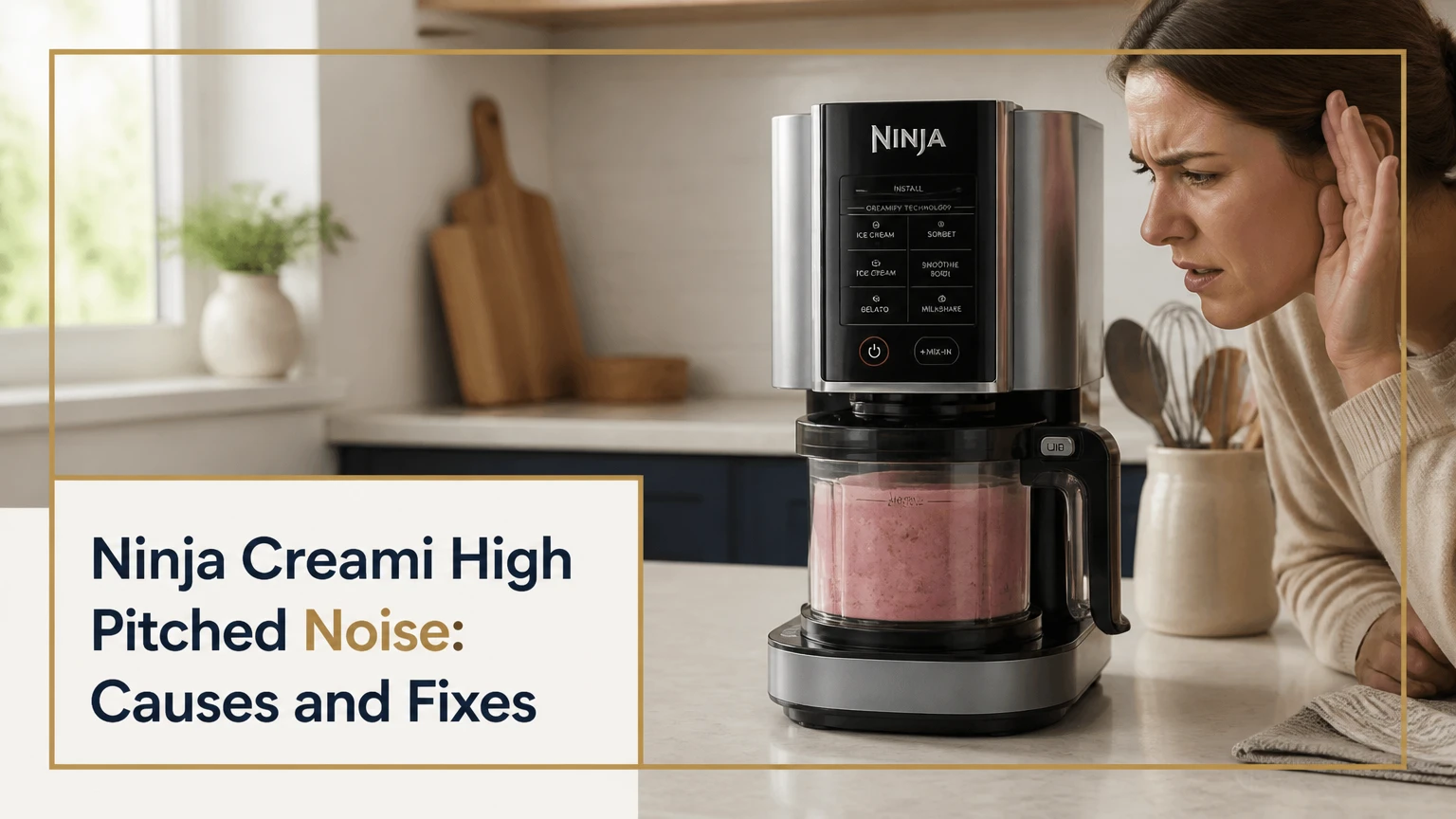
A Ninja Creami high pitched noise is usually the sound of its high-torque motor and Creamerizer paddle cutting through a dense frozen base. A loud whine is expected during a 1-2 minute cycle, but a new screech, grinding sound, burning odor, repeated stall, or visible wobble can indicate incorrect assembly, excessive hardness, or a damaged component.
Key Facts / Quick Answer
Normal Creami operation is commonly reported at approximately 71-81 dB, with some user measurements near 90 dB.
The Lite Ice Cream setting often sounds sharper because low-fat, low-sugar bases freeze harder.
Freeze the pint level and solid for at least 24 hours, then let it sit for about 10 minutes before processing.
Grinding, repeated clicking, paddle wobble, smoke, burning odor, and stalling are not normal operating sounds.
Never run a Creami with an unlocked bowl, a damaged pint, an improperly seated paddle, or a soft liquid base.
A one-year SharkNinja limited warranty commonly determines whether replacement is more sensible than repair.
What Causes the Ninja Creami High Pitched Noise?
The Ninja Creami makes a high-pitched sound because a fast-spinning paddle descends through a solid frozen pint rather than slowly churning liquid while it freezes. The motor encounters changing resistance as the blade shaves ice, and the bowl, paddle, spindle, and countertop can amplify different frequencies.
Traditional ice cream machines use a dasher that rotates through a partially frozen mixture. The Creami takes a different approach: the pint freezes first, then the Creamerizer paddle moves downward while rotating. That design creates a short, intense load instead of a quieter, longer churning period.
Recipe composition changes the load. A low-sugar protein mixture usually freezes harder than a full-sugar ice cream base because sugar depresses the freezing point. Fat also affects lubrication and texture. Water-heavy sorbet, skim-milk mixtures, and some high-protein bases may produce a sharper mechanical whine than a softer, richer base.
The setting matters as well. Lite Ice Cream and some sorbet cycles can sound more aggressive because the blade meets a harder surface. A re-spin may become quieter after the first pass, because the initial cycle breaks the frozen mass into smaller particles.
How Loud Is a Creami During Processing?
A Creami typically operates around 71-81 dB according to user measurements, while some reports describe short peaks near 90 dB. These figures are practical ranges rather than a universal manufacturer specification, because sound varies with model, recipe, countertop, microphone distance, and measurement device.
A smartphone decibel application is useful for comparing two cycles from the same location, but it is not a calibrated occupational sound meter. Place the phone roughly one metre from the machine, keep the room unchanged, and record the maximum and average readings separately.
| Sound reference | Approximate level | Practical interpretation |
|---|---|---|
| Quiet refrigerator | 40-45 dB | Normal background sound |
| Normal conversation | 60-65 dB | Noticeably quieter than a Creami cycle |
| Creami user reading | 71-81 dB | Typical reported operating range |
| Loud vacuum cleaner | 75-85 dB | Similar household sound |
| Reported Creami peak | Around 90 dB | Very loud, especially in a small room |
Noise exposure depends on both loudness and duration. A Creami cycle lasts only about 1-2 minutes, so occasional use differs from prolonged exposure near a loud machine. Hearing protection is reasonable for sensitive users, children nearby, or repeated batch preparation, but hearing protection does not correct a mechanical fault.
Expert insight: The highest reading is not always the most useful diagnostic signal. A machine that reaches 82 dB consistently may be healthy, while a machine that suddenly develops a narrow, piercing tone at a lower measured level can have a spindle or paddle problem.
Which Creami Sounds Are Normal?
A steady, powerful whir or high motor hum is normal when the Creami processes a properly frozen pint. A brief change in pitch is also expected as the paddle meets denser sections, but the sound should remain mechanically controlled and should not come with movement, odor, smoke, or repeated interruption.
The following sound categories help separate normal load from a likely problem:
- Steady whirring: Normal motor and paddle operation.
- Sharp high-pitched whine: Often associated with a hard base, especially Lite Ice Cream or low-sugar recipes.
- Brief squeal: May result from an uneven frozen surface, a slippery bowl, or vibration against the counter.
- Grinding: Suggests contact, misalignment, damaged plastic, or a distorted pint.
- Repeated clicking: May indicate a paddle, spindle, bowl, or locking mechanism issue.
- Pulsing or slowing: Indicates changing resistance, a hard obstruction, or motor strain.
- Rattle from above: Often points to a loose paddle or incorrectly installed drive assembly.
| Sound pattern | When it occurs | Likely explanation | Next action |
|---|---|---|---|
| Smooth whine | Entire 60-120 second cycle | Normal high-torque processing | Continue if assembly is secure |
| Pitch rises briefly | Dense section of pint | Uneven hardness or hard recipe | Stop and thaw longer if severe |
| Squeal at startup | First 5-15 seconds | Bowl vibration or paddle seating | Recheck bowl and paddle |
| Grinding throughout | Every cycle | Contact or misalignment | Stop and inspect components |
| Click every rotation | Repeated at steady intervals | Paddle or spindle damage | Do not continue processing |
| Whine plus burning odor | Mid-cycle or shutdown | Motor or electrical overheating | Unplug and contact Ninja |
A normal sound generally begins when the motor engages, rises under load, and ends when the cycle finishes. A defective sound often has a new onset, a repeating rhythm, or a physical symptom such as wobbling. Compare the same machine with an empty bowl only if the model’s instructions permit that test, and never improvise a test that defeats the safety interlock.
Why Does the Noise Change With the Recipe?
The recipe changes Creami noise by changing hardness, friction, and how evenly the frozen pint yields to the paddle. Low-sugar, low-fat, protein-heavy, and water-rich mixtures usually create more resistance than a sweet, higher-fat base processed after a short tempering period.
| Recipe condition | Typical frozen behavior | Noise tendency | Texture risk |
|---|---|---|---|
| Full-sugar ice cream base | Softer at freezer temperature | Lower, smoother whine | Melting if left out too long |
| Low-sugar base | Harder and less yielding | Sharper motor pitch | Crumbly first pass |
| Protein shake base | Dense, often low-fat | High whine or pulsing | Powdery or chalky texture |
| Fruit sorbet | Ice-rich and abrasive | Strong cutting sound | Iciness or uneven shaving |
| Partially frozen base | Soft or slushy | Irregular load | Poor processing and splashing |
| Base with a center hump | Uneven paddle contact | Squeal or vibration | Detached or stressed paddle risk |
A raised center is especially important. When a pint freezes with a hump, the paddle can strike the high point before it reaches the rest of the surface. The machine may sound strained even though the ingredients are otherwise safe.
Do not fill above the marked maximum line. Overfilling leaves insufficient clearance for the paddle and increases resistance. Do not add loose mix-ins before the main cycle unless the model and program specifically call for them. Add-ins belong in the designated mix-in step.
How to Reduce Creami Noise Safely
The most effective noise reduction steps are to freeze a level pint, temper it briefly, secure the bowl correctly, and reduce countertop vibration. Covers and mats can lower perceived sound, but they must not block vents, interfere with the paddle, or enclose a running motor.
Use this sequence before changing recipes or buying accessories:
- Inspect the frozen surface. If the pint has a pronounced hump, allow it to soften slightly and level the top carefully without introducing warm liquid.
- Confirm solid freezing. Freeze the pint for at least 24 hours in a freezer set near 0°F, or follow the model’s manual when its requirements differ.
- Temper the container. Let the pint stand for approximately 10 minutes at room temperature. Very hard bases may need a little longer, but do not allow the mixture to become liquid.
- Check the paddle. The Creamerizer paddle must be clean, undamaged, and fully seated in the outer lid.
- Lock the bowl. Twist the outer bowl into the base until the locking position is complete and the lid engages correctly.
- Place the machine on a stable surface. Use a rigid, level counter or a thin non-slip mat that does not obstruct ventilation.
- Select the appropriate program. Match the setting to the recipe instead of repeatedly using a harder cycle.
- Stop for abnormal symptoms. Unplug the unit if grinding, smoke, burning odor, or repeated stalling appears.
A damp towel can reduce sliding, but it is not a substitute for a stable counter and should not cover air openings. A quilted appliance cover such as a vented Kozie-style cover may reduce perceived noise during operation, yet any cover must remain clear of the motor vents and moving parts.
Expert insight: Tempering is a mechanical intervention, not merely a texture preference. Ten minutes can reduce the initial torque spike, but excessive thawing creates a different problem because a soft base can smear, splash, or process unevenly.
What Should You Inspect Before Using the Machine Again?
Inspect the Creamerizer paddle, outer lid, pint container, bowl locking points, and drive spindle before repeating a noisy cycle. The goal is to identify contact or misalignment without opening the motor housing, defeating an interlock, or continuing to test a potentially damaged unit.
Look for these specific conditions:
| Inspection point | Acceptable condition | Warning sign | Decision |
|---|---|---|---|
| Paddle blade | Straight, clean, firmly attached | Bent edge, crack, looseness | Replace or contact Ninja |
| Outer lid | No distortion or food buildup | Lid will not seat evenly | Clean and stop if still loose |
| Pint container | Round, intact, level base | Warping, cracks, deep scratches | Do not process that container |
| Outer bowl | Locks with normal movement | Excessive play or failed lock | Stop use |
| Spindle area | Clean and centered | Food residue, wobble, damage | Unplug and seek service |
| Countertop | Level and non-slip | Machine walks or vibrates | Relocate before use |
Clean dried mixture from the paddle and lid after every use. Sticky residue can prevent complete seating and cause the paddle to catch. Wash removable parts according to the manual, dry them fully, and keep water away from the motor base.
Third-party pints deserve caution. A container that appears compatible may have slightly different internal dimensions, wall thickness, or lid geometry. Those small differences can create wobble or paddle contact, so use the container specified for the exact Creami model.
When Is the Noise Unsafe?
A high-pitched motor sound becomes a stop-use issue when it is accompanied by smoke, a burning electrical smell, grinding, repeated stalling, visible wobble, liquid entering the base, or a paddle that does not remain secure. Unplug the machine, allow it to cool, and do not restart it to confirm the diagnosis.
Do not put fingers into the bowl or attempt to free a jam while the machine is connected to power. Do not lubricate the spindle with cooking oil, drill into the housing, or bypass the locking system. These actions can create electrical, mechanical, and food-safety hazards.
A short squeal caused by a sliding bowl is less concerning than a repeating metallic scrape. Sound location matters too: noise from the top assembly points toward the paddle or spindle, while a hot electrical odor from the base points toward the motor or control system.
How Long Should a Creami Cycle Run?
A standard Creami program commonly runs for approximately 1-2 minutes, although repeated re-spins and mix-in cycles can extend total preparation to about 6 minutes. A cycle that stops early, stalls repeatedly, or takes substantially longer than the selected program requires investigation.
| Operating event | Typical timeframe | What the user should observe |
|---|---|---|
| Initial processing cycle | 60-120 seconds | Strong, consistent motor sound |
| One re-spin | About 60-120 seconds | Lower resistance in many recipes |
| Mix-in cycle | Usually under 2 minutes | Short, controlled processing |
| Tempering before use | About 10 minutes | Firm base with softened edges |
| Minimum freezing period | At least 24 hours | Solid, level pint |
| Cooling pause after strain | 15-30 minutes | Motor and base return toward room temperature |
Repeated re-spins are not a solution for a machine that grinds or smells hot. They add motor time and can worsen a mechanical defect. If a properly frozen pint remains powdery, use the model’s recommended re-spin procedure and adjust the recipe rather than forcing more cycles.
Ninja Creami Versus Traditional Ice Cream Makers
The Ninja Creami trades a short, loud processing cycle for flexible preparation from a pre-frozen pint. Traditional slow churners usually make less abrupt noise but require a longer run and often need a compressor, a pre-frozen bowl, or a larger batch.
| Feature | Ninja Creami | Slow churner | Compressor maker |
|---|---|---|---|
| Typical processing time | 1-2 minutes | 20-40 minutes | 20-45 minutes |
| Sound profile | 71-81 dB commonly reported | Lower continuous hum | Compressor plus dasher noise |
| Freezing requirement | Pint frozen 24 hours | Bowl or mixture preparation varies | Usually no pre-freezing |
| Typical batch size | One pint, about 16 oz | 1.5-2 quarts | 1-2 quarts |
| Texture method | Shaves a frozen block | Churns while freezing | Churns while freezing |
| Best use | Small customized servings | Family-size batches | Frequent batch production |
The Creami is not ideal for users who need near-silent operation, large batches, or immediate processing from a liquid base. A compressor machine may fit that workflow better, while a slow churner may be preferable when lower sound matters more than speed.
What Does Repair or Replacement Usually Cost?
Warranty coverage should be checked before paying for a motor or spindle repair. SharkNinja products commonly include a one-year limited warranty, but eligibility depends on the model, purchase date, region, proof of purchase, and the nature of the fault.
| Decision path | Typical cost range | Typical timeframe | When it makes sense |
|---|---|---|---|
| Warranty evaluation | $0 if accepted | Several days to a few weeks | Mechanical fault within coverage |
| Replacement paddle | About $15-$40 | Days to several weeks | Paddle is worn or damaged |
| Replacement pint | About $10-$25 | Days to several weeks | Container is warped or cracked |
| Third-party repair attempt | About $30-$100 | 1-4 weeks | Only when warranty is unavailable |
| Refurbished replacement | About $20-$100 in reported deals | Immediate to 2 weeks | Repair cost approaches unit value |
| New replacement machine | About $150-$250, model dependent | Immediate to 2 weeks | Motor or base failure |
These are typical consumer price ranges, not a guaranteed SharkNinja price list. Parts availability and model compatibility change, and an apparently inexpensive refurbished listing may exclude accessories or carry limited coverage.
Document the serial number, purchase receipt, model name, sound recording, and exact symptom before contacting support. A video showing the installed paddle and the noise can help distinguish a recipe-load issue from a persistent mechanical fault.
Expert insight: A replacement paddle is a plausible fix for a damaged blade, but it is not a universal cure for grinding. If the noise remains with a new, correctly installed paddle and an approved pint, the bowl lock, spindle, or motor assembly becomes more likely.
Common Edge Cases That Mislead Users
Several situations make a healthy Creami sound defective or make a defective Creami seem normal. The most common mistake is judging noise without recording when it starts, what recipe is inside, and whether the machine physically moves.
A first-use machine may sound unusually loud because the owner expects blender-level noise. A previously quiet machine that suddenly screams deserves a different response. Changes in sound over time carry more diagnostic value than a single subjective description such as “jet engine.”
A basement or garage can also change the perceived volume. Hard walls reflect high frequencies, while a countertop can act as a resonator. Moving the unit to another room may reduce perceived loudness without reducing the sound produced at the motor.
Never process a base that is only chilled, partially frozen, or liquid. The Creami is designed around a solid frozen preparation, and using the wrong state can create poor texture, splashing, or an abnormal load.
Frequently Asked Questions About ninja creami high pitched noise
Is the Ninja Creami louder than a blender?
The Ninja Creami often sounds louder than a standard blender during its short cycle because its high-torque motor cuts through a solid frozen block. User measurements commonly place operation around 71-81 dB, although blender design, distance, room acoustics, and recipe hardness can reverse the comparison.
Can I run the Creami in a garage or laundry room?
You can place the Creami in another suitable room if the surface is level, dry, stable, and within the model’s operating conditions. Keep the motor vents clear, avoid extreme temperatures, and never operate the machine inside a sealed cabinet, insulated box, or covered enclosure.
Does a re-spin damage the Creami?
A correctly used re-spin does not normally damage the Creami, and the program exists to improve texture after the first pass. Stop instead of re-spinning when the machine grinds, stalls, smells electrically hot, shows wobble, or produces smoke, because additional cycles increase stress without correcting the fault.
Why does my protein ice cream sound worse than regular ice cream?
Protein ice cream often sounds harsher because it may contain less sugar and fat, leaving the frozen base harder and less lubricated. Allow the pint to temper for approximately 10 minutes, verify a level surface, and follow the recipe’s recommended program before considering a mechanical problem.
Can I make the Creami quieter with a rubber mat?
A thin, non-slip rubber mat can reduce sliding and countertop vibration, which may lower perceived noise. The mat must not block ventilation, raise the machine into an unstable position, or replace correct bowl locking. Do not wrap the base in towels or place it on a soft, sinking surface.
Should I contact Ninja for a high-pitched whine?
Contact Ninja when the whine is new, worsening, accompanied by grinding, burning odor, smoke, stalling, wobble, or an unsecured paddle. Provide the model, serial number, purchase evidence, cycle used, recipe condition, and a short recording so support can assess warranty or replacement options.
Final Diagnosis
A Ninja Creami high pitched noise is usually normal when it is a steady, short-lived motor whine produced while the paddle shaves a solid frozen pint. Start with a level 24-hour freeze, a roughly 10-minute temper, clean assembly, and a stable surface. Stop using the machine for grinding, burning odor, smoke, repeated stalling, or visible component damage, then pursue SharkNinja support before attempting an out-of-warranty repair.