

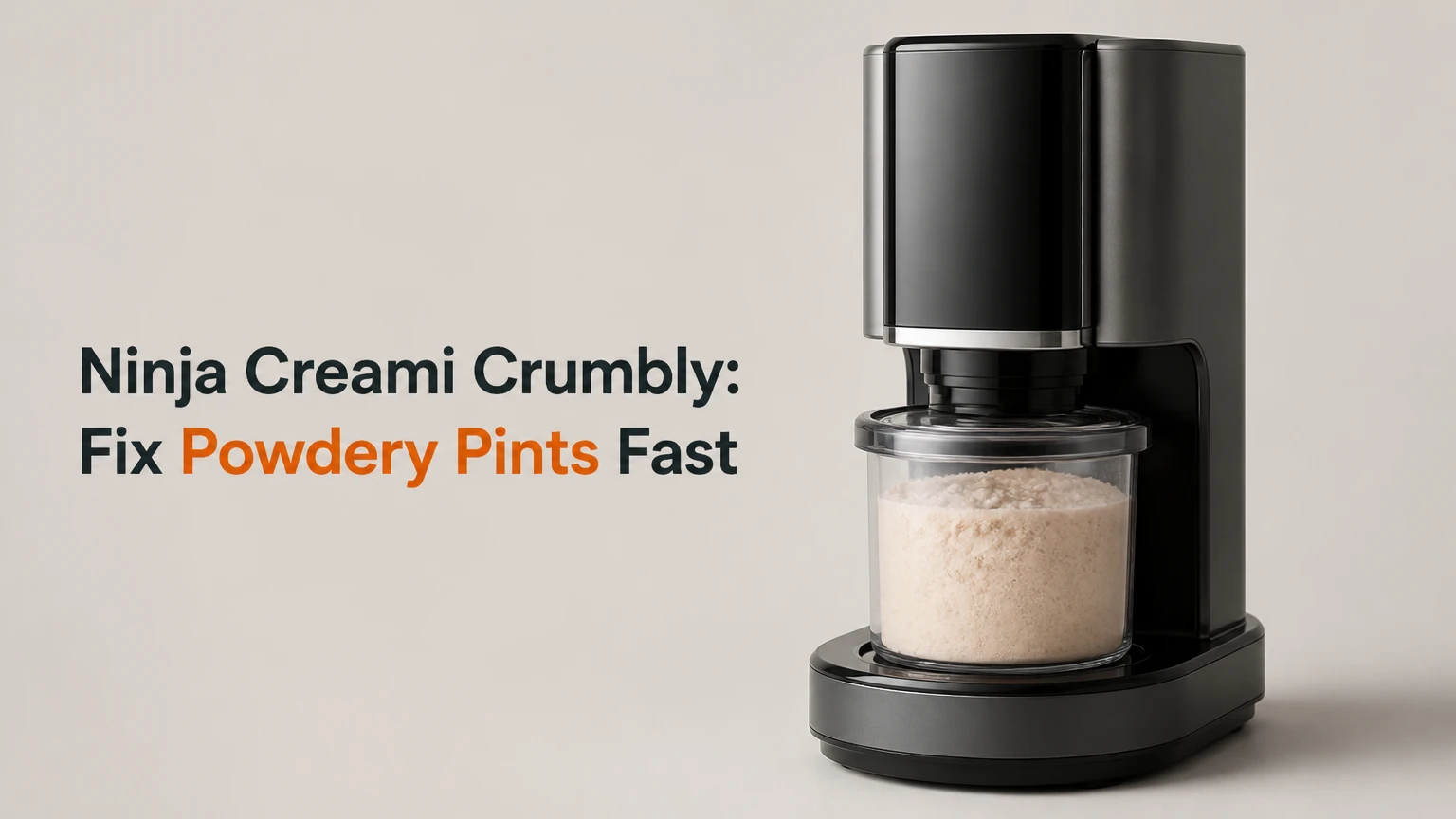
A Ninja Creami crumbly result usually means the frozen base has too little available liquid, sugar, or fat for the processed ice crystals to bind into a cohesive texture. The fastest fix is to add 15-30 ml of milk or another suitable liquid, then run Respin once; ingredient balance and freezer conditions determine whether that repair succeeds.
Key Facts at a Glance
- Ninja recommends freezing a filled Creami pint for at least 24 hours on a level surface before processing.
- A powdery first spin is common in high-protein, low-sugar, low-fat, and water-heavy recipes.
- Start a rescue with 15 ml of liquid, scrape the walls, and use Respin before adding more.
- Xanthan gum can improve a lean base, but approximately 0.25 g to 0.75 g per pint is usually safer than a full teaspoon.
- A freezer colder than standard home settings can make a pint harder, but temperature alone does not guarantee a crumbly result.
- Never force the paddle through a damaged, bulging, partially frozen, or improperly seated pint.
Why Does a Ninja Creami Turn Crumbly?
A Ninja Creami turns crumbly when the blade pulverizes a hard frozen base but the resulting ice particles do not contain enough unfrozen water, dissolved sugar, fat, or stabilizer to recombine. The result resembles wet sand, snow, chalk, or loose crumbs rather than a continuous scoop.
Traditional ice cream churns while liquid freezes. The Ninja Creami freezes the base first, then processes the solid pint with a rotating paddle. That reverse sequence makes the frozen formula more important than the machine’s program name.
The following causes are the most useful diagnostic starting points:
| Cause | Typical symptom | First correction |
|---|---|---|
| Low free water | Dry snow after the first spin | Add 15 ml milk or compatible liquid |
| Low sugar | Icy, brittle, hard particles | Add sweetened base or use a balanced recipe next time |
| Low fat | Chalky mouthfeel in light recipes | Add yogurt, milk, cream, or a measured fat source |
| High protein | Dense powder and chalkiness | Reduce powder or increase liquid and sweetener |
| Very cold pint | Hard crumbs with little cohesion | Rest 5-10 minutes, then process safely |
| Uneven frozen surface | Side or top sections remain untouched | Freeze level and inspect the surface before processing |
“Low fat” does not automatically mean failure. Fruit sorbet, reduced-calorie dairy bases, and protein recipes can work well when their water, sugar, and stabilizer levels are balanced. The common mistake is treating protein powder or sugar-free syrup as a complete ice cream formula.
What does crumbly texture tell you?
Texture reveals the failure location. Uniform powder usually points to recipe balance or excessive hardness, while a creamy center with dry walls often points to uneven freezing, a bulged surface, or material that the paddle did not contact fully.
A bottom-only problem deserves extra caution. A small amount of loose material at the base can result from normal processing, but large hard chunks may indicate an uneven pint, an overfilled container, or a processing issue. Do not repeatedly run the machine if unusual noise, vibration, or paddle resistance occurs.
How Do You Fix a Powdery Ninja Creami Pint?
Fix a powdery Ninja Creami pint by adding a small amount of compatible liquid, scraping loose material toward the center, and running Respin once. Use 15 ml first, evaluate the texture, and add another 15 ml only if the mixture remains dry; excessive liquid can create a thin or icy result.
Step 1: Inspect the Pint Before Reprocessing
Remove the pint from the outer bowl and check the frozen surface, container rim, and paddle path. Confirm that the pint is not cracked, swollen, leaking, or frozen at a steep angle. A damaged container should not go back into the machine.
If a raised hump formed above the level surface, do not process it as-is. The machine needs the pint seated correctly, and an uneven frozen block can increase stress on the paddle. A minor flatness variation may be manageable, but a prominent dome should be softened according to the manufacturer’s instructions and leveled before processing.
You will know this step worked when the pint is intact, seated correctly, and free from a large frozen ridge. A common mistake is scraping the frozen block with a metal utensil, which can damage the container.
Step 2: Add Liquid and Use Respin
Add 15 ml, or 1 tablespoon, of milk, half-and-half, cream, yogurt, or the liquid that matches the recipe. Place the pint back into the outer bowl, attach the paddle correctly, and select Respin according to the instructions for your model.
Use milk for a dairy protein base, unsweetened plant milk for a vegan base, and a small amount of fruit puree for a fruit-forward sorbet. Water is the least useful rescue liquid because it dilutes flavor and adds free ice without supplying much body.
| Original base | Preferred rescue liquid | Starting quantity | Main risk |
|---|---|---|---|
| Dairy protein shake | 2% milk or whole milk | 15 ml | Extra sweetness or dilution |
| Greek yogurt base | Milk or thin yogurt | 15 ml | Excess acidity |
| Coconut milk base | Coconut milk beverage | 15 ml | Weaker coconut flavor |
| Fruit sorbet | Fruit puree or juice | 10-15 ml | Larger ice crystals |
| Coffee base | Milk or brewed coffee | 10-15 ml | Reduced coffee intensity |
| High-fat cream base | Milk, not more cream | 10-15 ml | Greasy, dense texture |
The mixture should look cohesive after Respin, with fewer dry pockets and a smoother surface. A second Respin may help a very lean pint, but repeated cycles cannot fully correct a poorly balanced formula.
Step 3: Correct Hardness Without Overheating
Let an exceptionally hard pint rest for 5-10 minutes at room temperature before processing, especially if it came from a very cold chest freezer. Keep the container closed and monitor the surface. The goal is modest softening, not melting.
Do not use a hot-water bath as a routine shortcut. Hot water can soften the outside unevenly, create a slippery container, and warm the pint faster than the center. Do not microwave a pint while it contains a metal component or while it is installed in the outer bowl. If your model’s official instructions permit brief microwave softening after removing all machine parts, follow that manual exactly; otherwise, use controlled countertop resting.
You will know the pint is ready when the surface remains frozen but the container is no longer unusually cold and rigid. A common mistake is leaving the pint out for 30-60 minutes, which can produce a partially melted perimeter and an icy refreeze later.
Which Ingredients Cause a Crumbly Creami Result?
High-protein, sugar-free, very low-fat, and water-based ingredients cause the most predictable crumbly Creami results. Protein powder adds solids but does not replace the freezing-point and texture effects of sugar or fat, while sugar-free sweeteners vary widely in their ability to control ice formation.
| Ingredient pattern | Why texture suffers | Better adjustment |
|---|---|---|
| Protein shake only | Limited fat and structure | Add yogurt, milk, or a stabilizer |
| Water plus flavor drops | Almost no body or dissolved solids | Use fruit, juice, or a formulated sorbet base |
| Skim milk and protein powder | High protein, low fat | Add milk powder, yogurt, or modest fat |
| Erythritol-heavy base | Cooling effect and recrystallization risk | Blend sweeteners and reduce total erythritol |
| Unsweetened almond beverage | Low solids and low fat | Add yogurt, nut butter, or a tested thickener |
| Heavy cream without enough liquid | Fat-rich but potentially waxy | Balance with milk and dissolved sugar |
How much xanthan gum should you use?
Use approximately 0.25 g to 0.75 g of xanthan gum per standard pint when adjusting a lean base, with thorough blending before freezing. That range is a practical starting point, not a universal rule, because protein powders, fruit acids, and dairy solids change the required amount.
A full 1/4 teaspoon can weigh roughly 0.6-1.2 g depending on the powder and spoon, so volume measurements are imprecise. A small digital scale gives more consistent results. Guar gum can provide a softer, less elastic texture, but too much of either gum creates a gummy or slippery mouthfeel.
Blend the stabilizer into the liquid before freezing. Sprinkling gum onto a frozen block creates clumps that Respin cannot distribute evenly. Stabilizer improves cohesion; it cannot compensate for an underfilled pint, spoiled ingredients, or a damaged machine.
How Does Freezer Temperature Change Texture?
Freezer temperature changes hardness and processing resistance, but a colder freezer does not automatically guarantee a crumbly pint. Ninja’s 24-hour freezing instruction is the practical baseline, while a chest freezer operating near -25°C can create a harder block that may need a controlled 5-10 minute rest.
Most household freezers operate near 0°F, or -18°C, but actual temperatures vary by location, load, airflow, and thermostat calibration. The pint’s position also matters. A container against a very cold wall can freeze differently from one surrounded by other food.
Freeze every pint level with its lid attached and leave clearance around it for airflow. Do not stack warm pints directly against one another. A level shelf prevents the hump effect, where the frozen surface develops a raised area that interferes with consistent paddle contact.
| Freezer situation | Likely texture effect | Practical response |
|---|---|---|
| Standard freezer near 0°F | Firm, expected block | Freeze 24 hours and process |
| Chest freezer near -10°F | Extra-hard surface | Rest 5-10 minutes |
| Chest freezer near -13°F | Very hard block | Check manual and soften cautiously |
| Warm or frequently opened freezer | Uneven freezing | Extend freezing and relocate pint |
| Pint frozen on an angle | Slanted processing path | Level the surface before spinning |
| Pint frozen without lid | Raised or exposed surface | Inspect and correct before processing |
The AI Overview’s claim that a very cold freezer “guarantees” crumbling is too strong. Recipe composition, surface shape, fill level, and program choice also affect the result.
What Do Side-Wall and Bottom Crumbs Mean?
Side-wall crumbs usually mean the paddle did not contact or incorporate the frozen perimeter efficiently, while bottom crumbs can indicate a dense, unevenly frozen area or a formula that became progressively drier during processing. Neither pattern alone proves that the motor is defective.
First, scrape the sides into the center with a silicone or plastic utensil after the initial cycle. Add only enough liquid to coat the loose material, then use Respin. If the same area remains untouched across several correctly prepared pints, stop troubleshooting recipes and inspect the paddle, lid assembly, pint seating, and machine instructions.
| Crumb pattern | Most likely cause | Diagnostic check |
|---|---|---|
| Entire pint resembles snow | Lean or water-heavy formula | Review sugar, fat, and liquid |
| Creamy center, dry sides | Uneven contact or frozen edge | Check hump and pint level |
| Dry bottom third | Dense lower block or overfill | Check fill line and freezing angle |
| Large hard chunks | Incomplete processing | Stop if vibration or resistance occurs |
| One-sided frozen wall | Uneven freezer airflow | Rotate storage location next time |
| Oily rather than crumbly | Excess fat or poor emulsion | Blend base more thoroughly |
A thin frozen ring near the wall is often recoverable. A cracked pint, detached paddle piece, or repeated abnormal noise is not a texture problem and should not be solved with additional cycles.
How Should You Choose the Program?
Choose the program that matches the base composition rather than selecting a setting solely because it sounds creamier. Light Ice Cream generally suits reduced-fat dairy recipes, while Sorbet fits fruit and juice bases; the exact program names and options depend on the Ninja Creami model.
Program selection cannot overcome severe formula imbalance. A protein shake may still need Respin, and a fruit base may remain icy if it contains too little dissolved sugar or soluble fruit solids.
| Base composition | Common program | Expected first result | Best follow-up |
|---|---|---|---|
| Reduced-fat dairy | Light Ice Cream | Fine crumbs or soft powder | Respin with 15 ml milk |
| Full-fat dairy | Ice Cream | Dense, cohesive texture | Respin only if dry |
| Fruit and juice | Sorbet | Shaved fruit ice | Respin with puree |
| Milkshake-style base | Milkshake | Thick liquid texture | Add liquid gradually |
| Frozen yogurt base | Frozen Yogurt | Tangy, dense texture | Add milk if chalky |
| Protein dessert base | Light Ice Cream | Powdery or dense | Adjust protein and stabilizer |
Use the first spin as a diagnostic. A slightly crumbly surface that becomes smooth after Respin can be normal for a lean formula. A completely dry pint after two correctly performed cycles needs recipe correction, not a more aggressive button.
Is a Crumbly Pint Safe to Eat?
A crumbly pint is generally safe to eat when it was prepared with fresh ingredients, frozen promptly, kept continuously frozen, and processed in an intact container. Crumbly texture alone indicates a structure problem, not bacterial contamination.
Discard the pint if the base sat warm for an extended period, smells fermented or rancid, contains mold, or thawed and refroze repeatedly. Freezing does not reverse spoilage. Dairy, egg, and plant-based ingredients can all deteriorate before freezing if handled poorly.
Inspect the pint and paddle for plastic fragments or metal damage after an unusual cycle. The United States Department of Agriculture advises keeping perishable food at 40°F or below during refrigerated storage and limiting time in the temperature danger zone; apply those food-safety principles before focusing on texture.
How Do You Prevent Crumbling Next Time?
Prevent crumbling by balancing the base, freezing it level for at least 24 hours, choosing the matching program, and reserving Respin for dry first results. A small amount of dissolved sugar, dairy solids, fruit solids, or stabilizer usually improves cohesion more reliably than adding extra cream alone.
Use a tested recipe ratio rather than improvising from a beverage. For a protein pint, combine the shake with a structure-building ingredient such as Greek yogurt or milk, then assess sweetness and thickness before freezing. For a sorbet, fruit puree generally provides more body than flavored water.
Fix Cost, Time, and Ingredient Ranges
| Fix | Typical quantity | Typical time | Typical cost |
|---|---|---|---|
| Milk or plant milk rescue | 15-30 ml | 2-4 minutes | $0.03-$0.20 |
| Yogurt rescue | 15-30 g | 3-5 minutes | $0.10-$0.35 |
| Xanthan gum adjustment | 0.25-0.75 g | 5-10 minutes | $0.02-$0.10 |
| Countertop softening | No added ingredient | 5-10 minutes | $0 |
| New balanced pint | 1 full pint | 24 hours freezing | $1-$5 |
| Replacement pint container | 1 container | 1-3 days delivery | $10-$25 |
These are typical US ingredient and replacement ranges, not fixed retail prices. The least expensive intervention is usually a measured liquid addition and one Respin cycle.
Expert rules that prevent repeat failures
- Measure powder by weight when possible. Two scoops of different protein powders can differ by more than 10 g, changing both sweetness and water binding.
- Do not solve every dry pint with cream. Extra cream can make a base greasy while leaving insufficient dissolved sugar or liquid for a smooth frozen structure.
- Treat the frozen surface as part of the recipe. A level, covered pint processes more evenly than an identical formula frozen on an angle.
- Change one variable per test pint. If you add yogurt, gum, sweetener, and extra liquid together, you cannot identify which adjustment solved the problem.
How Does the Creami Compare With a Traditional Churner?
The Ninja Creami is more forgiving of low-fat and high-protein recipes after processing, while a traditional churner produces a better result when the liquid base is properly balanced before freezing. The Creami also requires a 24-hour pint freeze, whereas a compressor machine can churn a prepared base immediately.
| Metric | Ninja Creami | Freezer-bowl churner | Compressor churner |
|---|---|---|---|
| Pre-freezing requirement | 24-hour pint freeze | 12-24-hour bowl freeze | None for bowl |
| Processing time | About 2-5 minutes | About 20-40 minutes | About 30-50 minutes |
| Lean-base flexibility | High after Respin | Low to moderate | Moderate |
| Recovery after crumbling | Add 15-30 ml and Respin | Melt and rechurn | Melt and rechurn |
| Typical appliance price | $150-$250 | $50-$150 | $300-$700 |
| Texture mechanism | Blade processes frozen block | Churns while freezing | Churns while freezing |
| Best use case | Single pints and diet recipes | Family batches | Frequent premium batches |
The comparison depends on workflow. A Creami is a poor choice when you need several gallons of ice cream immediately, but it is useful when each person wants a different flavor or macro profile. A compressor machine avoids the frozen-pint wait, yet it still cannot rescue an unbalanced base without melting and reformulating it.
Common Mistakes and Their Fixes
Skipping Respin
A lean base often needs one Respin cycle because the first pass breaks the block into particles before enough liquid is redistributed. Add 15 ml first rather than pressing the same program repeatedly with no liquid.
Adding too much liquid
More liquid does not always produce more creaminess. Add 15 ml, evaluate, and stop when the texture becomes cohesive; 30 ml is a practical upper starting range for a standard dry pint.
Using pure water
Water-based frozen desserts need dissolved solids and flavor structure. Replace part of the water with fruit puree, juice, dairy, coconut beverage, or another formulated base.
Overusing xanthan gum
Excess gum creates elasticity and a slick mouthfeel. Weigh 0.25-0.75 g, blend completely, and test the next pint before increasing the amount.
Freezing without a level surface
A frozen hump or angled pint can produce uneven blade contact. Use a flat shelf, leave the lid on, and check the surface before processing.
Assuming every crumb means machine failure
Texture variation usually begins with the base or freezing conditions. Investigate the machine only after the same defect appears with a known balanced recipe and correct container setup.
FAQ
Can I refreeze a Ninja Creami pint after Respin?
Yes, you can refreeze a respun pint when the ingredients remained cold and the container is intact, but the second freeze may create a firmer or icier texture. Flatten the surface before refreezing, replace the lid, and process again with the appropriate program if the texture becomes crumbly.
Why is my Creami crumbly without protein powder?
A protein-free pint can still crumble when it contains mostly water, unsweetened plant milk, low-solids fruit, or very little sugar. Review the total dissolved solids and add body through fruit puree, yogurt, milk solids, or a carefully measured stabilizer rather than assuming protein powder is required.
Can I fix a crumbly pint without adding milk?
You can use another compatible liquid or semi-liquid ingredient, including yogurt, fruit puree, coconut milk beverage, or a small amount of coffee. The replacement should match the flavor and dietary requirements. Adding plain water is possible, but it usually weakens flavor and may increase iciness.
Why does my Creami become crumbly after sitting in the freezer?
A pint can become harder and drier after prolonged storage because ice crystals change size and the formula loses its initially smooth structure. Keep the pint tightly covered, avoid repeated thawing, and allow an exceptionally hard container to rest for 5-10 minutes before processing.
Should I use Ice Cream or Light Ice Cream for a protein shake?
Light Ice Cream is usually the more appropriate starting program for a low-fat protein shake, but the program cannot replace recipe balance. If the first result is powdery, add 15 ml of the shake or milk and use Respin; adjust protein concentration for future pints.
How full should a Ninja Creami pint be?
Fill the container only to the marked maximum line and follow the instructions for your specific Ninja Creami model. Overfilling can interfere with the paddle’s travel and processing path, while underfilling may produce uneven contact and a dry section near the bottom.
The Bottom Line
A ninja creami crumbly pint is usually a reformulation or processing problem, not an automatic appliance failure. Start with a 15 ml compatible liquid addition and one Respin, then inspect freezer hardness, level freezing, program choice, and the base’s protein, sugar, fat, and stabilizer balance before changing the next recipe.