

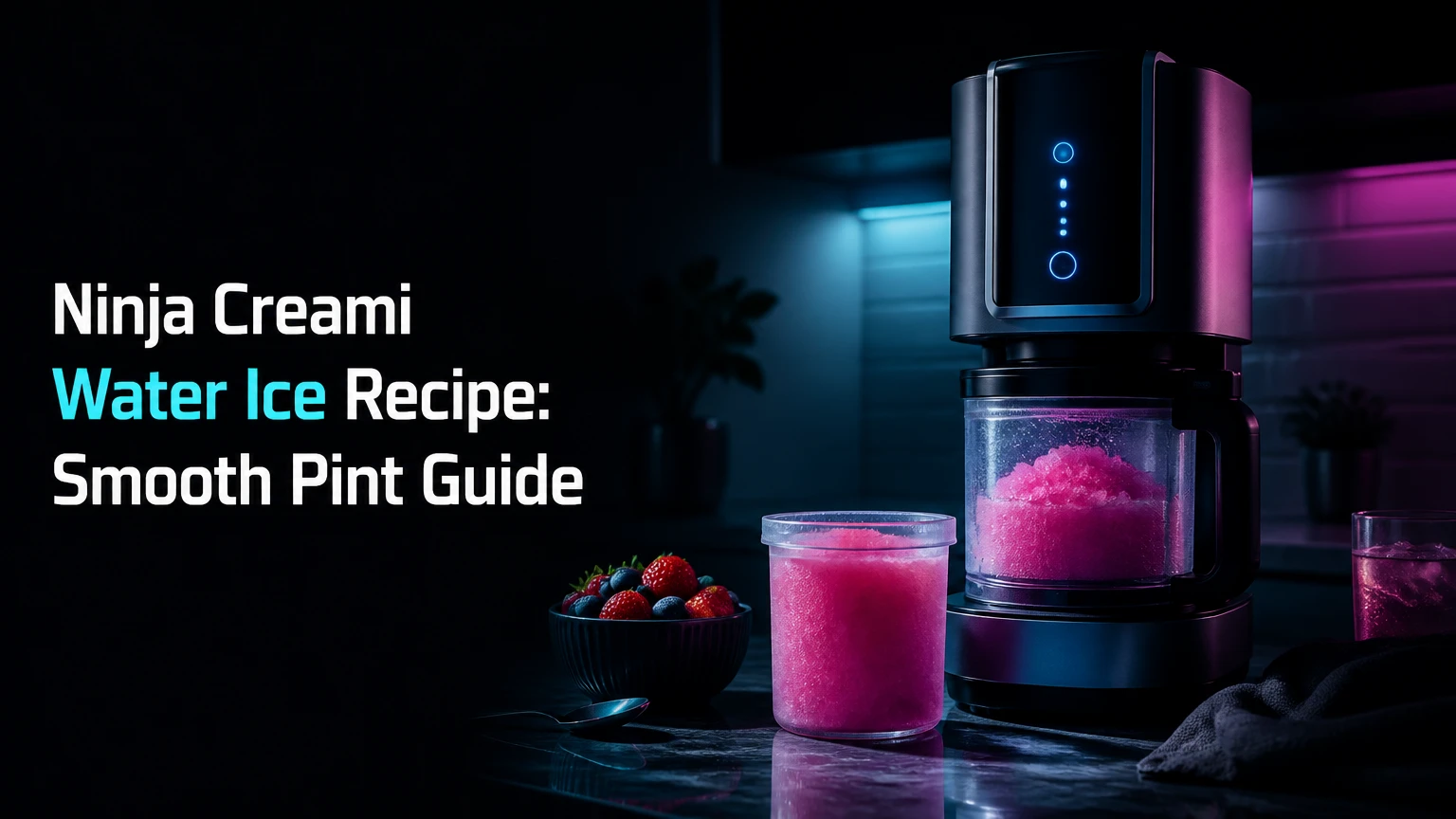
A ninja creami water ice recipe is a frozen mixture of water, sugar, fruit, juice, or flavoring processed into Italian ice with the machine’s rotating paddle. The mixture freezes solid for about 24 hours, then the Sorbet program shaves and compresses the ice into a smooth, scoopable dessert without churning a liquid base.
Key Facts / Quick Answer
Use 1 pint of sweetened water, juice, puree, or soda, leaving the fill line visible.
Freeze the pint level at 0°F (-18°C) or colder for at least 24 hours.
Process on Sorbet when available; program names vary by Ninja Creami model.
A typical lemon formula uses 1.5 cups water, 0.5 cup sugar, and 0.5 cup lemon juice.
Powder after the first spin usually needs 1 tablespoon of water or juice, followed by Re-Spin.
Do not process a slushy base, loose ice cubes, or a frozen mound that rises above the pint surface.
What Is Ninja Creami Water Ice?
Ninja Creami water ice is a dairy-free frozen dessert made from a sweetened, flavored liquid that freezes inside the Creami pint before processing. Italian ice, water ice, and many fruit ices use water as their primary ingredient, while sorbet usually contains fruit and may have a denser puree base.
The appliance does not freeze and churn the liquid during processing. Instead, the paddle moves through a frozen block and removes thin layers from the surface and interior. The shavings are compressed into a cohesive texture as the paddle travels downward.
A standard Ninja Creami pint holds approximately 16 fluid ounces to the fill line, but a recipe’s finished volume changes with fruit solids and air incorporation. The dessert is best eaten immediately after processing because repeated melting and refreezing increases ice-crystal size.
Water ice is a good choice when you want:
- A dairy-free dessert with no cream or milk.
- A fruit-forward flavor with a clean finish.
- A small batch that costs about $0.50-$1.50 in typical United States grocery conditions.
- A dessert that can use lemon juice, fruit puree, flat soda, tea, or sports drink.
How Does the Ninja Creami Process a Frozen Base?
The Ninja Creami processes a completely frozen pint by driving a paddle downward through the block, shaving ice and mixing the shavings into a spoonable mass. The machine’s texture comes from mechanical processing after freezing, so the starting temperature, surface shape, sugar concentration, and liquid level affect the result.
A traditional churner agitates a liquid while it freezes. A blender breaks already frozen pieces at high speed. The Creami follows a different sequence: freeze first, then shave and mix. That sequence explains why a Creami can produce a smooth result from a low-fat water base, but it also explains why the machine cannot safely correct a partially frozen mixture.
The paddle needs a reasonably level surface. A convex hump can force the paddle into uneven resistance, while a deep crack can create an irregular load. The safest routine is to inspect the frozen surface, remove any high ridge with a spoon, and process the pint according to the instructions for the specific model.
Ninja’s owner guidance differs by model, so the control panel matters. Many machines label the relevant program Sorbet, while some versions use different preset names. The appliance’s manual takes priority over a generic recipe.
Sugar Concentration Controls Texture
Sugar affects water ice in two ways: it sweetens the base and lowers the freezing point. A typical water-only formula targets approximately 20%-25% sugar by weight for a soft, scoopable Italian-ice texture, although fruit pulp, juice solids, and dissolved acids change the calculation.
The lemon recipe below contains less sugar than that range when measured against the entire liquid mixture. It still works because lemon juice contributes dissolved solids and the finished product is processed rather than hand-scooped from a hard storage container. For a firmer, less sweet lemon ice, reduce sugar gradually instead of removing it entirely.
Use a kitchen scale when targeting a percentage. Half a cup of granulated sugar weighs about 95-105 grams depending on how it is filled, while a cup of water weighs about 236 grams. Volume cups make repeatability harder.
Which Base Works Best?
The best water-ice base depends on the desired flavor, sweetness, and texture. Sugar syrup gives the most predictable texture, fruit puree gives the most body, soda requires the least preparation, and sugar-free mixtures need a texture aid.
| Base type | Typical pint formula | Freeze behavior | Best use |
|---|---|---|---|
| Sugar syrup | 350 g water, 100-120 g sugar | Softest and most predictable | Lemon, lime, cherry |
| Juice or puree | 300 g juice, 150 g puree, 50-90 g sugar | Medium firmness | Mango, strawberry, peach |
| Flat soda | 450-473 g soda, optional 10-30 g sugar | Often hard and crystalline | Cola, orange soda, ginger ale |
| Sugar-free | 450 g liquid, sweetener, 0.25-0.5 tsp gum | Firm and prone to powder | Low-sugar citrus or berry |
| Tea or infusion | 400 g strong tea, 50-100 g sugar | Clean but relatively icy | Peach tea, hibiscus, mint |
Sugar-Syrup Base
Dissolve sugar in part of the water over low heat, then cool the syrup completely before adding citrus or delicate flavorings. Warm syrup dissolves efficiently, but hot syrup can dull fresh lemon aroma and can partially melt an already frozen pint if added later.
A simple syrup base is easy to scale. The trade-off is that water and sugar alone can taste flat, so citrus zest, a pinch of salt, or a concentrated fruit component improves flavor without adding much volume.
Fruit and Juice Base
Fruit puree adds pectin, fiber, and dissolved solids, which often produce a fuller texture than flavored water. Strain fibrous puree when seeds or stringy pulp could make the paddle work harder or create a gritty bite.
Fresh pineapple, mango, peach, and berries behave differently. Pineapple contains strong acidity and fibrous strands; berries contribute seeds; mango gives substantial body; peach puree can freeze relatively soft when fully ripe. These differences make fruit weight more useful than a single universal cup measurement.
Soda and Ready-to-Drink Bases
Flat soda can be processed directly after freezing, but carbonation must be released first. Pour the beverage into the pint slowly, stir it, and refrigerate it uncovered or loosely covered until the foam subsides. Carbonation does not improve the finished texture.
Sports drinks, sweet tea, lemonade, and flavored water also work, provided they fit the pint’s fill line and contain no large solid pieces. Highly acidic beverages can taste sharper after freezing because cold reduces perceived sweetness.
How Do You Make Lemon Water Ice?
This lemon water ice recipe produces one Ninja Creami pint with a bright citrus flavor and a balanced sweet-acid profile. Dissolving the sugar first prevents sandy crystals, while adding lemon after cooling preserves more fresh juice character.
Ingredients
| Ingredient | Amount | Function |
|---|---|---|
| Water | 1.5 cups, about 355 g | Main liquid |
| Granulated sugar | 0.5 cup, about 100 g | Sweetness and freezing control |
| Fresh lemon juice | 0.5 cup, about 120 g | Acidity and citrus flavor |
| Fine lemon zest | 1 tablespoon | Volatile lemon aroma |
| Fine salt | 1/16 teaspoon | Flavor balance, optional |
Method
- Add 1 cup of the water and the sugar to a small saucepan.
- Warm the mixture over low heat until the sugar disappears. Do not boil it.
- Remove the syrup from the heat and add the remaining 0.5 cup water.
- Cool the mixture to room temperature, then refrigerate it until cold.
- Stir in the lemon juice, zest, and optional salt.
- Pour the mixture into a Ninja Creami pint without exceeding the maximum fill line.
- Freeze the pint on a level shelf for at least 24 hours at 0°F (-18°C) or colder.
- Inspect the surface. Scrape away a raised center or sharp ridge.
- Install the pint according to the machine manual and select Sorbet, if that preset is available.
- Run one cycle, then assess the texture. Use Re-Spin if the mixture is dry or powdery.
- If needed, add 1 tablespoon of cold water or lemon juice before Re-Spin.
- Serve immediately, or transfer the finished ice to a shallow freezer-safe container.
The finished mixture should hold a soft mound on a spoon. A wet ring around the edge suggests partial melting or an over-warm pint, while loose snow throughout the container usually indicates insufficient liquid, low sugar, or a freezer that did not reach a stable temperature.
What Freeze Time and Temperature Produce the Best Texture?
A Creami water-ice pint should freeze for at least 24 hours at 0°F (-18°C) or colder. The time matters because the center of a full pint freezes more slowly than its surface, and the temperature matters because a partially frozen core can create uneven resistance during processing.
Place the pint upright on a flat shelf rather than in a door compartment. Avoid stacking warm items around it during the first several hours. A household freezer may fluctuate above 0°F, so a 24-hour minimum is a practical baseline rather than a guarantee for every appliance.
| Stage | Typical target | Why it matters | Failure sign |
|---|---|---|---|
| Mixing | 5-10 minutes | Dissolves sugar evenly | Grit at the bottom |
| Cooling | Below 40°F, 4°C | Protects flavor and food quality | Warm citrus aroma |
| Freezing | 24 hours minimum | Solidifies the center | Slush or liquid core |
| Processing | 2-3 minutes per cycle | Shaves and mixes the block | Unprocessed center |
| Re-Spin | About 1 minute | Removes loose powder | Dry, snowy texture |
| Serving | Within 10 minutes | Preserves smoothness | Rapid melting |
How Should You Freeze the Pint?
Keep the pint level and uncovered only while its surface is being checked. Once the base is cold, secure the lid and freeze it upright. Do not intentionally freeze a rounded mound above the fill line.
A shallow freezer-safe container can be used after processing for storage, but the original pint is preferable for the initial freeze because its dimensions match the paddle and outer bowl. Do not freeze the base in cubes and transfer them to the Creami unless the appliance manual specifically allows that method.
How Do You Fix Powdery or Icy Water Ice?
Powdery water ice usually means the frozen block contains too little free liquid for the first processing cycle to bind the shavings. Add 1 tablespoon of compatible liquid, spread it over the surface, and run Re-Spin; adding too much liquid at once creates a loose slush.
| Result after first cycle | Likely cause | Correction |
|---|---|---|
| Dry powder throughout | Low sugar or low liquid | Add 1 tbsp water, then Re-Spin |
| Hard chunks at the bottom | Base froze unevenly | Re-freeze 4-6 hours, then process |
| Wet outer ring | Pint warmed before processing | Return to freezer 2-4 hours |
| Gritty fruit texture | Seeds, pulp, or crystals | Strain puree and adjust sugar |
| Sharp frozen hump | Pint froze on an uneven shelf | Scrape level before processing |
| Thin slush | Base was partially frozen | Stop and freeze 12-24 hours |
Expert Insight: Powder Is Often a Formula Problem
Re-Spin corrects distribution, but it cannot fully replace missing dissolved solids. If a zero-sugar beverage repeatedly becomes powder, adding another cycle without changing the formula usually increases melt around the edges while the center remains dry.
Expert Insight: Humps Matter More Than Appearance
A small frozen ridge can change the paddle’s contact pattern. Leveling the surface takes seconds and reduces the chance of an uneven load, especially with low-fat mixtures that freeze harder than custard bases.
What Happens If the Base Is Not Fully Frozen?
A partially frozen base can produce a watery ring, loose chunks, and an uneven center instead of smooth ice. Stop processing if the pint contains visible liquid, then refreeze it until solid; do not use a Creami cycle to turn a slush into water ice.
The machine is designed around a frozen block. A liquid or semi-liquid base can move unpredictably under the paddle, while loose ice cubes can stress the drive system and damage the container or blade assembly. Follow the safety limits in the manual for your model.
How Do the Main Methods Compare?
The Ninja Creami is strongest when you want a small, smooth batch with little active labor. A traditional churner handles larger liquid batches, while a blender is faster for immediate slush but gives less consistent Italian-ice texture.
| Method | Active time | Freeze or churn time | Typical texture | Typical equipment cost |
|---|---|---|---|---|
| Ninja Creami | 5-10 minutes | 24 hours plus 2-3 minutes | Smooth, dense, scoopable | $170-$230 |
| Traditional churner | 10-20 minutes | 20-40 minutes churning | Aerated, soft, variable | $50-$300 |
| High-power blender | 5-8 minutes | 4-8 hours for cubes | Slushy to chunky | $80-$500 |
| Food processor | 8-12 minutes | 4-8 hours for slices | Coarse to smooth | $60-$400 |
A churner may be more efficient for a party because it can produce multiple quarts continuously. The Creami’s pint size, approximately one serving for four to six people, limits throughput but improves portion control.
The Creami also cannot create the same overrun as a churner. If you prefer a light, airy frozen dessert, a churner may be the better tool. If you prefer concentrated flavor and a dense spoon texture, the Creami is more suitable.
How Much Does Homemade Water Ice Cost?
A homemade pint typically costs $0.50-$1.50, excluding the machine and electricity. Citrus, berries, specialty sweeteners, and imported juices move the price upward, while tap water, sugar, and bottled flavor extracts keep it near the lower end.
| Ingredient profile | Typical ingredient cost | Active preparation | Expected yield |
|---|---|---|---|
| Sugar and flavor extract | $0.50-$0.80 | 5 minutes | 1 pint |
| Lemon water ice | $1.00-$1.75 | 10 minutes | 1 pint |
| Berry puree | $1.50-$3.00 | 10-15 minutes | 1 pint |
| Mango puree | $1.25-$2.50 | 8-12 minutes | 1 pint |
| Sugar-free citrus | $1.00-$2.25 | 8-12 minutes | 1 pint |
Commercial premium Italian ice often costs approximately $4.00-$6.00 per pint in United States retail settings. Those prices include packaging, labor, distribution, and refrigeration, so ingredient cost alone is not a direct retail comparison.
How Do You Make Sugar-Free Water Ice?
Sugar-free water ice needs a sweetener plus a texture strategy because removing sucrose removes both sweetness and freezing-point control. A typical pint uses 0.25-0.5 teaspoon of guar gum or xanthan gum, but too much produces a sticky or gummy mouthfeel.
Sugar-Free Citrus Formula
| Ingredient | Amount | Role |
|---|---|---|
| Cold water | 350 g | Liquid base |
| Lemon or lime juice | 120 g | Acid and flavor |
| Allulose | 80-120 g | Sweetness and softer freeze |
| Stevia or monk fruit blend | According to label | Additional sweetness |
| Xanthan or guar gum | 0.25 tsp initially | Body and water control |
| Salt | 1/16 tsp | Flavor balance |
Whisk the gum into the dry allulose before adding liquids. This dispersion step prevents clumps. Chill the mixture, freeze it level for 24 hours, and process it on Sorbet when available.
Allulose usually creates a softer result than erythritol, which can produce a cooling sensation and recrystallization. Stevia and monk fruit provide sweetness with little bulk, so they cannot replace all the structural effects of sugar by themselves.
Sugar-free water ice is often less forgiving than the standard recipe. If it remains powdery, add 1 tablespoon of water or juice and Re-Spin. If it melts quickly, reduce the added liquid and refreeze the processed pint for 30-60 minutes.
Can You Use Fruit, Soda, or Juice?
Fruit, soda, and juice can all work in a Creami water-ice base, but each needs a different preparation step. Strain fibrous fruit, flatten soda by releasing carbonation, and taste juice after chilling because cold temperatures reduce perceived sweetness.
| Ingredient | Preparation | Typical added sweetener | Main risk |
|---|---|---|---|
| Strawberries | Blend and strain seeds | 30-70 g per pint | Seed grit |
| Mango | Blend ripe flesh | 0-40 g per pint | Dense, thick puree |
| Orange juice | Use pulp-free juice | 20-60 g per pint | Bitter pith |
| Cola | Stir until mostly flat | 0-30 g per pint | Large ice crystals |
| Hibiscus tea | Brew concentrated tea | 70-110 g per pint | Thin, sharp flavor |
Fresh fruit should be washed, trimmed, and refrigerated promptly. Perishable puree should not sit at room temperature for extended periods. The United States Food and Drug Administration identifies 40°F-140°F, or 4°C-60°C, as the temperature danger zone for many perishable foods, so cool prepared mixtures quickly.
Do not add whole nuts, hard candy, or large frozen fruit pieces to the pint. Those ingredients can create hard inclusions that the paddle cannot shave uniformly.
What Are the Recipe’s Main Limitations?
Water ice made in a Ninja Creami is not a substitute for every frozen-dessert method. The machine requires advance planning, produces a small batch, and cannot repair a formula that freezes into an excessively hard or flavorless block.
The main limitations are:
- Twenty-four-hour planning: The pint cannot be prepared and served immediately.
- Small capacity: One pint is practical for a household serving, not a large gathering.
- Melt sensitivity: The smooth texture declines after repeated thawing and refreezing.
- Formula dependence: Very low-sugar bases often need a gum or a softer sweetener.
- Program variation: Button names and cycle behavior differ among Creami models.
- Cleaning requirements: Citrus pulp, puree, and sticky sweeteners require prompt washing.
For a large event, freeze several pints in advance and process them close to serving time. For instant frozen drinks, use a blender. For a low-sugar dessert with a creamy mouthfeel, a sorbet or frozen-yogurt formula may perform better than plain water ice.
Frequently Asked Questions About ninja creami water ice recipe
Can I freeze the lemon mixture for less than 24 hours?
A lemon mixture may freeze sooner in a shallow container, but a full Creami pint generally needs at least 24 hours to freeze solidly through the center. Processing earlier can create a wet perimeter and hard core. Keep the pint frozen longer if the freezer runs warmer than 0°F (-18°C).
Why does my water ice taste less sweet when frozen?
Frozen desserts taste less sweet because cold suppresses aroma and sweetness perception. Taste the chilled liquid before freezing and adjust gradually, usually by adding 10-20 grams of sugar or a small amount of syrup. Lemon and lime bases often need more sugar than mild fruit bases.
Can I use bottled lemon juice instead of fresh lemon juice?
Bottled lemon juice can replace fresh juice at a one-to-one volume ratio, but fresh juice usually provides a brighter aroma. Bottled juice may taste more uniform and sharper. Omit or reduce zest when using bottled juice, because zest contributes fresh citrus oils that bottled juice lacks.
How long does processed water ice keep?
Processed water ice has its best texture immediately and remains usable for about one week in a tightly covered freezer container. After longer storage, ice crystals grow and the surface dries. Re-Spin with 1 tablespoon of compatible liquid can improve texture, but it cannot restore all freshly processed quality.
Can I double the recipe in one pint?
Do not double a recipe inside one pint. The container’s fill line limits the safe volume, and overfilling leaves insufficient space for processing. Prepare two identical pints instead, freezing each level and processing them separately according to the machine instructions.
Is Italian ice the same as sorbet?
Italian ice and sorbet are closely related frozen desserts, but recipes and regional definitions differ. Italian ice often emphasizes a water, sugar, and flavor base with a dense texture, while sorbet commonly contains more fruit puree. A Ninja Creami Sorbet program can process either style when the base is fully frozen.
Conclusion
A reliable ninja creami water ice recipe starts with a balanced liquid base, a level pint, and a full 24-hour freeze at 0°F (-18°C) or colder. For the most dependable first batch, use the lemon formula, process it on Sorbet, and correct powder with 1 tablespoon of water or juice before Re-Spin.