

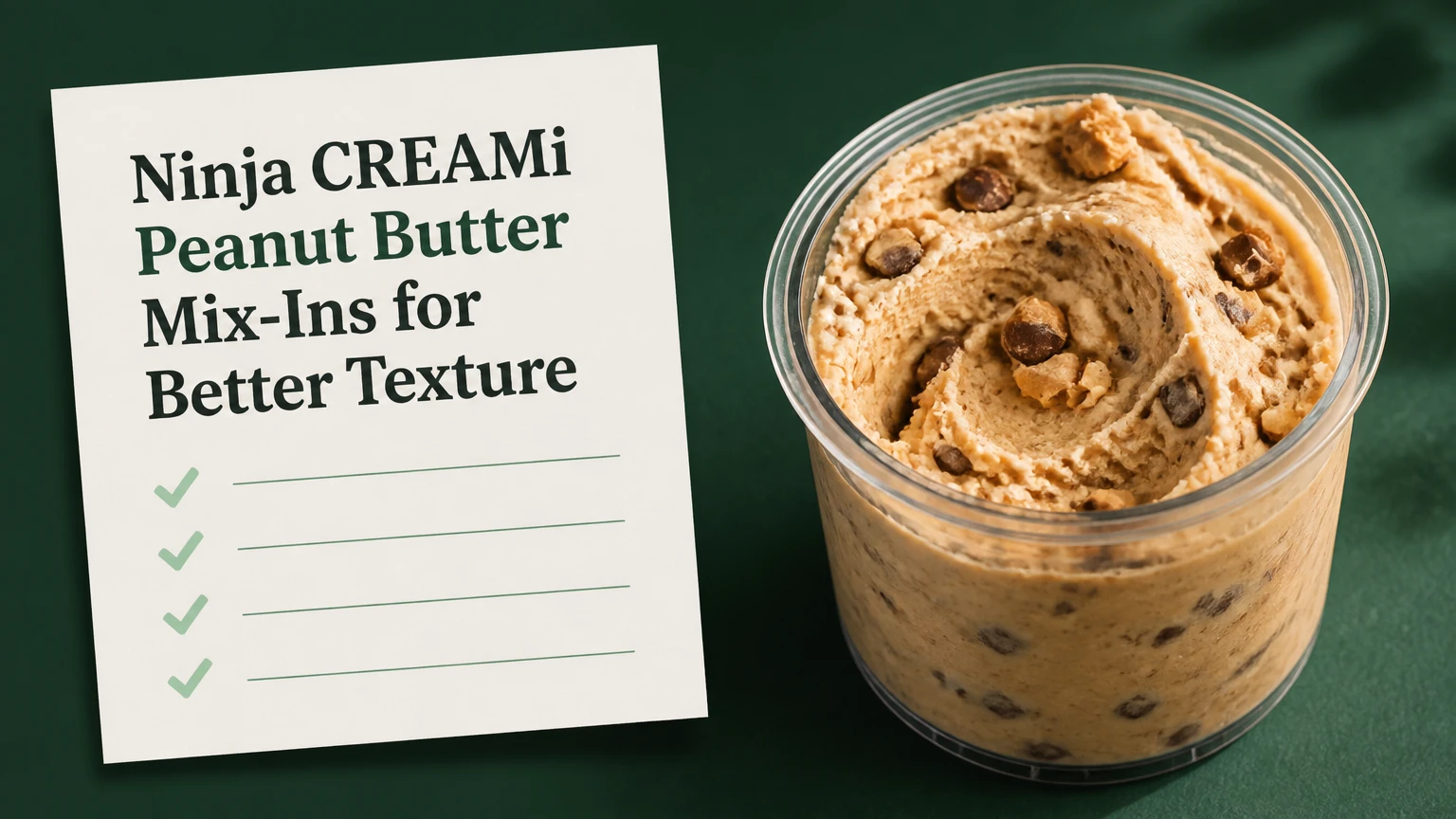
Ninja Creami peanut butter mix in is the final-stage process of folding peanut butter, candy, cookies, or peanut powder into a processed frozen dessert. The method preserves recognizable pockets and pieces better than blending them into the base, provided the pint is frozen for about 24 hours and ingredients stay below the fill line.
Key Facts
Freeze the prepared base level for at least 24 hours at 0°F (-18°C) before processing.
Process the pint first, then make a narrow center well that reaches the bottom.
Start with 1-2 tablespoons of peanut butter or ¼-½ cup of chopped solid mix-ins per pint.
Use the MIX-IN program once; a second cycle can reduce candy and cookie pieces to fine crumbs.
Peanut butter becomes firmer when frozen because its fat does not distribute like water.
Typical cost ranges from $0.20-$0.50 per serving for pantry ingredients and $1.00-$1.50 for premium candy-heavy portions.
What Does Ninja Creami Peanut Butter Mix In Mean?
Ninja Creami peanut butter mix in means adding peanut-based ingredients after the main frozen base has been processed, then using the machine’s MIX-IN function to distribute them through the pint. The paddle moves through the softened dessert and breaks up or folds ingredients without treating the entire mixture like a high-speed smoothie.
The sequence matters. Peanut butter added before the first processing cycle becomes part of the base, while peanut butter added afterward creates ribbons, pockets, or small dispersed pieces. The exact motion and cycle duration vary among Ninja CREAMi models, so the owner’s manual remains the final authority for program selection and maximum fill guidance.
The Ninja Kitchen manuals for CREAMi models consistently direct users to freeze the base level, process it first, create a center well, add mix-ins, and select MIX-IN. The manufacturer’s design goal is distribution, not complete preservation of every original chunk. Soft cookies may break down substantially, while chilled candy pieces usually remain more recognizable.
How Does the Mix-In Process Work?
The Ninja CREAMi mix-in process uses a processed pint with a center channel so ingredients enter the paddle’s path from top to bottom. A level, fully frozen base and a properly sized ingredient load produce more even distribution than placing mix-ins only on the surface.
Step-by-Step Method
- Prepare the base. Pour the liquid mixture into the pint without exceeding the MAX FILL line. Freeze the container on a level surface for at least 24 hours.
- Process the frozen base. Select the mode that matches the formula, such as Ice Cream, Lite Ice Cream, Sorbet, or Smoothie Bowl. If the result is powdery, use the appropriate RE-SPIN instruction before adding solid mix-ins.
- Create the well. Remove a center column of processed dessert with a spoon. A well about 1.5 inches wide that reaches near the bottom gives mix-ins a route through the pint.
- Add the peanut ingredient. Put chilled peanut butter, peanut powder paste, candy, or cookie pieces into the well. Keep the total load moderate.
- Run MIX-IN once. Lock the outer bowl in place and select MIX-IN. The typical program takes about 45-60 seconds, but the exact duration depends on the model.
- Inspect before serving. Scrape the sides and check the bottom for concentrated ingredients. Hand-fold any remaining large cluster rather than automatically repeating the cycle.
The center well is a distribution aid, not a guarantee of perfect top-to-bottom mixing. A very thick nut butter may remain in streaks, especially when the dessert is extremely cold or the base is low in fat.
| Process Variable | Typical Target | Why It Matters |
|---|---|---|
| Freezing time | 24 hours minimum | Produces a solid block for the processing paddle |
| Freezer temperature | 0°F to 5°F | Reduces soft edges and uneven processing |
| Center well diameter | About 1.5 inches | Places ingredients inside the paddle’s working path |
| MIX-IN duration | 45-60 seconds typical | Allows one distribution cycle without excessive breakdown |
| Peanut butter quantity | 1-2 tablespoons | Creates flavor and ribbons without making the pint greasy |
| Solid mix-in quantity | ¼-½ cup | Adds texture while limiting motor and fill stress |
Which Peanut Butter Mix-Ins Work Best?
Peanut butter mix-ins differ mainly by water content, fat content, hardness, and particle size. Smooth peanut butter creates ribbons, peanut powder creates a drier peanut flavor, and chopped candy or cookies supplies the clearest textural contrast.
- Smooth peanut butter: Use 1-2 tablespoons in small chilled dollops. Natural peanut butter with separated oil can create greasy streaks unless thoroughly stirred.
- Powdered peanut butter: Combine the powder with a small amount of water or milk until it forms a thick paste. The paste spreads more evenly than refrigerated peanut butter.
- Peanut butter chips: Add ¼ cup for firm, sweet morsels. Chips may remain hard, so avoid large pieces.
- Peanut butter cups: Quarter miniature cups or cut standard cups into pieces smaller than ½ inch. Chocolate softens faster than the peanut filling.
- Peanut butter cookies: Break Nutter Butter-style cookies into pieces about ¼-½ inch wide. The wafers absorb moisture and produce a cake-like crumb.
- Peanut butter fudge: Use small chilled cubes, approximately ¼ inch wide, because dense fudge can resist distribution.
- Peanuts and pretzels: Choose roasted, chopped pieces for crunch, but protect the base from excessive salt by starting with 2-3 tablespoons combined.
| Mix-In Type | Starting Quantity per Pint | Expected Texture | Typical Ingredient Cost |
|---|---|---|---|
| Smooth peanut butter | 1-2 tbsp | Soft ribbons and pockets | $0.15-$0.35 |
| Powdered peanut butter paste | 2-3 tbsp prepared | Even peanut swirls | $0.25-$0.60 |
| Mini peanut butter cups | ¼-½ cup chopped | Soft chocolate chunks | $1.00-$2.50 |
| Peanut butter chips | ¼ cup | Firm sweet bites | $0.60-$1.20 |
| Peanut butter cookies | 2-4 cookies, broken | Moist cookie crumbs | $0.50-$1.25 |
| Roasted peanuts | 2-3 tbsp chopped | Crisp nut crunch | $0.20-$0.70 |
Expert insight: Peanut butter is not a neutral swirl. Its fat can coat the processed dessert and mute cold perception, while its low free-water content makes thick ribbons firmer than the surrounding ice cream. A smaller quantity often tastes more integrated than a larger quantity.
How Much Peanut Butter Should You Add?
One to two tablespoons of peanut butter per standard pint is a reliable starting range for ribbons, while 2-3 tablespoons of prepared peanut powder paste gives a stronger peanut flavor with more even distribution. Larger quantities can create oily streaks, dense frozen clumps, or a dessert that tastes salty and heavy.
Measure the ingredient before adding it. “A spoonful” varies widely, and an overfilled well can force material upward into the lid area. If using candy and cookies together, reduce the peanut butter itself to 1 tablespoon because the solid ingredients already add fat, sugar, and salt.
A typical serving is one quarter of a pint. At 1 tablespoon per pint, each serving contains roughly ¾ teaspoon of added peanut butter before accounting for the base or candy. Costs depend on brand and package size, but pantry peanut butter is usually far cheaper than branded candy cups.
| Formula | Peanut Component | Other Mix-Ins | Approximate Cost per Pint |
|---|---|---|---|
| Pantry peanut swirl | 2 tbsp | None | $0.30-$0.70 |
| Chocolate peanut cup | 1 tbsp | ½ cup mini cups | $2.00-$4.00 |
| Cookie crunch | 1 tbsp | 3 crushed cookies | $1.25-$2.50 |
| Protein peanut pint | 2 tbsp powder paste | 1 tbsp cacao nibs | $0.90-$2.00 |
| Premium loaded pint | 2 tbsp peanut butter | Cups, fudge, pretzels | $3.50-$6.00 |
These are typical ingredient estimates in the United States, excluding the base, electricity, and the cost of the appliance. A full pint divided into four servings usually adds $0.20-$0.50 per serving for standard ingredients and $1.00-$1.50 for premium candy-heavy combinations.
Which Base Pairs With Peanut Butter?
Chocolate, banana, vanilla, and coffee bases pair most predictably with peanut butter because each supplies enough flavor contrast or sweetness to support the salty roasted profile. Low-fat bases can still work, but they tend to produce a colder, harder result after storage.
| Base Style | Peanut Pairing | Suggested Additions | Result After MIX-IN |
|---|---|---|---|
| Chocolate dairy | Peanut butter cups | 1 tbsp peanut butter, ¼ cup cups | Dense chocolate-peanut pockets |
| Banana dairy-free | Peanut powder paste | 2 tbsp paste, cinnamon | Soft banana-peanut ribbons |
| Vanilla high-protein | Smooth peanut butter | 1 tbsp peanut butter, cacao nibs | Strong peanut flavor with crunch |
| Coffee ice cream | Peanut butter chips | ¼ cup chips | Bitter-sweet coffee contrast |
| Low-sugar base | Unsweetened peanut butter | Roasted peanuts, sugar-free chips | Less sweet, firmer texture |
| Coconut milk base | Powdered peanut butter | Toasted coconut, cocoa | Dairy-free, slightly dry finish |
High-protein bases often contain less sugar and more concentrated milk or whey solids. Those formulas may process crumbly, then become dense after peanut butter is added. A tablespoon of milk, cream, or another compatible liquid can improve the initial base, but liquid should be incorporated before freezing rather than poured into the finished pint.
For keto or low-sugar use, check labels on peanut butter cups and chips. Sugar-free coatings frequently use sugar alcohols that harden or produce a cooling sensation, and the texture can differ sharply from conventional chocolate.
Mix-In Versus Blending or Hand Folding
The MIX-IN program is best when the goal is distributed pockets and recognizable pieces. Blending peanut butter into the liquid base gives the smoothest flavor, while hand folding offers the greatest control over chunk size and is useful when ingredients are fragile.
| Method | Texture | Distribution | Best Use | Main Limitation |
|---|---|---|---|---|
| CREAMi MIX-IN | Pockets and small chunks | Moderate to even | Cookies, cups, chips | Can break delicate pieces |
| Hand folding | Large intact pieces | Uneven but controllable | Fudge, brittle, fragile candy | Requires softened dessert |
| Blend into base | Completely smooth | Uniform | Strong background peanut flavor | Removes chunk contrast |
| Frozen dollops | Distinct ribbons | Localized streaks | Thick peanut butter swirls | Can freeze very hard |
| Peanut powder paste | Fine swirls | Very even | Low-fat or protein bases | Less rich than regular butter |
The most reliable hybrid method is to blend peanut powder into the base for background peanut flavor, then use the MIX-IN cycle for a smaller amount of candy or cookie texture. This prevents the final pint from relying on a large quantity of dense peanut butter.
Expert insight: Hand folding is often superior for large fudge cubes or brittle. The machine distributes efficiently, but it cannot distinguish a desirable chunk from a piece that is too hard for the paddle path.
What Can Go Wrong With Peanut Butter Mix-Ins?
Most failures come from ingredient temperature, excessive quantity, incorrect timing, or a base that was already poorly processed. Peanut butter added before the first spin does not normally “damage the blade” by itself, but dense frozen inclusions, oversized hard pieces, or an overfilled container can strain the machine and create poor results.
Common Problems and Fixes
| Problem | Likely Cause | Immediate Fix | Prevention |
|---|---|---|---|
| Hard peanut butter ribbons | Thick fat-rich dollops | Let the pint stand 5-10 minutes | Use smaller chilled pieces |
| Greasy streaks | Oil-separated natural butter | Stir peanut butter fully | Choose homogenized peanut butter |
| Powdery finished dessert | Base underprocessed | Follow model-specific RE-SPIN guidance | Freeze level and process correctly |
| Unmixed ingredients at bottom | Well too shallow or overloaded | Fold by hand after serving | Reach near the bottom and reduce quantity |
| Soup-like texture | Warm base or excess liquid | Refreeze only if food safety permits | Chill ingredients and avoid extra liquid |
| Fine sandy crumbs | Repeated MIX-IN cycles | Stop processing and hand fold | Run MIX-IN once |
| Lid contamination | Ingredients placed on top | Remove residue before closing | Put ingredients in the center well |
| Motor resistance | Hard pieces or overfill | Stop and inspect the bowl | Cut pieces below ½ inch |
Do not put warm peanut butter into a frozen pint. Warm fat melts the dessert around each dollop, creating wet pockets that may refreeze as icy chunks. Room-temperature peanut butter is less problematic in a small amount, but chilled dollops produce cleaner ribbons.
Do not exceed the MAX FILL line. The line applies to the filled pint, not only the original base. Overfilling can push dessert into the lid and outer bowl, complicating cleanup and potentially interfering with the machine’s operating parts.
Do not assume every hard ingredient is appropriate. Large frozen chocolate bars, hard caramel, whole nuts, and ice cubes can create excessive resistance. Cut pieces under ½ inch, and use a smaller amount when the ingredient is unusually dense.
How Should You Store Leftovers?
Peanut butter mix-in desserts are best eaten immediately after processing because the contrast between soft base and firm pieces decreases during storage. A sealed pint can be returned to the freezer, but the peanut butter ribbons, candy, and cookies will usually harden at different rates.
| Storage Situation | Typical Time | Expected Change | Best Serving Step |
|---|---|---|---|
| Freshly processed | 0-15 minutes | Softest texture | Serve immediately |
| Covered in freezer | 1-4 hours | Firmer ribbons | Rest 5-10 minutes |
| Overnight storage | 8-24 hours | Harder candy and base | Use model-approved reprocessing |
| Several days frozen | 2-7 days | Cookie softening, candy hardening | Rest, then assess texture |
| Repeated thaw and refreeze | Any duration | Ice crystals and separation | Avoid for quality and safety |
Food safety depends on the base ingredients and temperature history. The United States Department of Agriculture recommends keeping perishable foods at 40°F or below and avoiding extended time in the 40°F-140°F danger zone. Do not refreeze a pint that has sat warm for an extended period.
Is Peanut Butter Mix-In Safe for Every User?
Peanut-based mix-ins are unsafe for people with peanut allergies, and shared equipment can create cross-contact even when the finished pint contains no visible peanut pieces. Separate containers, paddles, utensils, and storage areas are the safest approach for a peanut-free household or allergy-sensitive user.
Read labels for “may contain” and shared-facility statements on candy, cookies, chips, and powdered peanut products. Tree-nut allergies also require label review because some products combine peanuts with almonds, cashews, or other nuts.
Inspect the paddle after processing. A damaged or loose paddle should not be used, and a hard object should never be forced through the machine. Follow the specific cleaning and dishwasher instructions for the Ninja CREAMi model because container, lid, paddle, and outer-bowl guidance differs by product generation.
What Are the Best Practical Combinations?
The best combinations balance one creamy peanut component with one or two textural additions. A pint overloaded with peanut butter, cups, cookies, and pretzels becomes salty, dense, and difficult to distribute, even when the machine operates normally.
- Chocolate peanut cup: Use a chocolate base, 1 tablespoon smooth peanut butter, and ¼ cup quartered mini cups.
- Peanut butter cookie: Use vanilla base, 1 tablespoon peanut butter, and 3 broken sandwich cookies.
- Banana peanut: Use banana base and 2 tablespoons powdered peanut butter paste for a softer swirl.
- Salted peanut crunch: Use vanilla or caramel base, 2 tablespoons chopped roasted peanuts, and a pinch of flaky salt.
- Coffee peanut: Use coffee base, 1 tablespoon peanut butter, and ¼ cup peanut butter chips.
- High-protein chocolate: Use a chocolate protein base, 2 tablespoons peanut powder paste, and 1 tablespoon cacao nibs.
A practical rule is to keep the total solid mix-in volume near ¼ cup for a first attempt. Increase toward ½ cup only after confirming that the base remains below the fill line and the ingredients are small enough to move freely.
Frequently Asked Questions About ninja creami peanut butter mix in
Can I put peanut butter in the Ninja CREAMi before freezing?
Yes, peanut butter can be blended into the liquid base before freezing, but the result will be a uniform peanut-flavored dessert rather than a distinct mix-in. For ribbons or pockets, reserve the peanut butter until after the first processing cycle and add it through the center well.
Why is peanut butter hard after freezing?
Peanut butter becomes firm because its fat phase solidifies at freezer temperature and contains relatively little free water. Small dollops soften faster than thick ribbons. Powdered peanut butter mixed into a paste generally distributes more easily, although it produces a lighter, less rich texture.
Can I use natural peanut butter with separated oil?
You can use natural peanut butter after stirring the oil fully back into the solids. Unmixed oil may create greasy streaks and uneven flavor. Chilling the stirred peanut butter for about 10 minutes before adding small dollops can improve ribbon definition.
Should peanut butter cups be frozen before adding them?
Freezing peanut butter cups for 10-20 minutes is optional, but chilling helps the chocolate resist smearing during the MIX-IN cycle. Cut the cups into pieces smaller than ½ inch, because large frozen pieces are harder on the paddle and may remain unpleasantly hard.
Why did my peanut butter mix-in disappear?
A peanut butter mix-in can disappear when the portion is too small, the ingredient is soft, or the pint is processed repeatedly. Increase the quantity modestly, use colder dollops, and run the MIX-IN program only once. For visible pockets, combine peanut butter with chopped cups or cookies.
Can I run MIX-IN twice for better distribution?
A second MIX-IN cycle is usually a poor solution. Repeating the program can turn cookies into crumbs, break candy into fine particles, and make peanut butter streaks less distinct. If distribution is imperfect, stir the finished pint gently by hand instead of automatically processing it again.
Ninja Creami peanut butter mix in works best when the base is fully frozen, the center well reaches near the bottom, and the peanut component is measured rather than poured freely. Start with 1-2 tablespoons of chilled peanut butter or a prepared peanut powder paste, add small solid pieces below ½ inch, and run MIX-IN once before adjusting the pint by hand.