

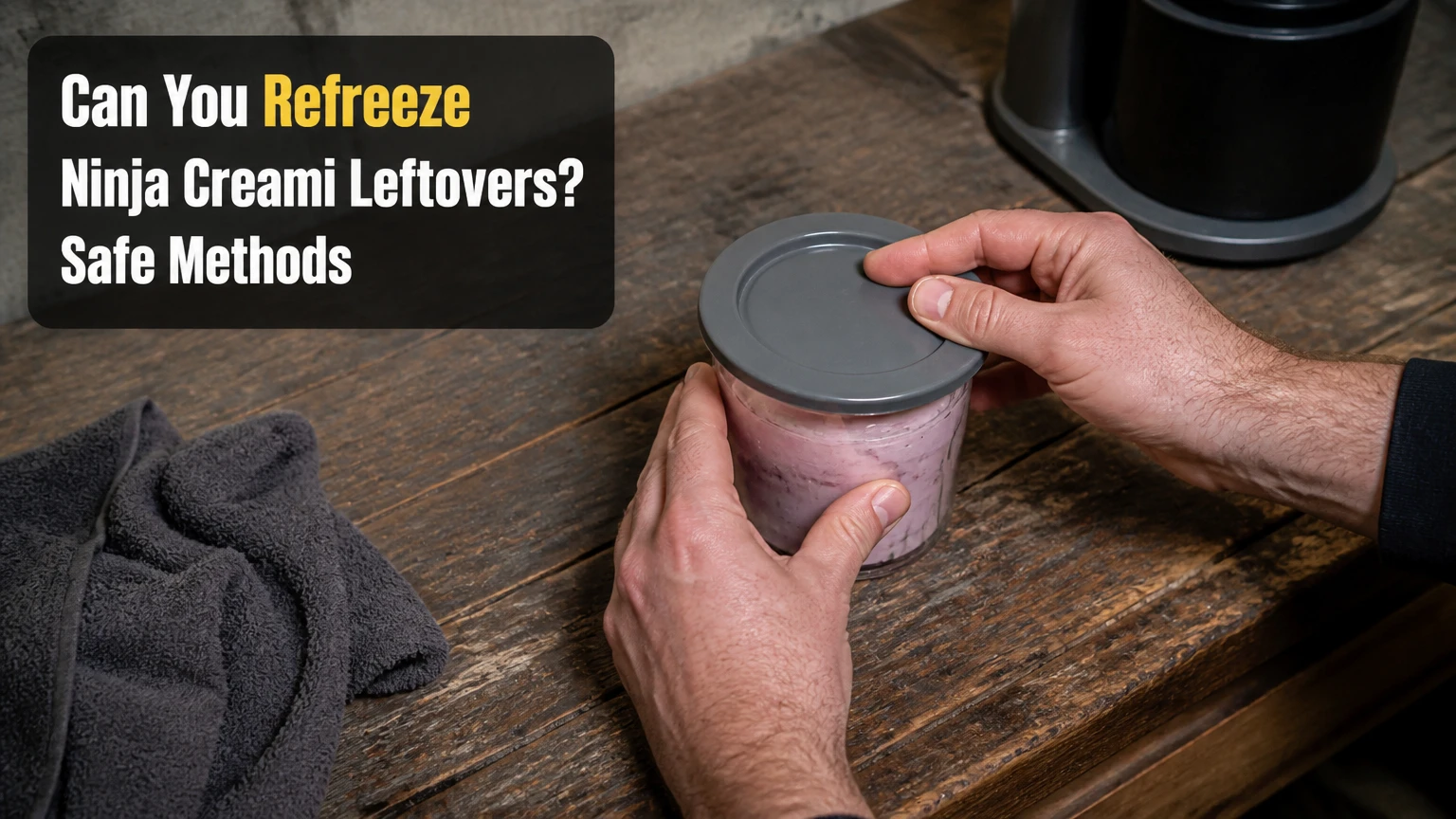
Yes, you can refreeze Ninja Creami leftovers when the mixture stayed properly chilled and was not left in unsafe temperatures. Ninja Creami leftovers usually become a hard, compact block after refreezing because the machine processes a frozen base rather than churning continuously, so the best recovery method is to level the surface, refreeze it, and run an appropriate program again.
Key Facts / Quick Answer
Refreezing restores food storage, not the original texture. A second processing cycle is usually needed.
Scrape the remaining dessert into a level surface before replacing the lid.
If the pint partially melted, refreeze it only when it remained at or below 40°F, or still contains ice crystals.
Use the original program for a fully solid pint and Re-Spin for a processed pint that remains soft but crumbly.
Low-fat, protein, and sorbet recipes generally need more liquid than full-fat dairy recipes.
Hard mix-ins may be shredded during reprocessing, so add fresh mix-ins after the base becomes smooth.
What Happens When a Ninja Creami Pint Is Refrozen?
A refrozen Ninja Creami pint becomes denser and harder because the original aerated texture is lost as the dessert warms, collapses, and freezes again. The Creami does not churn liquid while it freezes, like a traditional ice cream maker. Instead, its processing blade moves through a frozen mixture and creates the final texture during a program cycle.
The first processing cycle breaks down ice crystals and distributes air, fat, sugar, and water throughout the base. After serving, the exposed surface can melt slightly, while the remaining air escapes and the liquid refreezes around the existing dessert. That structure is usually too hard to scoop directly.
Ninja’s owner guides require the contents to be frozen level and solid before processing. The exact buttons differ among models such as the Ninja CREAMi, CREAMi Deluxe, and CREAMi Breeze, so the program names on the control panel take priority over generic instructions.
Is Refreezing the Same as Re-Spinning?
Refreezing means returning the leftover dessert to the freezer. Re-spinning means processing a frozen pint again to improve its texture. Refreezing alone does not recreate the smooth consistency produced by the first Creami cycle.
A second cycle can help, but it cannot reverse every quality change. Large ice crystals, freezer burn, melted mix-ins, and a dried protein base may remain noticeable even after reprocessing.
How Should You Prepare Leftovers Before Refreezing?
Prepare Ninja Creami leftovers by scraping the sides, pressing the remaining dessert into a flat surface, and sealing the container before freezing. A flat top gives the processing blade a more even path and reduces the chance that a frozen ridge or protruding mound interferes with the machine’s operation.
Use a clean spoon rather than a utensil that contacted raw eggs, uncooked meat, or another allergen. Keep the pint upright, place the storage lid on securely, and return it to a consistently cold freezer.
Do not overfill the container with added liquid. The mixture should remain below the pint’s fill line because expansion during freezing can push food into the lid or interfere with processing.
| Preparation step | Typical time | Why it matters |
|---|---|---|
| Scrape food from sidewalls | 1-2 minutes | Removes thin ice layers and dried residue |
| Level the top | 1 minute | Reduces ridges and uneven blade contact |
| Seal with storage lid | Immediately | Limits freezer air and odor transfer |
| Refreeze before processing | 4-24 hours | Produces a solid, machine-ready pint |
Should the Surface Be Flat or Indented?
A level surface is the safest default. A small, shallow depression in the center is acceptable when it does not expose the blade to a large hard ridge, but a deep hole is not a substitute for leveling the pint.
The most common practical error is freezing a half-eaten pint with a steep crater. The frozen mass then presents an uneven resistance pattern to the blade. Follow the owner’s manual for your model, and stop processing if the machine makes unusual sounds, stalls, or vibrates.
How Long Should Leftovers Freeze Before Re-Processing?
A refrozen pint generally needs at least 4-6 hours to become solid, while an overnight freeze gives more consistent results. A newly prepared Ninja Creami base normally requires about 24 hours because the entire container must freeze uniformly before the first cycle.
The 24-hour guideline applies to an unfrozen base, not necessarily to a small amount of already processed dessert. A nearly full leftover pint may need overnight freezing because its center remains softer than the outside. A shallow portion in a smaller freezer-safe container can freeze faster, but the Creami pint must still be solid enough for the selected program.
Freezer temperature also changes the timing. The FDA recommends keeping a freezer at 0°F for food storage, while a warmer or frequently opened freezer can lengthen freezing and increase crystal growth.
| Situation | Recommended freeze time | Processing decision |
|---|---|---|
| Fresh liquid base | About 24 hours | Run the recipe’s designated program |
| Small, soft leftover portion | 4-6 hours | Check that the center is firm |
| Nearly full refrozen pint | Overnight | Use the original program if fully solid |
| Freezer with frequent door opening | 12-24 hours | Allow extra time for uniform freezing |
How Do Different Bases Refreeze?
Full-fat dairy recipes usually recover more smoothly than low-fat, protein, water-based, or fruit-heavy recipes because fat and dissolved sugar limit ice-crystal growth. Low-fat mixtures contain more available water, so they often become harder, icier, and more crumbly after a second freeze.
Recipe results depend on the full formula, not one ingredient. A high-protein mixture with added sugar may process better than a low-sugar full-fat mixture, while sugar alcohols can produce a softer or brittle texture depending on the recipe.
| Base type | Refrozen texture | Typical added liquid | Best starting program |
|---|---|---|---|
| Full-fat dairy | Dense, usually recoverable | 0-1 tablespoon | Original program or Re-Spin |
| Protein shake or low-fat dairy | Hard, powdery, or crumbly | 1-2 tablespoons | Lite Ice Cream, then Re-Spin |
| Fruit sorbet | Icy and compact | 1-2 tablespoons water or juice | Sorbet |
| Dairy-free milk base | Firm, sometimes chalky | 1-2 tablespoons matching milk | Model-specific dairy-free option |
| Water-based sweetener recipe | Very hard and brittle | 1-2 tablespoons water | Sorbet or Re-Spin, if permitted |
Why Do Protein Pints Become Chalky?
Protein pints often become chalky because they contain relatively little fat and a high proportion of water-binding protein powder. Refreezing concentrates the dry solids at the surface and enlarges ice crystals, producing a powdery or crumbly bite.
Add liquid gradually rather than flooding the pint. For a standard pint, begin with 1 tablespoon of the original liquid, such as milk, unsweetened almond milk, or a compatible protein beverage. Add a second tablespoon only if the first re-spin remains dry.
Do Sorbets Need a Different Treatment?
Sorbets usually need the Sorbet program because their structure comes mainly from fruit, water, and sugar rather than dairy fat. A refrozen sorbet can become an especially hard block, but a second cycle often restores a spoonable texture when the mixture was stored safely.
Use fruit juice or water that matches the recipe. Too much liquid can dilute flavor and create a slushy result after processing.
Which Creami Program Should You Use?
Choose the original program when the pint is completely frozen, and choose Re-Spin when the product is already processed and only needs texture correction. Program names vary by model, so the owner’s manual determines whether Lite Ice Cream, Sorbet, Gelato, or another setting is appropriate.
A fully solid protein pint may need the recipe’s original Lite Ice Cream cycle before Re-Spin. A slightly soft, crumbly pint may need only Re-Spin. Do not treat Re-Spin as a universal setting for every hard block.
| Pint condition | First action | Liquid guidance | Expected result |
|---|---|---|---|
| Solid full-fat dairy | Original program or Re-Spin | None initially | Dense, smooth texture |
| Solid protein base | Lite Ice Cream | 1-2 tablespoons | Less chalky and crumbly |
| Solid sorbet | Sorbet | 1 tablespoon if dry | Finer fruit ice |
| Soft but crumbly | Re-Spin | 0-1 tablespoon | Smoother consistency |
| Large ice ridge or frozen mound | Stop and level | Do not process yet | Safer, more even cycle |
How Much Liquid Should You Add?
Add 1 tablespoon first, then reassess after processing. Most standard pint leftovers do not need more than 2 tablespoons, although a very dry, low-fat mixture may require additional adjustment in a later cycle.
Use a liquid that fits the recipe’s allergen and flavor profile. Milk can improve dairy texture, while water may preserve a sorbet’s fruit flavor. A large amount of liquid changes the recipe’s sugar and fat balance, so adding half a cup is not a texture correction.
Can You Refreeze Leftovers After They Melt?
You can refreeze a melted Ninja Creami dessert only when it stayed at or below 40°F, or when it still has ice crystals and remained cold throughout handling. If the pint sat at room temperature for more than 2 hours, discard it; the limit falls to 1 hour when the surrounding temperature exceeds 90°F.
The USDA uses 40°F as the upper limit for refrigerated food and identifies the 40-140°F range as the temperature danger zone. The FDA Food Code uses similar cold-holding principles for perishable foods. Refreezing does not destroy bacteria or toxins that may have developed during warm storage.
The USDA’s consumer guidance summarizes the decision plainly: “When in doubt, throw it out.” That rule is more important than preserving a few dollars of dessert.
| Storage event | Safe action | Texture consequence |
|---|---|---|
| Still fully frozen | Refreeze immediately | Minor additional quality loss |
| Partly soft with ice crystals | Refreeze promptly | More ice crystals likely |
| Fully melted, refrigerated below 40°F | Refreeze or discard for quality | Texture may become icy |
| Room temperature under 2 hours | Refreeze immediately or refrigerate | Quality declines |
| Room temperature over 2 hours | Discard | Refreezing is not a safety fix |
| Above 90°F for over 1 hour | Discard | Unsafe holding period |
Does Refreezing Kill Bacteria?
Refreezing does not reliably kill bacteria. Freezing slows microbial growth, but many microorganisms can remain alive and resume activity during thawing.
A Creami cycle also is not a validated cooking or pasteurization step. Treat recipes containing milk, cream, eggs, or protein beverages as perishable foods, and use pasteurized ingredients when the recipe calls for them.
What Is the Safest Re-Processing Method?
The safest practical method is to flatten the leftovers, refreeze them until solid, add a small amount of compatible liquid only when needed, and use the program that matches the base. Process the whole pint rather than trying to force a spoon through a rock-hard center.
- Inspect the leftovers for freezer burn, contamination, or an unsafe thawing history.
- Scrape the sides and level the surface with a clean spoon.
- Replace the storage lid and freeze the pint upright for 4-24 hours.
- Remove the lid and inspect the top for hard ridges or a protruding frozen mound.
- Add 1 tablespoon of compatible liquid if the mixture looks dry or protein-heavy.
- Install the pint according to the model’s instructions and select the matching program.
- Use Re-Spin if the result is crumbly, then add fresh mix-ins afterward.
- Stop if the machine stalls, vibrates excessively, or produces abnormal noise.
Do not run the machine with the storage lid attached. The storage lid is for freezing and storage, while the processing lid and paddle assembly belong to the machine’s operating setup.
What If the Pint Is Rock Hard?
A rock-hard pint is normal after refreezing, but the machine should process it only when the surface is level and the container is correctly installed. Do not hammer the pint, pry frozen food out with a knife, or force the paddle downward by hand.
For a particularly hard low-fat pint, allow it to sit briefly according to the owner’s manual and kitchen conditions. A short 5-10 minute tempering period can reduce surface brittleness, but partial melting should not replace proper freezing.
Can You Eat Refrozen Creami Leftovers Without the Machine?
You can soften a safe leftover portion in the refrigerator and eat it without another Creami cycle, but the result will usually be denser and icier. A countertop thaw is faster, yet it provides less temperature control and increases the chance that a dairy or protein dessert spends too long in the danger zone.
Do not microwave a Ninja Creami pint unless the specific container documentation explicitly identifies it as microwave-safe. Many plastic storage containers are not intended for microwave heating, and hot spots can melt the dessert unevenly.
For a small serving, transfer the portion to a microwave-safe bowl if you choose a brief thawing method. Refrigerator thawing is the more controlled option.
| Alternative | Typical time | Best use | Main limitation |
|---|---|---|---|
| Refrigerator thaw | 1-3 hours | Food-safety control | Slow and still somewhat icy |
| Counter softening | 10-20 minutes | Immediate serving | Temperature rises quickly |
| Microwave-safe bowl | 10-second intervals | Very small portions | Uneven softening |
| High-speed blender | 30-90 seconds | Milkshake texture | Needs added liquid |
| Silicone portions | 4-8 hours to freeze | Single servings | More cleanup and storage space |
What Are the Best Alternatives to Refreezing a Whole Pint?
Portioning future batches before they become fully frozen is the best alternative when one pint is routinely too large. Silicone freezer molds, small freezer-safe containers, or ice cube trays let you reblend only the amount needed and reduce repeated thawing.
A high-speed blender can turn frozen leftovers into a drinkable dessert with milk or another compatible liquid. The result will resemble a thick shake more than a newly processed Creami dessert because a blender changes particle size without using the Creami’s pint-processing path.
Use extra Ninja containers when convenience matters more than minimizing cost. Typical replacement-container prices vary by model and retailer, often around $15-$30 per container in the United States, so portioning in inexpensive freezer-safe containers may cost less.
How Do Mix-Ins Behave After Refreezing?
Mix-ins can become harder, softer, or more fragmented after refreezing, and a full processing cycle may break them into small pieces. Chocolate chips, nuts, candy, and cookie pieces should usually be added after the base has been re-spun.
Hard candy creates a separate equipment risk because large pieces can resist the paddle or produce an uneven load. Sticky caramel and fruit preserves can smear into the container walls, while cookies absorb moisture and become dense.
Allergen control also matters. A spoon used in peanut butter, tree nuts, or wheat-based cookies can contaminate a pint that otherwise has a different ingredient profile.
- Remove large hard pieces before processing.
- Add fresh mix-ins after the base becomes smooth.
- Label pints containing peanuts, tree nuts, dairy, eggs, soy, or wheat.
- Do not mix a questionable leftover with a fresh batch.
- Discard food with an off odor, mold, swollen packaging, or unexplained discoloration.
Can You Refreeze a Pint With Mix-Ins?
You can refreeze a pint with mix-ins if the food remained safely cold, but the texture may deteriorate more than a plain base. If the pieces are large or hard, remove them before reprocessing and replace them afterward.
Soft fruit and small cookie crumbs generally tolerate a second freeze better than nuts or candy. The safest quality strategy is to separate the base from fragile mix-ins whenever possible.
How Long Do Refrozen Leftovers Keep?
Refrozen Ninja Creami leftovers have no single guaranteed shelf-life number because safety depends on ingredients, temperature control, contamination, and freezer performance. For quality, use them within 1-2 weeks, while properly handled frozen food can remain safe longer at 0°F even as texture declines.
The USDA explains that frozen food kept continuously at 0°F remains safe indefinitely, although recommended storage periods are mainly quality guidelines. That principle does not rescue food that was previously held warm or contaminated.
Freezer burn is a quality problem, not automatically a safety problem. It causes dry, gray, leathery areas and stale flavors. Cut away severe freezer-burned sections only when the remaining food has a safe storage history.
| Storage period at 0°F | Quality expectation | Practical recommendation |
|---|---|---|
| 1-7 days | Best texture after re-spin | Use normally |
| 8-14 days | Minor ice growth possible | Re-spin with little liquid |
| 15-30 days | Noticeable dryness or freezer odor | Use in a shake or discard poor-quality portions |
| Over 30 days | Texture increasingly degraded | Evaluate carefully; safety depends on history |
What Problems Indicate You Should Stop?
Stop using the pint when the container is cracked, the lid no longer seals, the paddle cannot engage correctly, or the food has an unsafe thawing history. Stop the machine when it stalls or makes abnormal mechanical noise rather than repeatedly pressing the program button.
The Ninja Creami is not a rescue tool for spoiled food or a substitute for freezer discipline. Its blade can improve texture, but it cannot remove bacterial hazards, freezer odors, or rancid flavors.
Why Is My Re-Spun Pint Powdery?
A powdery pint usually needs more moisture, contains a high proportion of protein solids, or has been exposed to freezer air. Add 1 tablespoon of compatible liquid and run Re-Spin once; repeated cycles can warm the dessert and worsen separation.
If the mixture remains chalky after a second cycle, use it in a smoothie or shake rather than continuing to process it. More spinning cannot compensate for a badly imbalanced frozen formula.
Why Is My Re-Spun Pint Icy?
An icy pint usually contains excess free water, low sugar, or large ice crystals created during slow thawing and refreezing. Full-fat dairy may soften the perception of ice, but it cannot eliminate crystals that already formed.
For future batches, freeze the base promptly, keep the freezer at 0°F, minimize door opening, and avoid leaving the container uncovered. Leveling the pint reduces air exposure across the surface.
Frequently Asked Questions About can you refreeze ninja creami leftovers
Can I refreeze a half-eaten Ninja Creami pint overnight?
Yes, if the half-eaten pint stayed frozen or remained below 40°F during handling. Level the surface, close the storage lid, and freeze it overnight. Process the solid pint again before serving because refreezing alone will usually create a hard, dense block.
Can I refreeze a protein shake made in a Ninja Creami?
Yes, a protein-based Creami dessert can be refrozen when it was safely stored. Protein and low-fat recipes commonly become chalky, so add 1 tablespoon of compatible milk or protein beverage before a Lite Ice Cream cycle or Re-Spin.
Should I use Re-Spin after freezing leftovers?
Use Re-Spin when the leftover pint is already processed and remains somewhat soft or crumbly. Use the recipe’s original program when the pint has frozen into a completely solid block. Program names differ by Ninja model, so follow the control panel and manual for your machine.
Can I refreeze Ninja Creami sorbet?
Yes, sorbet can be refrozen safely when it stayed cold, but its high water content often produces a very hard, icy block. Run the Sorbet program again and add up to 1 tablespoon of water or matching fruit juice if the result looks dry.
Is a refrozen Creami pint safe after sitting out?
Safety depends on time and temperature. A pint left at room temperature for more than 2 hours, or more than 1 hour above 90°F, should be discarded. Refreezing slows future growth but does not undo the hazard created by prolonged warming.
Can I use a blender instead of re-spinning leftovers?
Yes, transfer the frozen dessert to a blender with a small amount of compatible liquid. A blender can produce a shake or soft dessert, but it will not duplicate the Creami’s texture exactly. Blend only a safe portion and return unused food to the freezer promptly.
Conclusion: Can You Refreeze Ninja Creami Leftovers?
You can refreeze Ninja Creami leftovers when they stayed safely cold, but the dessert will usually return as a hard block that needs another processing cycle. Flatten the surface, freeze the pint securely, choose the correct program for the base, and add liquid sparingly to protein or low-fat recipes. When temperature history is uncertain, discard the pint rather than relying on refreezing to make it safe.