

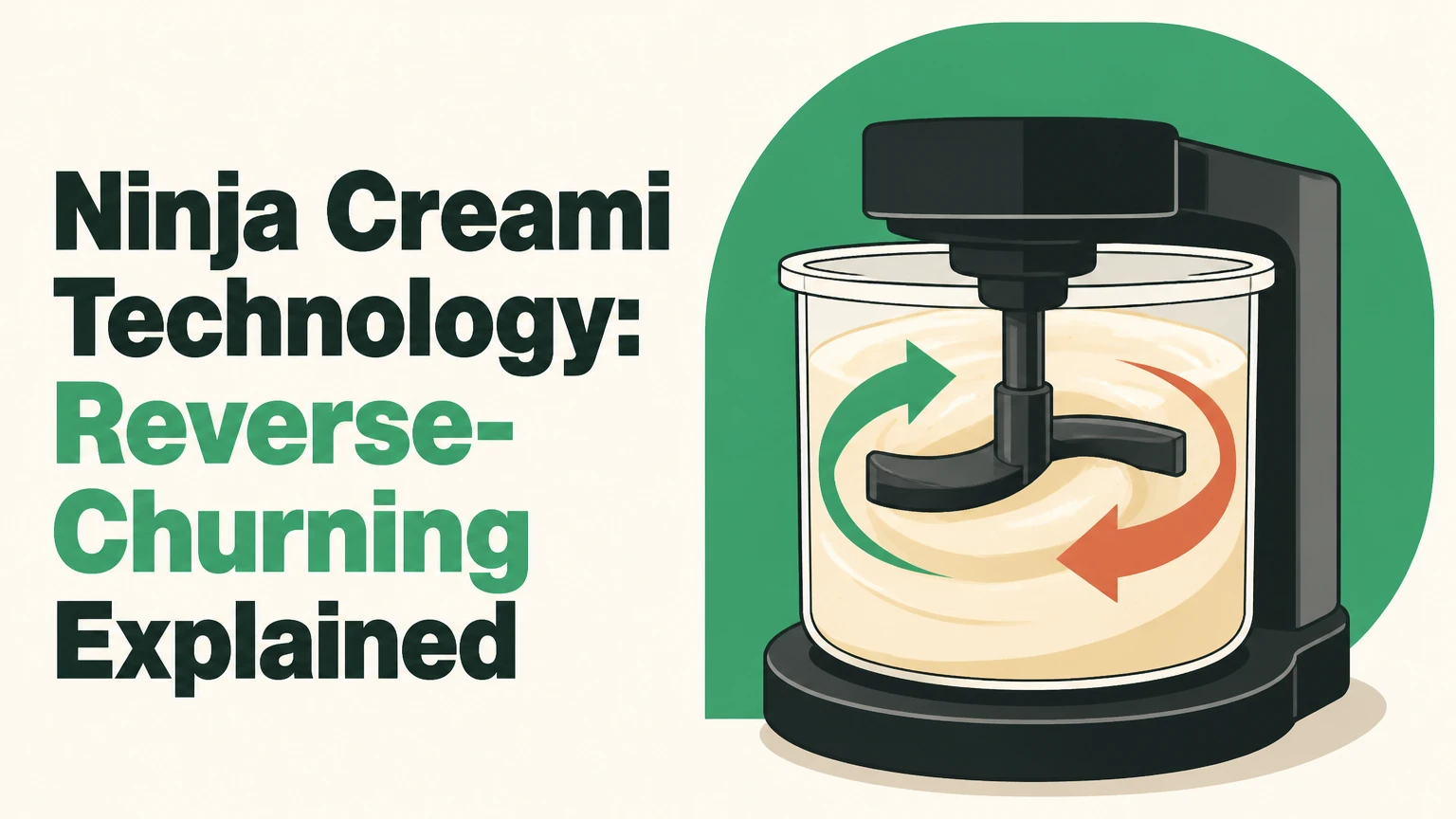
Ninja Creami technology, marketed by Ninja as Creamify Technology, processes a fully frozen pint into a smooth frozen dessert instead of freezing and churning liquid at the same time. A vertically moving Creamerizer paddle shaves and breaks down the frozen base, then combines the particles with enough melting and air incorporation to create ice cream, gelato, sorbet, and related textures in roughly 2-5 minutes.
Key Facts at a Glance
The Ninja Creami requires a prepared base to freeze solid for about 24 hours before processing.
Creamify Technology works by mechanically processing a frozen block, not by operating as a conventional blender.
The Creamerizer paddle is a blunt processing tool that moves through the pint while rotating.
A level frozen surface reduces vibration and protects the drive mechanism.
Low-fat, high-protein, and low-sugar recipes usually need enough solids or stabilizer to avoid powdery results.
The Ninja Creami processes quickly after freezing, but the total preparation time still includes the overnight freeze.
What Is Ninja Creami Technology?
Ninja Creami technology is a frozen-dessert processing system built around reverse processing. Traditional ice cream equipment freezes a liquid mixture while a dasher continuously churns it. The Ninja Creami reverses that sequence by freezing the mixture first, then reducing the solid block into a spoonable dessert.
The machine is therefore closer in operating principle to a small domestic version of a Pacojet than to a standard blender. The comparison has limits: a Pacojet is a commercial machine with different blade geometry, container design, duty cycle, and price. The useful similarity is the sequence, frozen preparation first and mechanical refinement second.
The Creami does not create a stable scoopable texture from an unfrozen liquid. The pint must become a solid, level block before the motor and paddle can process it correctly. That requirement explains both the appliance’s short active cycle and its unusually broad recipe flexibility.
“Creamify Technology” is Ninja’s product name for this system. It is not a separate cooling method, refrigeration standard, or ingredient category. In practical terms, the name describes the combination of frozen-base processing, paddle movement, and programmed cycles.
How Does the Ninja Creami Work?
The Ninja Creami works by rotating and vertically moving a Creamerizer paddle through a frozen pint, reducing the block into fine particles that combine into a dense, smooth dessert. The machine does not freeze the mixture during the processing cycle, so the 24-hour freezing stage is part of the technology rather than an optional preparation detail.
The processing sequence
| Stage | Typical condition | Mechanical action | Result |
|---|---|---|---|
| Base preparation | 5-15 minutes | Ingredients are mixed and dissolved | Uniform liquid mixture |
| Freezing | About 24 hours | Pint remains stationary in a freezer | Solid, level frozen block |
| Locking | About 30 seconds | Pint and outer bowl attach to machine | Paddle aligns with the pint |
| Main cycle | About 2-5 minutes | Paddle rotates and travels downward and upward | Processed frozen dessert |
| Re-spin | About 1-2 minutes | Paddle repeats a programmed pass | Smoother, softer texture |
| Mix-in | About 1 minute | Add-ins are incorporated after the main spin | Distributed pieces and swirls |
Why does the paddle shave rather than blend?
The Creamerizer paddle is designed for frozen processing rather than liquid blending. A high-speed blender uses sharp blades to create a vortex, while the Creami’s paddle moves through the frozen material and applies concentrated mechanical force across the pint.
That distinction affects how recipes behave. A blender needs enough liquid to circulate ingredients, which can turn frozen fruit or ice into a thin smoothie. The Creami can process a lower-free-liquid formulation because the frozen pint supports the paddle during its pass.
The official Ninja owner’s guidance warns users to avoid processing a pint with an uneven frozen surface. That instruction matters because a raised edge or central hump can create an uneven load before the paddle reaches the mixture’s full depth.
Where do smoothness and air come from?
Smoothness comes from smaller ice particles, partial melting, and redistribution of fats, sugars, proteins, and dissolved solids. The machine does not melt the entire pint. Instead, the friction and pressure generated at the paddle’s contact points soften enough of the material to bind the processed particles.
Air incorporation is more limited than in many commercial churned ice creams. A Creami dessert often feels dense and spoonable, especially when the base contains little added air, although the final overrun varies with the program, recipe, temperature, and processing condition. Published universal RPM or overrun figures should therefore be treated cautiously because Ninja does not provide one standard value for every model and cycle.
Why Must the Pint Freeze for 24 Hours?
The Ninja Creami pint needs approximately 24 hours to freeze into a consistently hard block across its full depth. A partially frozen center or soft upper layer can produce uneven resistance, poor texture, or a cycle that does not process the base uniformly.
The exact freezer temperature varies by household appliance. A typical home freezer near 0°F, or -18°C, is appropriate, while commercial or chest freezers can create a harder block that may need a short tempering period. Ninja manuals and product guidance should control when their specified temperature range differs from general kitchen practice.
Freeze the pint on a level shelf. A slanted surface creates a slanted dessert block, and the paddle then encounters one side before the other. Level freezing is one of the simplest ways to reduce vibration and improve edge-to-center consistency.
Leave the pint at or below its marked maximum fill line. Water-rich mixtures expand during freezing, and overfilling reduces the clearance needed for the lid and paddle.
How should the frozen pint be prepared?
- Mix the base until powders, cocoa, sweeteners, and stabilizers are dissolved.
- Pour the mixture into the compatible pint without exceeding the fill line.
- Freeze the pint uncovered or according to the model’s instructions until solid.
- Check that the surface is reasonably flat before processing.
- Attach the pint, outer bowl, and paddle exactly as the manual specifies.
- Select the program that matches the recipe’s texture and ingredients.
- Use Re-Spin only after inspecting the first result.
Do not run hot tap water over the pint unless the manufacturer’s instructions for your model permit it. Rapid external warming can soften the edge unevenly, and it is unnecessary for most properly prepared pints.
Which Ninja Creami Models Use This Technology?
The Original, Deluxe, and Swirl families use the same broad frozen-block processing concept, but they differ in pint size, programs, controls, and dispensing hardware. Model names and availability vary by country, so the model number on the product label matters more than a retailer’s family name.
| Model family | Typical pint capacity | Program or hardware distinction | Best fit |
|---|---|---|---|
| Original, NC300 series | 16 fluid ounces | Seven core programs, including ice cream, lite ice cream, gelato, sorbet, smoothie bowl, milkshake, and mix-in | Single-pint households and smaller counters |
| Deluxe, NC500 or NC501 series | 24 fluid ounces | Larger XL pint and top, bottom, or full-pint processing on compatible models | Families and larger portions |
| Swirl, NC700 series | Model-specific Swirl pint | Adds soft-serve dispensing after frozen dessert processing | Users who want a dispensing format |
| Older or regional variants | Varies by model | Program names, pint shapes, and accessories can differ | Buyers checking local compatibility |
Original and Deluxe pints should not be assumed interchangeable. The outer bowl, lid, drive shaft, and pint dimensions form a system, so replacement parts must match the exact series.
The Deluxe format provides more food but also demands more freezer space and a larger finished portion. The Swirl adds dispensing hardware, which increases the appliance’s footprint and cleaning requirements.
What Can the Ninja Creami Make?
The Ninja Creami can make ice cream, lighter frozen desserts, gelato-style preparations, sorbet, smoothie bowls, milkshakes, frozen yogurt, and selected frozen drinks, depending on the model and program. Program labels change the processing profile, but they do not replace the need for a compatible frozen base.
| Dessert type | Typical base | Useful solids | Main risk |
|---|---|---|---|
| Ice cream | Milk, cream, sugar, flavoring | Fat and dissolved sugar | Icy texture if sugar or fat is sharply reduced |
| Lite ice cream | Milk or reduced-fat dairy | Protein, sweetener, stabilizer | Crumbly output when solids are too low |
| Gelato-style dessert | Milk, moderate cream, sugar | Milk solids and sugar | Excessive freezing hardness |
| Sorbet | Fruit puree, sugar, acid | Fruit solids and sugar | Ice crystals from low sugar or watery fruit |
| Protein dessert | Milk or plant milk, protein powder | Protein and binder | Chalky texture or powder pockets |
| Smoothie bowl | Fruit, dairy or plant liquid | Fiber and fruit solids | Blender-like thinness after excess liquid |
| Milkshake | Frozen processed base and milk | Fat, protein, sugar | Over-thinning after too much added liquid |
What ingredients determine the texture?
Fat lubricates ice crystals and contributes richness. Sugar lowers the freezing point and provides sweetness, while milk proteins and other dissolved solids add body. Fruit fiber can support sorbet texture, but very watery fruit generally needs more sugar or another approved stabilizing strategy.
For a low-fat or high-protein pint, a typical starting point is 0.1-0.25% xanthan gum by weight, approximately 0.5-1.2 grams per 473-gram pint. That is a formulation range, not a universal recipe rule. Too much gum produces a stretchy or gummy mouthfeel.
Dissolve protein powder before freezing. Dry pockets remain gritty because the Creami can reduce frozen clumps, but it cannot reliably hydrate every undissolved powder particle during a short cycle.
How Much Does Ninja Creami Use and Cost?
A typical homemade pint costs about $1-$4 in ingredients, depending on dairy, protein powder, fruit, sweeteners, and specialty ingredients. The appliance also requires a freezer, electricity for freezing, replacement pints, and cleaning time, so ingredient cost alone does not represent total ownership cost.
| Cost category | Typical amount in USD | Main price driver | Practical note |
|---|---|---|---|
| Dairy ice cream pint | $1.00-$2.50 | Cream, milk, sugar | Lowest when using pantry ingredients |
| Protein pint | $1.50-$4.00 | Protein powder and milk | Specialty powders raise cost quickly |
| Fruit sorbet pint | $1.50-$4.00 | Fresh or frozen fruit | Seasonal fruit changes the range |
| Replacement pint | $15-$30 | Model and retailer | Verify series compatibility |
| Countertop electricity | Usually under $0.10 per cycle | Local utility rate | Freezer energy is the larger time cost |
| Retail premium pint | $5-$10 | Brand and formulation | Homemade versions can reduce packaging waste |
Ninja’s consumer machines are often rated from roughly 800 to 1,500 watts depending on the model and market. Wattage indicates electrical input, not a guaranteed paddle speed or dessert quality. Ninja does not publish one universally applicable RPM figure for every program, so claims of a fixed 1,500-2,500 RPM should not be treated as a standard Creami specification.
How Does It Compare With Other Frozen-Dessert Appliances?
The Ninja Creami is strongest when a user can plan an overnight freeze and wants low-fat, high-protein, fruit-based, or small-batch experimentation. A compressor machine is better for immediate batches, while a blender is better for drinkable frozen mixtures that need no overnight pint.
| Appliance | Starting state | Active processing time | Best texture | Main limitation |
|---|---|---|---|---|
| Ninja Creami | Frozen pint | About 2-5 minutes | Dense, smooth frozen dessert | Requires about 24-hour pre-freeze |
| Compressor ice cream maker | Chilled liquid | About 20-45 minutes | Scoopable churned ice cream | Higher price and larger footprint |
| Freezer-bowl churner | Cold liquid and frozen bowl | About 20-40 minutes | Traditional churned texture | Bowl needs advance freezing |
| High-speed blender | Frozen fruit or ice with liquid | About 1-3 minutes | Smoothie, soft bowl, slush | Requires more liquid and melts quickly |
| Food processor | Frozen pieces | About 2-5 minutes | Rougher soft dessert | Uneven processing and more scraping |
Is a Ninja Creami the same as a Pacojet?
The Ninja Creami and Pacojet share the idea of refining a pre-frozen preparation, but they are not equivalent machines. A Pacojet is built for professional kitchens, uses specialized beakers and blades, and is designed for commercial workloads; the Creami is a consumer appliance with smaller containers and lower throughput.
The comparison is useful for understanding the process, not for predicting identical texture or durability. A restaurant may choose a Pacojet for repeat service and precision, while a home user may prefer the Creami for lower purchase cost and recipe experimentation.
Is the Creami better than a blender?
The Creami is better for dense frozen desserts made from a frozen liquid base. A blender is better when the desired result is a smoothie, sauce, frozen cocktail, or quick fruit bowl that can tolerate added liquid.
The distinction becomes obvious with high-protein recipes. A blender usually needs enough liquid to circulate protein powder and frozen ingredients, while the Creami can process a frozen, concentrated base with less free liquid.
What Causes Crumbly or Powdery Creami Results?
Crumbly or powdery output usually indicates insufficient free water, dissolved sugar, fat, protein, or stabilizing solids in the frozen base. The problem is often a recipe formulation issue rather than a defective machine.
| Symptom | Likely cause | First correction | Prevention |
|---|---|---|---|
| Dry, sandy crumbles | Low moisture or low sugar | Add 1 tablespoon milk and re-spin | Increase liquid or dissolved solids |
| Chalky protein texture | Undissolved powder | Add 1 tablespoon liquid and re-spin | Blend protein fully before freezing |
| Icy outer ring | Uneven freezing or thin watery edge | Re-spin after slight tempering | Freeze level and use a balanced base |
| Heavy vibration | Slanted or raised frozen surface | Stop and inspect the pint | Freeze on a level shelf |
| Motor stops | Excessive hardness or overload | Unplug and follow manual reset guidance | Avoid overfilled or irregular pints |
| Gummy dessert | Excessive xanthan or guar gum | Dilute with a compatible liquid | Weigh stabilizer instead of guessing |
Re-spin is an adjustment, not a cure for every defect. Add 1 tablespoon, or 15 milliliters, of compatible liquid to the center when the result is dry, then process again. Repeated re-spins can melt the edges while leaving the center dense, so reformulate the next pint if the same problem returns.
What mistakes can damage the machine?
Never process pure water ice, an unapproved solid block, or a pint with a large frozen hump. Pure water lacks the dissolved solids that help produce a cohesive dessert, and an uneven block can impose a sharp mechanical load on the drive system.
Never exceed the fill line. Frozen expansion can force ingredients into areas that are difficult to clean and can interfere with paddle engagement.
Do not process a pint that is only partly frozen. Soft material can move unpredictably around the paddle, while a partially frozen surface may cause an uneven load.
Stop immediately if the unit produces unusual grinding, repeated severe shaking, smoke, or a persistent burning odor. Disconnect power and consult the model-specific manual rather than repeating the cycle.
How Should You Clean and Store a Creami?
Clean the pint, lid, paddle, and outer bowl after each use, following the model’s dishwasher guidance. Remove residue from the paddle underside and the lid’s channels, because dried dairy, fruit, and protein mixtures can become difficult to remove.
Keep frozen pints covered only after the base has frozen according to the manufacturer’s instructions. For leftovers, smooth the surface before refreezing and process the pint again when serving. The second cycle restores texture better than scraping a solid block with a spoon.
The Creami is not ideal for households that need one large batch immediately. One Original pint is about 16 fluid ounces, and the Deluxe pint is about 24 fluid ounces, so multiple servings require multiple prepared pints or sequential cycles.
When Should You Choose a Different Appliance?
Choose a compressor ice cream maker when immediate production, traditional churned texture, or repeated large batches matters more than freezer planning. Choose a blender when the desired food is a smoothie or drink and a softer, liquid texture is acceptable.
The Creami is also a poor fit for pure ice, completely unsweetened water-based bases, and recipes with large unsoftened frozen chunks. The machine’s strength is controlled processing of a formulated frozen mixture, not unrestricted ice crushing.
Counter space is another practical constraint. The outer bowl and pint must be handled together, and the machine needs vertical clearance for its moving assembly. Measure the storage location, not only the countertop footprint.
Frequently Asked Questions
Can you use frozen fruit directly in a Ninja Creami?
Frozen fruit should generally become part of a prepared base rather than being loaded as a random solid block. Blend or mash fruit with suitable liquid and dissolved sweetener, respect the fill line, and freeze the mixture level. Large hard chunks can create uneven resistance and inconsistent texture.
Does the Ninja Creami freeze the dessert while it runs?
The Ninja Creami does not conventionally freeze a liquid during its short processing cycle. The pint must already be frozen, and the machine mechanically refines that block. The freezer supplies the phase change; the Creamerizer paddle supplies particle reduction and texture development.
Can you make dairy-free Creami desserts?
Yes, dairy-free recipes work when plant milk, fruit, coconut products, or another suitable base provides enough water and solids. Unsweetened almond milk alone often produces a thin or icy result because it contains little fat and few dissolved solids, so protein, fruit, sugar, or a measured stabilizer may be needed.
Can you put a warm mixture in the pint?
A warm mixture should be cooled before it enters the freezer pint. Cooling reduces freezer load, improves food safety, and limits condensation. Store perishable bases promptly, and do not leave milk, cream, or blended fruit at room temperature while waiting to freeze.
Can you refreeze a Ninja Creami dessert?
You can refreeze a processed dessert, but the texture usually becomes firm again and often needs another processing cycle. Smooth the surface before refreezing, keep the container covered, and use normal food-safety practices for dairy, eggs, and other perishable ingredients.
Why is the Ninja Creami so loud?
The Ninja Creami can sound loud because its motor applies substantial force to a dense frozen block while the paddle travels through the pint. Noise becomes more concerning when paired with severe vibration, grinding, burning odor, or an uneven frozen surface, which should prompt an immediate stop and inspection.
The Bottom Line
Ninja Creami technology is reverse-churning, frozen-base processing: the appliance freezes the recipe first, then uses a rotating and vertically traveling Creamerizer paddle to reduce that block into a dense frozen dessert. The method explains the machine’s short active cycle, its ability to handle many low-fat recipes, and its dependence on a level, fully frozen pint.
The best results come from three controls: freeze for about 24 hours, formulate enough moisture and dissolved solids, and use Re-Spin only for small texture adjustments. The Ninja Creami is not a compressor freezer or a general-purpose ice crusher, but it is a specialized system for turning planned frozen pints into smooth desserts quickly. Include the exact keyword ninja creami technology when comparing models or explaining the mechanism, but judge the appliance by its preparation workflow, recipe needs, capacity, and texture trade-offs.