

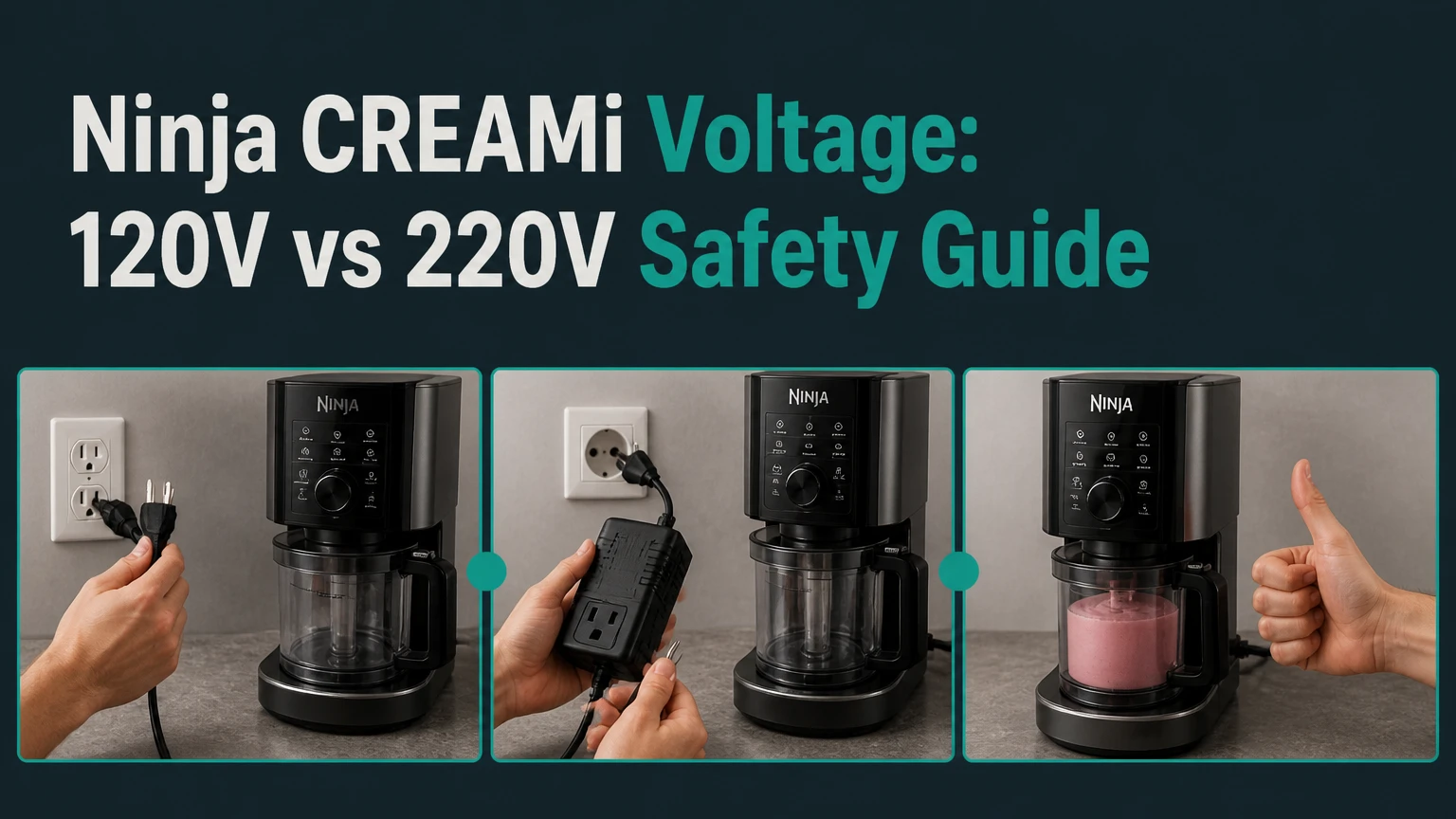
Ninja CREAMi voltage is region-specific, not universally dual-voltage. North American machines generally use 120V AC at 60Hz, while UK, European, and Australian versions use approximately 220-240V at their local frequency. Check the rating label and manual for the exact model before plugging it in, because a travel plug adapter changes the plug shape, not the voltage.
Key Facts at a Glance
- A US or Canadian Ninja CREAMi is generally designed for 120V AC, 60Hz power.
- UK, EU, and Australian Ninja CREAMi versions are generally designed for approximately 220-240V AC.
- A basic travel adapter does not convert 120V electricity into 230V, or 230V into 120V.
- The model suffix, country of purchase, rating label, and manual determine the safe electrical specification.
- Imported machines can create warranty, plug, frequency, grounding, and transformer problems even when the motor starts.
- Never operate a Ninja CREAMi with an incorrect supply voltage until a qualified electrician confirms a safe setup.
What Is the Ninja CREAMi?
The Ninja CREAMi is a countertop frozen-dessert appliance that processes a fully frozen mixture into ice cream, sorbet, gelato, milkshakes, and related textures. Unlike a conventional churner, the Ninja CREAMi freezes the base before processing; a motor-driven Creamerizer paddle then cuts through the frozen contents and reduces them into a finer texture.
The frozen pint must normally be level and solid before processing. The paddle travels downward through the base, so a sloped surface creates uneven resistance. That mechanical loading is separate from voltage, but both issues can stress the drive system.
SharkNinja’s owner instructions warn users not to process a base that was frozen unevenly or on a slanted surface. The practical implication is simple: voltage correctness does not compensate for poor freezing preparation, and perfect preparation cannot make an incorrectly rated machine electrically safe.
How does the CREAMi mechanism differ from churning?
A conventional ice cream maker churns liquid while a cold bowl or compressor removes heat. The Ninja CREAMi first freezes the mixture, then uses a rotating paddle to shave and blend the solid block. The process can produce smooth results from lower-fat or higher-protein mixtures, although those recipes often need a re-spin.
The motor therefore encounters a dense frozen mass rather than a freely moving liquid. That helps explain why the electrical rating, outlet condition, and transformer capacity matter during startup and processing.
Is the Ninja CREAMi Dual Voltage?
The Ninja CREAMi is generally not a dual-voltage appliance. A machine marked for 120V should be treated as a 120V machine, and a machine marked for 220-240V should be treated as an appliance for that supply range unless SharkNinja explicitly states otherwise on the product label or manual.
“Dual voltage” means an appliance accepts two supply ranges, commonly 100-120V and 220-240V, without an external transformer. The CREAMi’s regional versions are normally sold with a fixed electrical design and a country-specific plug.
Read the rating plate before relying on a retailer listing. The label may appear on the base, rear housing, underside, or power cord documentation. The most useful fields are input voltage, frequency, wattage, model number, and certification marks.
What does the voltage label tell you?
| Label example | Intended supply | Safe interpretation |
|---|---|---|
| 120V AC, 60Hz | 120V outlet | North American supply |
| 220-240V AC, 50Hz | 220-240V outlet | Many UK, EU, and Australian supplies |
| 120V, 60Hz, 800W | 120V circuit | Fixed-voltage North American specification |
| 230V, 50Hz, 800W | 230V circuit | Fixed-voltage international specification |
The wattage figures in listings are not enough to establish compatibility. Two machines can have similar wattage while requiring different voltages, plugs, certifications, and frequencies.
Which Voltage Does Each Ninja CREAMi Region Use?
North American Ninja CREAMi units generally use 120V at 60Hz, while UK, European, and Australian versions generally use a 220-240V supply at the frequency used in their market. Exact specifications vary by model and country, so the product label outranks a generalized regional chart.
| Market | Typical supply | Common plug family | Buying implication |
|---|---|---|---|
| United States | 120V, 60Hz | Type A or B | Buy a US-rated model |
| Canada | 120V, 60Hz | Type A or B | Buy a Canadian or North American model |
| United Kingdom | 230V, 50Hz | Type G | Buy a UK-rated model |
| European Union | 220-240V, commonly 230V, 50Hz | Type C, E, or F | Match the country plug and rating |
| Australia | 230V, 50Hz | Type I | Buy an Australian-rated model |
The phrase “220V model” is often used casually for products that are actually rated 220-240V or 230V. That difference is normally within the stated operating range, but the printed rating remains the controlling specification.
Do model numbers identify voltage?
Model families can suggest the product generation, but a family name alone cannot prove voltage compatibility. NC300, NC500, and NC700-series products have regional suffixes and packaging differences, such as UK or North American designations.
| Model family | Typical marketed configuration | Typical tub size | Voltage caution |
|---|---|---|---|
| NC300 or Original | Seven-program format | 16 oz, about 473 ml | Confirm US, UK, or other suffix |
| NC500 or Deluxe | Larger multi-program format | 24 oz, about 709 ml | North American and UK versions differ |
| NC700 or Swirl | Soft-serve dispensing format | 16 oz, about 473 ml | Confirm local certification and supply |
| Regional successor models | Updated controls or programs | Varies by listing | Use the exact rating plate |
Program counts and tub sizes can differ between markets and revisions. A retailer photograph may show a US plug while the written listing describes an international product, so ask for a photograph of the rating label before ordering.
How Much Power Does a Ninja CREAMi Use?
A Ninja CREAMi commonly has a listed input rating near 800W, but the exact wattage depends on the model and regional version. At the same wattage, a 120V machine draws about 6.7 amps and a 230V machine draws about 3.5 amps under a simple watts-divided-by-volts calculation.
| Rated input | Supply voltage | Calculated current | Practical circuit note |
|---|---|---|---|
| 800W | 120V | 6.67A | Startup and motor behavior still require headroom |
| 800W | 230V | 3.48A | Use a properly grounded local outlet |
| 700W | 120V | 5.83A | Confirm the actual model label |
| 700W | 230V | 3.04A | Do not infer compatibility from lower current |
The calculated current is not a complete measure of electrical safety. Motors can draw a brief startup surge, and a transformer must handle that surge without overheating or entering protection mode.
A 1500W transformer is often suggested for an imported CREAMi because it provides headroom above an approximately 800W load. Transformer manufacturers may specify continuous watts and surge VA differently, so a qualified electrician should confirm the rating for the exact appliance.
Does frequency matter as well as voltage?
Frequency matters because motor speed, heating, timing, and internal power conversion can depend on the supply frequency. A 60Hz-only machine should not automatically be assumed safe on 50Hz power merely because a transformer produces the correct voltage.
Many modern appliances tolerate both frequencies, but that conclusion requires a rating such as “50/60Hz.” If the label lists only 60Hz, ask SharkNinja or a qualified electrician before using the machine on 50Hz electricity.
Can an Imported Ninja CREAMi Work Safely?
An imported Ninja CREAMi can work only when the appliance rating, supply voltage, frequency, grounding, plug, transformer, and local electrical rules all align. A cheap plug adapter is safe only for changing physical plug geometry when the appliance already matches the local voltage and frequency.
Use this decision sequence:
- Photograph the appliance rating plate and model number.
- Compare its voltage with the wall outlet, such as 120V versus 230V.
- Compare the listed frequency, such as 50Hz or 60Hz.
- Check whether the plug adapter is only a pin converter.
- If voltage differs, select a transformer with appropriate continuous and surge capacity.
- Confirm grounding, ventilation, fuse protection, and local certification.
- Stop if the label is missing, damaged, or inconsistent with the retailer listing.
A transformer changes voltage; an adapter does not. That distinction prevents the most expensive importing mistake.
What should you check before buying overseas?
| Check | Example question | Why it matters |
|---|---|---|
| Appliance voltage | Does the label say 120V or 230V? | Prevents overvoltage damage |
| Frequency | Does it say 50Hz, 60Hz, or 50/60Hz? | Establishes motor compatibility |
| Plug | Is the plug Type A, G, F, or I? | Determines physical connection |
| Warranty | Does SharkNinja cover imported units? | Regional warranty may not transfer |
| Transformer | Is the continuous rating above appliance demand? | Reduces overload risk |
| Certification | Does the product meet local rules? | Supports legal, grounded operation |
Adapter or Transformer: Which One Do You Need?
A plug adapter is appropriate when voltage and frequency already match the appliance. A step-up or step-down transformer is required when the appliance and outlet operate at different voltages, but the transformer must also be compatible with the motor’s startup load.
| Device | Changes plug shape | Changes voltage | Suitable for mismatch |
|---|---|---|---|
| Travel plug adapter | Yes | No | No |
| Step-down transformer | Sometimes | 230V to 120V | Potentially, if correctly rated |
| Step-up transformer | Sometimes | 120V to 230V | Potentially, if correctly rated |
| Frequency converter | No | Sometimes | Separate specialist equipment |
A transformer does not automatically solve frequency or grounding problems. It also adds heat, weight, cost, and another failure point near a high-load motor appliance.
Do not place a transformer inside a closed cabinet. Keep ventilation clear, use the manufacturer’s fuse requirements, and avoid extension cords unless the transformer instructions explicitly permit them.
How Should You Operate a CREAMi After Checking Voltage?
Freeze the prepared base level for approximately 24 hours, install the processing paddle and outer bowl correctly, then select the program that matches the recipe. The electrical check happens before operation, while the texture check depends on a level freeze, correct fill line, and sufficient processing.
Typical operating sequence:
- Fill the pint below the maximum fill line.
- Freeze it level for at least 24 hours, commonly at 0°F or about -18°C.
- Inspect the frozen surface for a large slope or raised hump.
- Attach the paddle and outer bowl according to the manual.
- Select the appropriate program.
- Run one re-spin if the result is crumbly or powdery.
- Add a small amount of liquid only when the recipe instructions support it.
Processing usually takes roughly 2-4 minutes, with re-spin adding about 1 minute. The exact duration varies by program, model, base composition, freezer temperature, and starting condition.
Why does the CREAMi produce powdery ice cream?
Low-sugar, low-fat, and high-protein bases commonly produce a dry or crumbly first result because they form a harder, less plastic frozen matrix. A re-spin usually improves the texture, and a small quantity of milk or water can help when the recipe permits additional liquid.
Do not use a texture problem as evidence of incorrect voltage. Voltage faults usually present as failure to start, unusual electrical odor, tripping protection, overheating, or abnormal motor behavior.
What Are the Main CREAMi Models and Trade-Offs?
The Original, Deluxe, and Swirl families differ mainly in capacity, programs, and dispensing features rather than in the basic frozen-processing principle. Regional voltage remains a separate purchase criterion, so the most feature-rich model is still the wrong choice if its electrical specification does not match the home.
| Model type | Typical capacity | Typical functions | Best fit |
|---|---|---|---|
| Original | 16 oz, 473 ml | 7 programs | Single servings and lower purchase cost |
| Deluxe | 24 oz, 709 ml | About 10-11 programs | Larger batches and drinkable frozen treats |
| Swirl | 16 oz, 473 ml | About 13 programs | Soft-serve-style dispensing |
| Conventional churner | 1-2 quarts, 0.95-1.9 L | Churning cycle | Larger batch, liquid-base workflow |
Published retailer and review prices vary by sale, bundle, and market. Typical US pricing is approximately USD 180-220 for an Original, around USD 250 for a Deluxe, and approximately USD 279 for a Swirl, before taxes or shipping.
The CREAMi is less suitable for someone who wants a large batch immediately without pre-freezing. A compressor machine costs more but can freeze and churn a liquid base on demand, while a conventional freezer-bowl machine may require less specialized processing but usually depends more heavily on formulation and bowl preparation.
CREAMi Versus Other Frozen-Dessert Machines
The Ninja CREAMi is strongest when the user accepts a 24-hour pre-freeze and wants small, customizable portions. Compressor ice cream makers win for immediate batch production, while blenders win for speed with soft fruit mixtures but do not reproduce the same frozen-pint workflow.
| Feature | Ninja CREAMi | Freezer-bowl churner | Compressor machine | High-speed blender |
|---|---|---|---|---|
| Preparation | Freeze pint about 24 hours | Freeze bowl about 12-24 hours | No bowl pre-freeze | Use frozen ingredients |
| Typical batch | 16 or 24 oz | 1-2 quarts | 1-2 quarts | 1-6 servings |
| Main action | Shaves frozen base | Churns while freezing | Churns and freezes | Blends or pulverizes |
| Low-sugar flexibility | High, with re-spin | More formulation-sensitive | Moderate | Recipe-dependent |
| Immediate use | No | No | Yes | Yes |
| Leftover texture | Re-spin can restore texture | Often hard after storage | Usually good, recipe-dependent | Often hard after refreezing |
The “best” machine depends on the workflow rather than a universal texture ranking. CREAMi users trade waiting time for portion control and recipe flexibility.
What Happens If You Plug In the Wrong Voltage?
Plugging a 120V Ninja CREAMi into a 220-240V outlet without a suitable transformer can cause immediate damage, overheating, smoke, a blown fuse, or an electrical hazard. Plugging a 220-240V model into 120V power commonly causes failure to start or weak operation, but repeated attempts can still damage the appliance.
If the wrong voltage was used:
- Switch off the outlet immediately.
- Unplug the appliance without touching damaged insulation.
- Do not test it repeatedly with another adapter.
- Inspect for smoke, melted plastic, odor, or tripped protection.
- Contact SharkNinja support or a qualified appliance technician.
- Replace a visibly damaged cord, plug, or transformer before reuse.
A circuit breaker that trips does not prove the appliance is unharmed. It proves that protective equipment detected an abnormal electrical condition.
Can a travel adapter protect the CREAMi?
A travel adapter cannot protect a fixed-voltage appliance from an incompatible supply. Some adapters include a fuse, but a fuse limits excessive current and does not convert 230V to 120V.
The safest choice for regular use is a locally sold Ninja CREAMi with the correct plug, certification, voltage, and warranty. An imported unit should be a deliberate exception, not a shortcut around local availability.
What Other Mistakes Damage CREAMi Performance?
The most common failures are mechanical or recipe-related rather than voltage-related. Uneven freezing, overfilling, incorrect assembly, liquid intrusion, and skipped re-spin cycles each create symptoms that users can mistakenly attribute to the motor.
| Symptom | Likely cause | First correction | Stop-use trigger |
|---|---|---|---|
| Powdery result | Low-fat or high-protein base | Run re-spin; adjust recipe liquid | Burning odor |
| Loud scraping | Frozen hump or uneven surface | Level-freeze a replacement pint | Paddle visibly bent |
| Won’t start | Bowl or lid misassembly | Reinstall components | Repeated electrical trip |
| Leakage | Overfilling or damaged seal | Check fill line and gasket | Cracked container |
| Overheating | Excessive load or wrong transformer | Stop and cool fully | Smoke or melted housing |
The maximum fill line is a mechanical limit as well as a recipe guideline. Frozen liquid expands, and an overfilled pint can force material into the paddle path or create excessive resistance.
A short countertop thaw can help some recipes process more smoothly, but do not deliberately melt the base into a liquid. If the manual for the specific model gives a different preparation instruction, follow that instruction.
Which Regional Buying Strategy Makes Sense?
Buy the local Ninja CREAMi model when warranty coverage, electrical safety, and daily convenience matter more than obtaining a particular imported feature. Importing is most defensible for a buyer who has confirmed the rating plate, transformer arrangement, replacement-part availability, and support limitations in advance.
| Buyer situation | Recommended choice | Main reason | Main compromise |
|---|---|---|---|
| US resident | US 120V model | Correct outlet and warranty | Limited compatibility abroad |
| UK or EU resident | Local 220-240V model | Correct plug and certification | Different bundles or programs |
| Frequent traveler | Separate local unit | Avoids transformer dependence | Higher total purchase cost |
| Expat with existing US appliance | Transformer after assessment | Retains current machine | Heat, bulk, and warranty risk |
| Gift buyer | Recipient’s local model | Prevents voltage mismatch | May cost more locally |
Check replacement pint availability before purchasing a foreign model. A cheaper imported machine can become expensive when shipping a proprietary bowl, lid, paddle, or transformer across borders.
Expert Rules That Prevent Expensive Errors
Rule 1: Read the label, not the marketplace title. Retail listings often collapse different country versions into one product name. The physical rating label is the decisive evidence.
Rule 2: Size transformers by motor load, not average household wattage. An approximately 800W appliance may need materially more transformer headroom during startup. A 1500W continuous-rated unit is a commonly discussed minimum, but the transformer manufacturer and electrician should confirm motor suitability.
Rule 3: Separate electrical symptoms from texture symptoms. Crumbly ice cream usually needs re-spin or recipe adjustment. Smoke, burning odor, abnormal heat, and repeated breaker trips require immediate electrical inspection.
Rule 4: A bigger model is not automatically more demanding. Capacity and program count do not establish voltage. Two Deluxe units with similar names can have different country-specific electrical systems.
FAQ
Can I use a US Ninja CREAMi in the UK?
A US Ninja CREAMi should not connect directly to a UK 230V outlet because the US version is generally rated for 120V. A suitable step-down transformer may be possible, but frequency, grounding, surge capacity, plug protection, warranty, and local electrical rules must also be addressed.
Can I use a UK CREAMi in the United States?
A UK Ninja CREAMi generally expects approximately 220-240V, while US outlets supply about 120V. A step-up transformer would be required, and the rating label must confirm frequency compatibility. A three-pin travel adapter alone will not make the appliance operate safely.
Does the Ninja CREAMi use a lot of electricity?
A model listed at 800W uses 0.8 kilowatt-hours if it operated continuously for one hour, but a processing cycle typically lasts only a few minutes. Actual energy consumption depends on program duration, repeated cycles, standby behavior, and local electricity pricing.
Can I run a CREAMi from a portable power station?
A portable power station can run a Ninja CREAMi only when its inverter provides the correct voltage, frequency, waveform, continuous wattage, and surge capacity. A unit with an 800W appliance load should not be paired with an inverter whose output barely reaches 800W.
Why does my CREAMi stop during processing?
Stopping can result from incorrect bowl assembly, excessive resistance from an uneven frozen base, an overfilled pint, thermal protection, or an electrical supply problem. Reassemble the unit and inspect the pint first, but stop testing if the machine smells hot, trips protection, or shows cord damage.
How can I verify a CREAMi before buying it used?
Ask for clear photographs of the model number, rating plate, plug, paddle, outer bowl, and pint containers. Confirm the voltage and frequency against your outlet, test the machine briefly only if the supply matches, and treat missing labels or electrical damage as reasons to decline the purchase.
Conclusion: The Correct Ninja CREAMi Voltage Is Regional
Ninja CREAMi voltage is fixed by the model’s country-specific electrical design, so a 120V North American appliance and a 220-240V international appliance are not interchangeable through a simple plug adapter. Check the rating label, frequency, grounding, warranty, and transformer requirements before importing, and choose a local model whenever practical.