

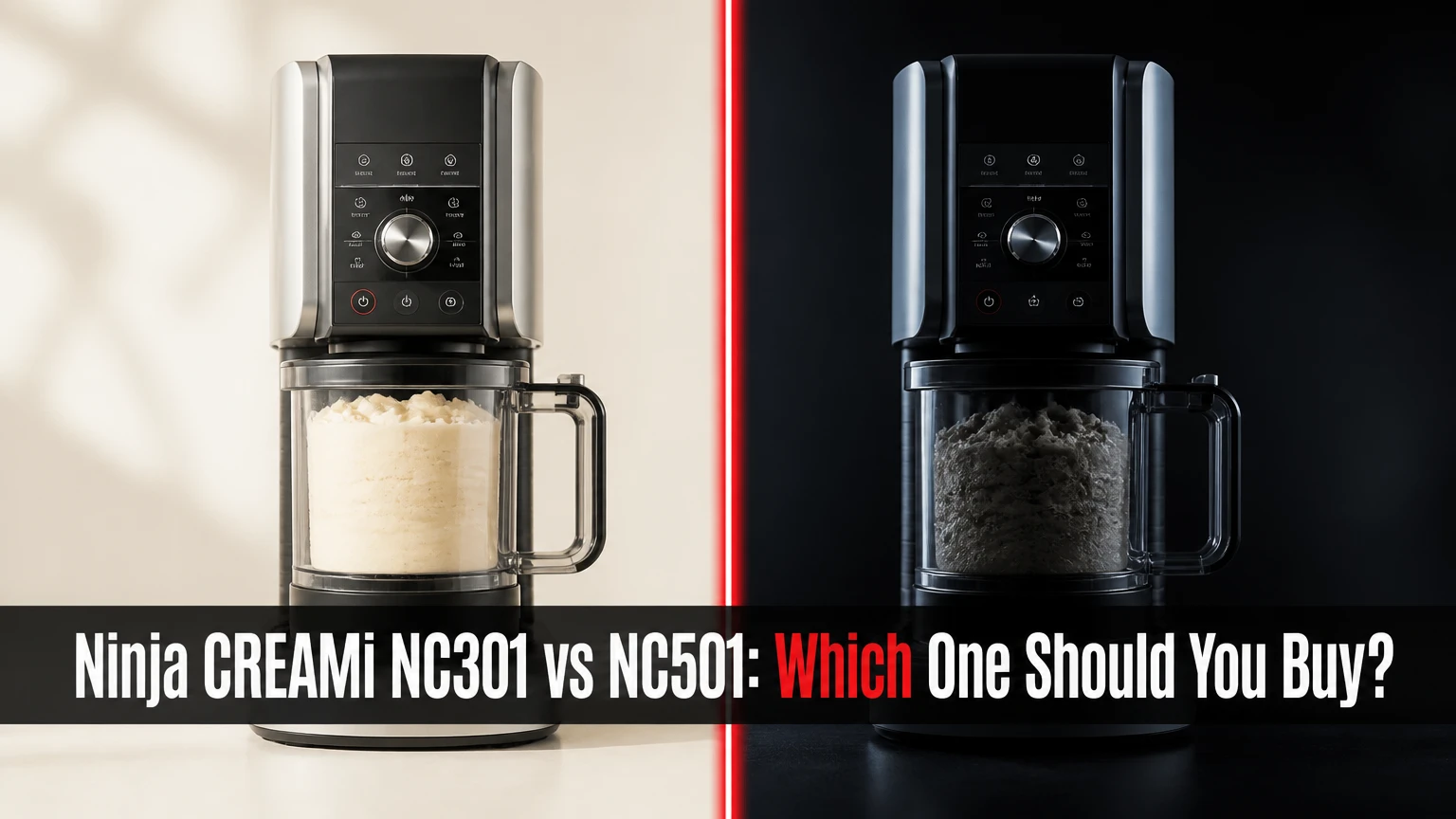
The Ninja CREAMi NC301 is the better value for single portions, protein desserts, and standard ice cream recipes, while the Ninja CREAMi NC501 Deluxe is better for families, larger batches, and frozen drinks. Both use an 800-watt motor and require a 24-hour pre-freeze, but the NC501 adds 24-ounce containers, 11 programs, and top-or-bottom processing.
Key Facts at a Glance
The NC301 processes 16-ounce standard CREAMi pints; the NC501 processes 24-ounce Deluxe pints.
The NC301 has seven programs; the NC501 has 11 programs, including Slushi, Frozen Drink, Italian Ice, and Creamiccino-style beverage functions.
Both machines require a level frozen base and approximately 24 hours of freezing before processing.
NC301 and NC501 containers are not interchangeable because their outer bowls and pint dimensions differ.
The NC501 does not automatically make smoother ice cream than the NC301; recipe formulation, freezing, and re-spin technique matter more.
The NC301 usually costs less and occupies less counter width, while the NC501 produces more finished dessert per batch.
Ninja CREAMi NC301 vs NC501: What Is the Difference?
The main difference between the Ninja CREAMi NC301 and NC501 is capacity and program range, not basic freezing technology. The NC301 is the original seven-program platform with a 16-ounce pint, whereas the NC501 Deluxe uses a 24-ounce pint and adds four functions aimed at drinks, Italian ice, and larger servings.
The capacity increase is substantial. A 24-ounce container holds 50% more base than a 16-ounce container, although the finished volume depends on mix-ins, expansion, and how much product is removed after spinning. The Deluxe model is also wider, so its larger pint system affects both storage and replacement-container cost.
| Specification | Ninja CREAMi NC301 | Ninja CREAMi NC501 Deluxe |
|---|---|---|
| Product series | Original CREAMi | Deluxe CREAMi |
| Motor rating | 800 watts | 800 watts |
| Pint capacity | 16 fl oz | 24 fl oz |
| Nominal volume | 2 cups | 3 cups |
| Program count | 7 | 11 |
| Typical US launch price | About $199.99 | About $249.99 |
| Pre-freeze requirement | About 24 hours | About 24 hours |
| Container family | Standard CREAMi pint | Deluxe CREAMi pint |
Retail suffixes and bundles can complicate model names. NC300 and NC301 commonly refer to closely related Original-series configurations, while NC500 and NC501 generally identify Deluxe-series configurations. Confirm the exact model number, included pints, voltage, and warranty before purchasing from a marketplace seller.
Which Programs Does Each CREAMi Include?
The NC301 covers the core dessert tasks, while the NC501 adds four preset categories for icy drinks and expanded dessert flexibility. For conventional ice cream, gelato, sorbet, milkshakes, smoothie bowls, and mix-ins, the two machines overlap heavily.
| Program or function | NC301 | NC501 | Practical consequence |
|---|---|---|---|
| Ice Cream | Yes | Yes | Standard dairy or nondairy frozen dessert |
| Lite Ice Cream | Yes | Yes | Lower-fat or lower-sugar formulations |
| Gelato | Yes | Yes | Dense, lower-overrun dessert style |
| Sorbet | Yes | Yes | Fruit-forward frozen dessert |
| Smoothie Bowl | Yes | Yes | Thick, spoonable frozen base |
| Milkshake | Yes | Yes | Soft, drinkable dairy or dairy-free result |
| Mix-In | Yes | Yes | Cookies, chocolate, nuts, or candy additions |
| Slushi | No | Yes | Frozen spoonable or drinkable slush texture |
| Frozen Drink | No | Yes | Cocktail and nonalcoholic beverage recipes |
| Italian Ice | No | Yes | Firm, icy fruit-based texture |
| Creamiccino or frappe-style function | No | Yes | Coffee-based frozen beverage recipes |
The added NC501 programs matter when frozen beverages are a recurring use rather than an occasional experiment. They do not turn the appliance into a high-volume party machine. A single 24-ounce container still requires separate processing cycles, and alcoholic recipes can remain softer or freeze differently because ethanol lowers the freezing point.
The NC301 is sufficient for most protein ice cream users. Protein powder, Greek yogurt, milk, fruit, cocoa, and sweetener can all be processed through the standard dessert programs, although the base may need a re-spin.
Does the NC501 Make Smoother Ice Cream?
The NC501 does not inherently produce smoother ice cream than the NC301 because both use the same general Creamerizer process and an 800-watt motor. Texture depends more heavily on the water-to-solids ratio, freezing temperature, level surface, program choice, and whether the mixture receives a re-spin.
Traditional churners freeze and agitate liquid simultaneously. CREAMi machines freeze the mixture solid first, then lower a rotating paddle through the block to shave and recombine it. That method is particularly useful for low-fat and high-protein recipes, where ordinary canister machines often struggle with large ice crystals.
| Texture factor | Recommended practice | Likely result when ignored |
|---|---|---|
| Base solids | Include sufficient sugar, protein, dairy solids, or stabilizer | Powdery or brittle mixture |
| Freezing time | Freeze the pint for approximately 24 hours | Soft center or inconsistent processing |
| Surface level | Freeze a flat top or scrape a raised dome level | Excess vibration or shaft stress |
| Preset selection | Match program to recipe composition | Wet, icy, or overly dense texture |
| Re-spin | Use one cycle for crumbly low-fat bases | Chalky or sandy mouthfeel |
| Added liquid | Add about 1 tablespoon when appropriate | Better cohesion after re-spin |
| Mix-ins | Add after the base reaches a spoonable texture | Broken pieces or uneven distribution |
A counterintuitive rule applies to healthy recipes: removing fat and sugar does not remove the need for structure. A low-calorie base may freeze harder because it contains more water, so the NC301 and NC501 can both require a re-spin even when the recipe appears fully frozen.
Is the Larger NC501 Pint Worth It?
The NC501 pint is worth the extra cost when a household regularly needs more than two cups of finished dessert or wants to process a beverage for several people. The larger container is less valuable for one-person use because leftovers can refreeze hard and require another processing cycle later.
A 24-ounce base provides 50% more nominal capacity than a 16-ounce base. That difference can reduce the number of batches for a family, but it does not eliminate planning because both models process one container at a time.
| Use case | NC301 capacity impact | NC501 capacity impact | Better fit |
|---|---|---|---|
| One nightly serving | 16 fl oz leaves modest leftovers | 24 fl oz may create excess | NC301 |
| Two adults | Often enough for two small servings | More generous portions | NC501 |
| Family dessert | Requires multiple pints | Fewer total containers | NC501 |
| Protein meal prep | Easier portion control | More base per preparation | NC301 |
| Party drinks | Limited single-container output | Larger drink batch | NC501 |
| Testing new recipes | Less ingredient waste | More failed recipe waste | NC301 |
The NC501 also supports processing part of a container on compatible settings, allowing users to process the top or bottom portion while leaving the rest frozen. That feature can reduce waste, but only when the remaining portion is stored properly and the recipe is suitable for partial processing.
What Is the Time and Workflow Difference?
Both Ninja CREAMi models require approximately 24 hours of pre-freezing, and neither machine delivers a fully frozen dessert from liquid in a few minutes. Active processing commonly takes about 2 minutes, followed by an optional re-spin of approximately 1 minute.
| Workflow stage | NC301 typical time | NC501 typical time | Operational note |
|---|---|---|---|
| Mix and fill base | 5-10 minutes | 5-10 minutes | Use the model-specific pint |
| Freeze solid | About 24 hours | About 24 hours | Keep container level |
| First processing cycle | About 1.5-2.5 minutes | About 1.5-2.5 minutes | Program determines duration |
| Re-spin, if needed | About 1 minute | About 1 minute | Common for lean bases |
| Add mix-ins | About 30-60 seconds | About 30-60 seconds | Use Mix-In function |
| Total planned elapsed time | About 24 hours | About 24 hours | Most time is passive |
The NC501 may take longer overall when its larger batch is divided into multiple flavor combinations, because each flavor still needs its own container. The NC301 often feels faster for personal use because a smaller pint is easier to fill, freeze, process, and finish in one sitting.
Are NC301 and NC501 Pints Interchangeable?
NC301 and NC501 pints are not interchangeable. The NC301 uses the standard CREAMi container and outer bowl, while the NC501 Deluxe uses a wider, larger-capacity container system; forcing one format into the other can damage the locking mechanism or prevent correct paddle alignment.
| Component | NC301 compatibility | NC501 compatibility | Buying implication |
|---|---|---|---|
| Standard 16-ounce pint | NC301 system | Not for NC501 processing | Buy Original-series replacements |
| Deluxe 24-ounce pint | Not for NC301 processing | NC501 system | Buy Deluxe-series replacements |
| Outer processing bowl | Original-series bowl | Deluxe-series bowl | Must match machine family |
| Paddle | Standard CREAMi paddle | Deluxe paddle system | Check model listing carefully |
| Storage lid | Standard pint lid | Deluxe pint lid | Diameter and fit differ |
| Typical replacement cost | About $20 for two | About $25 for two | Verify current retailer pricing |
Replacement accessories are a hidden ownership cost. A household making five pints weekly may need extra containers to maintain a rotation, and buying the wrong pint family can erase the apparent savings of a discounted machine.
How Do Noise, Size, and Cleaning Compare?
The NC301 generally fits smaller kitchens better, while the NC501 needs more lateral clearance because its Deluxe container and outer-bowl system are wider. Both machines produce a loud, mechanical processing sound for a short period, so users should not expect silent countertop operation.
| Kitchen consideration | NC301 | NC501 | Decision effect |
|---|---|---|---|
| Approximate height | About 15.9 inches | About 16.6 inches | Measure cabinet clearance |
| Container width | Standard pint format | Wider Deluxe pint | NC501 needs more storage width |
| Processing sound | Loud for about 1-2.5 minutes | Loud for about 1-2.5 minutes | Similar short-cycle noise |
| Dishwasher-safe removable parts | Pint, lid, bowl, paddle, subject to manual | Pint, lid, bowl, paddle, subject to manual | Similar cleanup pattern |
| Counter footprint | Smaller | Larger | NC301 suits compact kitchens |
| Empty-machine portability | Easier to move | More cumbersome | NC301 is easier to store |
Measure the space with the processing bowl installed, not merely the height of the motor base. A machine can fit beneath a cabinet while still requiring forward clearance to attach the bowl and paddle.
Neither model is ideal for a user who needs fresh ice cream immediately after deciding on a recipe. A compressor machine is better for spontaneous batches, even though it costs more and usually consumes more counter space.
Which Model Is Better for Protein Ice Cream?
The NC301 is usually the better protein-ice-cream purchase because its 16-ounce pint supports controlled portions, its seven programs include the functions most protein recipes need, and its lower price leaves room for extra containers or ingredients.
Both models can process whey, casein, plant protein, milk, yogurt, fruit, and sugar-free sweeteners. Protein-heavy mixes often emerge crumbly after the first cycle because the frozen matrix contains limited fat and sugar. One re-spin commonly improves cohesion, but adding liquid should be measured rather than poured freely because excess liquid can make the result soupy.
| Protein-dessert priority | NC301 result | NC501 result | Preferred model |
|---|---|---|---|
| One 16-ounce macro portion | Direct fit | Larger than needed | NC301 |
| Four weekly recipe flavors | More affordable extra pints | Fewer larger containers | NC301 for variety |
| Family protein dessert | Smaller servings | 24-ounce batch | NC501 |
| Low-sugar base | Re-spin often needed | Re-spin often needed | Tie |
| High-volume meal prep | More batches | More product per batch | NC501 |
| Limited freezer space | Smaller containers | Larger containers | NC301 |
The NC501 does not solve the main technical problem in protein recipes. Recipe solids and re-spin technique remain the controlling variables.
Which Model Should You Choose?
The best model depends on serving size, beverage interest, freezer organization, and how often extra containers will be used. The NC301 is the rational default for one or two people, while the NC501 earns its premium when larger servings or Deluxe-only programs will be used at least several times monthly.
Choose the NC301 for single portions
Choose the NC301 if you make protein ice cream, sorbet, gelato, or milkshakes for one or two people. The smaller pint limits ingredient waste, simplifies portion tracking, and usually costs about $50 less before sales and bundle differences.
Choose the NC501 for families
Choose the NC501 if several people share each batch or if a 16-ounce container creates too many repeat cycles. Its 24-ounce capacity provides 50% more nominal volume and can reduce the number of containers needed for a family dessert.
Choose the NC501 for frozen beverages
Choose the NC501 if Slushi, Frozen Drink, Italian Ice, and coffee-based frozen beverages are central to the purchase. The NC301 can make milkshakes and frozen desserts, but it does not provide the same dedicated program selection.
Choose the NC301 for compact kitchens
Choose the NC301 if cabinet clearance, freezer width, and storage simplicity matter more than batch volume. Its approximately 15.9-inch height is slightly lower than the NC501’s roughly 16.6-inch height, while the standard pints also occupy less refrigerator or freezer width.
Choose neither for instant batches
Choose a compressor machine instead if the key requirement is making ice cream without a 24-hour freeze. Compressor models such as the Breville Smart Scoop use active refrigeration, but their price, size, and cleaning requirements are often considerably higher.
How Does the CREAMi Compare With Alternatives?
The Ninja CREAMi NC301 and NC501 are strongest for preplanned frozen desserts, low-fat formulations, and high-protein bases. Compressor machines favor immediate preparation, while traditional freezer-bowl churners favor lower purchase prices and classic liquid-churning behavior.
| Machine type | Pre-freeze requirement | Typical US price range | Best use | Main limitation |
|---|---|---|---|---|
| Ninja CREAMi NC301 | About 24 hours | $150-$220 | Single portions and protein desserts | 16-ounce capacity |
| Ninja CREAMi NC501 | About 24 hours | $200-$300 | Families and frozen drinks | Larger footprint |
| Cuisinart ICE-21 | Bowl about 16-24 hours | $60-$100 | Traditional ice cream on a budget | Bowl occupies freezer space |
| Breville Smart Scoop | No bowl pre-freeze | $400-$600 | Spontaneous batches | High price and large footprint |
| Hand-churn or freezer method | Recipe-dependent | $20-$80 | Occasional low-cost use | Less consistent texture |
The CREAMi’s blade-driven processing can make leaner bases feel creamy because it breaks down the frozen block after freezing. That advantage does not mean every recipe succeeds: very watery mixtures, large frozen fruit pieces, and alcohol-heavy bases can still produce icy or soft results.
What Common Mistakes Damage Results?
The most damaging CREAMi mistakes are processing an uneven frozen surface, using the wrong container family, and treating a powdery first spin as a failed recipe. Correcting preparation and matching the re-spin to the base usually matters more than choosing the NC301 over the NC501.
- Process a raised dome. Scrape the surface flat before installing the lid and paddle. A central mound can create uneven resistance and unnecessary shaft stress.
- Use the correct pint. NC301 and NC501 containers have different dimensions. Never force a Deluxe pint into an Original bowl or use an Original pint in a Deluxe machine.
- Do not process an extremely hard block. A freezer operating below approximately -13°F, or -25°C, can create excessive mechanical resistance. Move the container to a warmer freezer area and confirm the base is suitable.
- Use re-spin strategically. A dry, crumbly result often needs one re-spin, especially with low-fat, low-sugar, or high-protein recipes. Add about 1 tablespoon of milk or another compatible liquid only when the recipe needs additional cohesion.
- Avoid overfilling. Expansion during freezing can push the lid upward or create an uneven surface. Follow the pint’s fill line rather than treating the nominal capacity as a required fill amount.
- Do not add hard mix-ins before the first spin. Cookies, nuts, and chocolate pieces belong in the designated mix-in stage. Frozen solids can obstruct the paddle or distribute poorly.
A useful practitioner rule is to freeze bases with the container level and inspect the surface before every processing cycle. Five seconds of leveling can prevent a noisy cycle and protect the paddle mechanism.
What Does Ownership Cost?
The NC301 usually has the lower entry cost, but the total difference narrows when both machines need extra containers. Typical US pricing varies by retailer, color, seasonal sale, and included accessories, so compare complete bundles rather than headline prices alone.
| Ownership item | NC301 typical amount | NC501 typical amount | Cost significance |
|---|---|---|---|
| Machine purchase | $150-$220 | $200-$300 | NC501 premium often $50-$80 |
| Two replacement pints | About $20 | About $25 | Deluxe accessories cost more |
| Four extra pints | About $40 | About $50 | Useful for flavor rotation |
| Typical serving volume | 16 fl oz | 24 fl oz | NC501 gives 50% more nominal capacity |
| Active cycle | About 2 minutes | About 2 minutes | No major time advantage |
| Freeze electricity | Low, shared freezer cost | Low, shared freezer cost | Similar passive-freezing model |
For a single user, the NC301’s lower waste can matter more than its lower purchase price. For a family, the NC501 may reduce ingredient preparation and container rotation enough to justify the initial premium.
How Should You Freeze and Process Either Model?
Freeze a prepared base level for approximately 24 hours, inspect the surface, select the program that matches the recipe, and use one re-spin if the first result is dry or crumbly. The level frozen surface is the most important preparation detail because an uneven block can stress the processing system.
- Prepare the base. Blend the liquid, dairy or nondairy ingredients, sweetener, and flavorings until uniform.
- Fill the correct pint. Stay below the maximum fill line and leave room for expansion.
- Freeze level. Place the uncovered or properly prepared pint on a flat freezer shelf for about 24 hours.
- Inspect the top. Scrape down any raised mound so the frozen surface is flat.
- Install the paddle and bowl. Use only the paddle, pint, and outer bowl designed for that model family.
- Select the program. Use Ice Cream, Lite Ice Cream, Gelato, Sorbet, Smoothie Bowl, or a Deluxe beverage function according to the base.
- Evaluate the texture. A smooth, cohesive surface indicates success; a sandy or powdery surface calls for re-spin.
- Add mix-ins last. Create a small well if needed, add the ingredients, and run Mix-In.
You will know the base worked when the finished product holds a scoopable shape without a dry ring around the container. A wet edge with a firm center usually indicates a recipe or freezing issue, not a capacity difference between the two machines.
The Bottom Line
The Ninja CREAMi NC301 is the best choice for most individual users because it costs less, uses smaller standard pints, and includes the seven programs needed for ordinary desserts and protein recipes. The Ninja CREAMi NC501 is the better purchase for families and frozen-drink enthusiasts who will use its 24-ounce Deluxe containers and four additional programs regularly.
The NC501 does not provide a fundamental texture upgrade. Both machines depend on the same 24-hour pre-freeze workflow, and both can produce powdery results when a low-fat or high-protein base needs a re-spin. Choose capacity and program variety, not motor wattage, as the deciding factors.
Frequently Asked Questions
Can the NC301 make dairy-free ice cream?
Yes, the Ninja CREAMi NC301 can process dairy-free bases made with oat milk, almond milk, coconut milk, soy milk, fruit, or plant-based yogurt. Dairy-free mixtures often contain more water and less fat than conventional ice cream, so the first spin may be icy or crumbly. A compatible stabilizer, adequate solids, and one re-spin can improve texture.
Is the NC501 quieter than the NC301?
The NC501 is not meaningfully quieter than the NC301 during normal processing. Both use a high-speed paddle and produce a loud mechanical sound for roughly 1-2.5 minutes per cycle. Run either model during reasonable daytime hours, keep it on a stable counter, and stop if the sound changes from normal processing to grinding or repeated impact.
Can I make a half batch in the NC501?
The NC501 supports partial-container processing on compatible functions, including processing the top or bottom portion while leaving the remaining frozen base for later. The result depends on a level frozen surface and correct fill. The NC301 is better for naturally small batches because its 16-ounce pint already limits the portion size.
How many pints should I buy?
Two pints suit occasional users, while four to six pints support weekly flavor rotation and meal preparation. NC301 owners should buy standard CREAMi pints, and NC501 owners should buy Deluxe pints. Extra containers reduce waiting between preparation and freezing, but they also increase accessory cost and freezer-storage requirements.
Does the NC501 replace a blender?
No. The NC501 processes frozen bases, but it does not replace a general-purpose blender for chopping raw ingredients, making soups, pulverizing large ice loads, or preparing liquid smoothies. Blend or thoroughly mix the base before freezing, then use the CREAMi for its intended frozen-texture processing.
Which CREAMi is better for a small apartment?
The NC301 is generally better for a small apartment because its standard pint system and slightly smaller body simplify storage. The NC501 can still fit many kitchens, but users should measure approximately 16.6 inches of height plus operating clearance and reserve additional width for the larger Deluxe containers.