

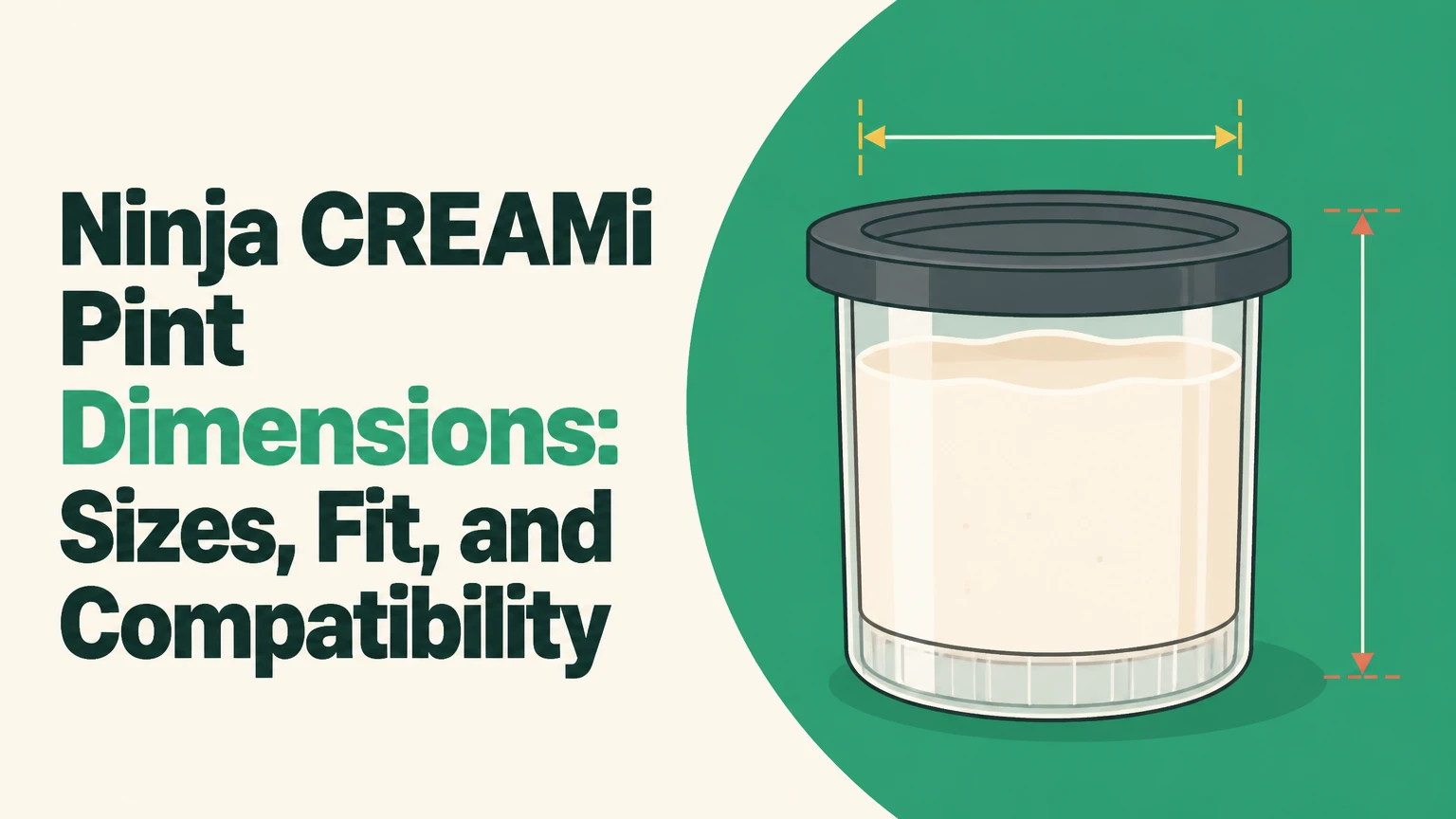
Ninja CREAMi pint dimensions depend on the machine family: standard containers are approximately 4.1 inches wide and 4.0 inches tall, while Deluxe containers are approximately 4.9 inches wide and 5.1 inches tall. Standard pints hold 16 fluid ounces at the fill limit; Deluxe pints hold 24 fluid ounces. The two formats are not interchangeable.
Key Facts About Ninja CREAMi Container Sizes
- Standard pints: approximately 4.1 inches in diameter and 4.0 inches high without the storage lid.
- Deluxe pints: approximately 4.9 inches in diameter and 5.1 inches high without the storage lid.
- Standard capacity: 16 fluid ounces, or 2 cups, at the marked Max Fill line.
- Deluxe capacity: 24 fluid ounces, or 3 cups, at the marked Max Fill line.
- Standard-compatible families: NC299, NC300, NC301, NC350, and NC700 Swirl models, subject to the model manual.
- Deluxe-compatible families: NC500 and NC501 machines.
- Freezing requirement: freeze the base level for at least 24 hours at 0°F, or -18°C, before processing.
The most important measurement is not the container alone. A pint must fit the outer processing bowl, lid assembly, freezer space, and machine drive system together. Measure the container with its storage lid when checking a shelf, but use the machine-specific compatibility list when deciding whether a replacement pint can be processed.
What Are the Standard Pint Dimensions?
A standard Ninja CREAMi pint has a typical outside diameter of about 4.1 inches, or 10.4 centimeters, and a container height of about 4.0 inches, or 10.2 centimeters, before the storage lid is installed. Small differences occur between production runs and aftermarket products, so treat these numbers as planning measurements rather than engineering tolerances.
The standard format is the smaller original CREAMi container. Its 16-fluid-ounce capacity equals 2 US cups, although the frozen mixture should never extend above the molded Max Fill line. The line normally leaves headspace for expansion and processing movement.
Standard Pint Measurements at a Glance
| Attribute | Typical standard value | Practical meaning | Measurement note |
|---|---|---|---|
| Nominal capacity | 16 fl oz | 2 cups of prepared base | Max Fill line controls use |
| Outside diameter | 4.1 in, 10.4 cm | Fits many narrow freezer shelves | Measure the widest wall area |
| Container height | 4.0 in, 10.2 cm | Height without storage lid | Lid adds vertical clearance |
| Typical yield | 2-3 servings | Depends on serving size and mix-ins | A ½-cup serving gives 4 theoretical cups only after aeration and additions |
| Recommended freeze time | 24 hours minimum | Base must be solid throughout | Level placement reduces surface distortion |
The standard pint is usually the easiest format for households with narrow freezer drawers. Four containers can occupy less shelf width than four Deluxe containers, but the exact arrangement depends on the freezer’s interior corners and drawer rails.
Which Machines Use Standard Pints?
Standard containers are intended for original-size CREAMi systems, including many NC299, NC300, NC301, and NC350 variants. The NC700 Swirl family uses its own documented compatibility requirements, even though its container format is associated with the standard ecosystem.
Check the model number printed on the machine before buying replacements. A product listing that says “Ninja CREAMi compatible” without naming the machine family does not establish fit.
What Are the Deluxe Pint Dimensions?
A Deluxe Ninja CREAMi pint measures approximately 4.9 inches in diameter, or 12.4 centimeters, and about 5.1 inches high, or 13 centimeters, without relying on an exact manufacturer-published external specification. The larger container holds 24 fluid ounces, equal to 3 US cups at the Max Fill line.
The Deluxe format is wider and taller than the standard format. That difference affects freezer placement, storage-lid clearance, outer-bowl engagement, and the machine’s processing geometry. A Deluxe pint cannot be substituted with a standard pint merely because both containers are marketed as “pints.”
Deluxe Pint Measurements at a Glance
| Attribute | Typical Deluxe value | Practical meaning | Measurement note |
|---|---|---|---|
| Nominal capacity | 24 fl oz | 3 cups of prepared base | Max Fill line remains the limit |
| Outside diameter | 4.9 in, 12.4 cm | Needs a wider shelf footprint | Measure across the widest point |
| Container height | 5.1 in, 13 cm | Requires more vertical freezer room | Add lid clearance before buying |
| Capacity increase | 50% over 16 fl oz | More base per processing cycle | Does not make the machine twice as fast |
| Typical yield | 4-5 servings | Depends on portion size | Mix-ins reduce available base volume |
The 24-ounce container is useful when a household wants more portions from one preparation cycle. Its larger footprint can become a disadvantage in shallow freezer drawers, crowded door compartments, or shelves with a low overhead lip.
Why Is the Deluxe Pint Larger?
The Deluxe container is larger because the NC500 and NC501 machines process a 24-ounce format and support additional processing options, including separate top and bottom sections on compatible programs. The outer bowl, lid, paddle position, and drive interface were designed around that format.
The extra capacity does not mean users may fill the container to its physical rim. The Max Fill line is lower than the rim because frozen bases need controlled clearance during paddle entry and processing.
Which Models Use Each Pint?
The standard and Deluxe CREAMi ecosystems use different container dimensions, outer bowls, lids, and drive interfaces. Compatibility follows the machine family, not the apparent shape of the container.
| Machine family or model | Pint ecosystem | Nominal capacity | Replacement guidance |
|---|---|---|---|
| NC299 series | Standard | 16 fl oz | Buy pints listed for NC299 |
| NC300 and NC301 series | Standard | 16 fl oz | Verify exact regional model suffix |
| NC350 series | Standard | 16 fl oz | Use standard outer-bowl components |
| NC500 and NC501 | Deluxe | 24 fl oz | Buy Deluxe pints only |
| NC700 Swirl | Swirl-specific standard ecosystem | Check manual | Do not assume every standard pint fits |
The NC700 designation deserves extra care because Swirl models may use a related but distinct accessory arrangement. SharkNinja product pages and the owner’s manual take precedence over a reseller’s compatibility claim.
Can a Standard Pint Fit a Deluxe Machine?
A standard pint should not be processed in a Deluxe machine unless SharkNinja specifically lists that combination for the exact model. Even when a smaller container appears to sit inside the outer bowl, the lid and paddle alignment may not match the intended operating position.
The reverse substitution is also unsafe. A 24-ounce Deluxe pint can prevent a standard machine’s outer bowl or lid from locking, leaving the drive assembly incorrectly positioned.
How Does the Container Fit the Machine?
The CREAMi pint remains stationary inside the outer processing bowl while the motor lowers a paddle through the lid into the frozen base. The container’s rigid wall, lid interface, and bottom drive geometry keep the frozen block aligned as the paddle shaves and mixes it.
A traditional ice cream maker rotates a chilled bowl or dasher. A CREAMi uses a different sequence: freeze first, then process the solid base from above. Container dimensions therefore affect mechanical alignment, not only storage capacity.
Component Dimensions and Functions
| Component | Standard system | Deluxe system | Function |
|---|---|---|---|
| Processing pint | 16 fl oz | 24 fl oz | Holds the frozen base |
| Storage lid | Standard lid | Deluxe lid | Covers the pint during freezing and storage |
| Outer bowl | Standard bowl | Deluxe bowl | Locks into the motor base |
| Processing lid | Standard assembly | Deluxe assembly | Holds the descending paddle |
| Paddle | Standard Creamerizer paddle | Deluxe-compatible paddle | Enters the frozen mixture vertically |
The pint itself does not spin during an ordinary CREAMi program. The outer bowl locks into the appliance, and the motor drives the paddle through the processing lid.
Capacity, Fill Lines, and Serving Yield
A standard container provides 16 fluid ounces, or 2 cups, at the Max Fill line, while a Deluxe container provides 24 fluid ounces, or 3 cups. These are preparation capacities, not guaranteed finished-volume measurements, because air incorporation, inclusions, melting, and serving size change the final yield.
| Container format | Base capacity | Cups | ½-cup portions before loss | Typical household use |
|---|---|---|---|---|
| Standard | 16 fl oz | 2 cups | 4 portions | One or two people |
| Deluxe | 24 fl oz | 3 cups | 6 portions | Family batch |
| Standard, reduced recipe | 12 fl oz | 1½ cups | 3 portions | Smaller calorie-controlled batch |
| Deluxe, reduced recipe | 18 fl oz | 2¼ cups | 4-5 portions | Fewer servings with freezer reserve |
The safest recipe calculation is based on the Max Fill line rather than the printed nominal capacity. A recipe can contain 16 fluid ounces yet rise above the line after yogurt, fruit puree, syrups, or dissolved ingredients are combined.
How Much Recipe Fits Below Max Fill?
For planning, use approximately 2 cups of liquid base in a standard pint and 3 cups in a Deluxe pint only when the combined mixture remains at or below the molded line. Solids count toward volume, so chopped cookies or fruit should be added after the initial spin when the program calls for a Mix-In.
A practical rule is to combine the base, refrigerate it if needed, and pour it into the pint while checking the line at eye level. Do not compensate for overfilling by removing the storage lid or freezing the container uncovered.
Freezer Fit and Clearance
A standard pint generally needs about 4.1 inches of width and 4.0 inches of container height, while a Deluxe pint needs about 4.9 inches of width and 5.1 inches of height before lid clearance. Freezer users should measure usable shelf space, because hinges, rails, evaporator covers, and shelf lips reduce the opening.
| Freezer situation | Standard pint planning space | Deluxe pint planning space | Check before storage |
|---|---|---|---|
| Container width | 4.1 in minimum | 4.9 in minimum | Add side clearance for removal |
| Container height | 4.0 in body | 5.1 in body | Measure shelf-to-ceiling distance |
| Lid-on height | Measure actual lid | Measure actual lid | Do not estimate from body height |
| Four-pint row width | About 16.4 in | About 19.6 in | Interior width varies by shelf |
| Level surface | Required | Required | Avoid sloped wire shelves |
How to Check a Freezer Drawer
- Measure the clear width between the drawer walls, not the nominal drawer width.
- Measure the vertical opening with the shelf or basket installed.
- Add room to grip the lid, because a container that fits tightly may become difficult to remove.
- Test one empty pint with its lid before buying a multipack.
- Keep the pint on a level tray or flat shelf during freezing.
In practice, the lid can be the deciding factor. The lid’s rim may catch on a freezer shelf even when the container body fits comfortably.
Freezing and Processing Requirements
A CREAMi base should freeze level for at least 24 hours at 0°F, or -18°C, before processing. The container lid protects the surface during storage, but the lid does not correct a freezer shelf that slopes enough to create an uneven frozen top.
| Step | Typical timeframe | Target condition | Failure risk |
|---|---|---|---|
| Mix and fill | 5-15 minutes | Below Max Fill | Expansion or leakage |
| Freeze | At least 24 hours | Solid at 0°F or colder | Crumbly or incomplete processing |
| Initial program | About 2 minutes | Program selected for recipe | Texture varies by base |
| Re-spin | About 1 minute | Add a small liquid amount if needed | Excess softening if overused |
| Mix-In cycle | About 1 minute | Add ingredients in the depression | Broken pieces or uneven mixing |
The 24-hour figure is a minimum, not a guarantee. A densely loaded freezer, warm freezer cycle, large sugar concentration, or recently installed container may require more time.
Why Does a Frozen Bulge Matter?
A frozen bulge forms when the liquid base freezes unevenly, often because the surface is uncovered or the container sits on an unstable shelf. The raised center can place unusual resistance against the descending paddle and may contribute to poor texture or mechanical stress.
If the surface is visibly domed, allow the pint to soften according to the model’s instructions and level the top carefully before processing. Do not chip the bulge with a knife while the pint remains hard, because sharp fragments can contaminate the food or damage the container.
SharkNinja’s CREAMi instructions repeatedly emphasize freezing the mixture level. That instruction is a mechanical requirement, not merely a presentation preference.
Replacement Pints, Lids, and Cost
Official replacement packs commonly cost about $15-$25 for two standard pints and approximately $30-$40 for four, although prices vary by retailer, promotion, and model. Third-party packs often cost about $15-$25 for four containers, but the lower price transfers more fit and material risk to the buyer.
| Purchase option | Typical pack size | Typical USD price | Main advantage | Main risk |
|---|---|---|---|---|
| Official standard replacement | 2 pints | $15-$25 | Model-specific fit | Higher unit cost |
| Official standard replacement | 4 pints | $30-$40 | Consistent accessories | More upfront cost |
| Third-party standard pack | 4 pints | $15-$25 | Lowest price per pint | Tolerance and plastic quality |
| Official Deluxe replacement | 2-4 pints | About $20-$45 typical | Correct NC500 fit | Regional stock changes |
| Replacement lids only | 2-4 lids | About $10-$25 typical | Reuses sound containers | Lid may not match model |
Check five details before ordering:
- The exact machine model number.
- Standard, Deluxe, or Swirl designation.
- Container capacity in fluid ounces.
- Inclusion of storage lids and processing accessories.
- Dishwasher and food-contact labeling.
An inexpensive container is a poor bargain if the outer bowl cannot lock, the lid leaks during freezing, or the paddle scrapes the wall. Official SharkNinja listings identify compatible series more reliably than generic marketplace titles.
Compatible Alternatives and Unsafe Substitutes
A Ninja CREAMi pint is a purpose-built processing container, not ordinary food-storage Tupperware. Standard storage containers may hold a frozen base, but they should not enter the CREAMi outer bowl unless the manufacturer explicitly approves the container and its complete processing interface.
| Container type | Freezer storage | CREAMi processing | Capacity consistency | Recommendation |
|---|---|---|---|---|
| Official standard pint | Yes | Yes with standard system | 16 fl oz | Best choice for NC299-NC350 families |
| Official Deluxe pint | Yes | Yes with NC500-NC501 | 24 fl oz | Best choice for Deluxe machines |
| Generic listed replacement | Usually | Only if exact fit is verified | Varies | Inspect dimensions and reviews |
| Glass food container | Yes, if freezer-rated | No | Varies | Storage only |
| Thin polypropylene tub | Often | No | Varies | Storage only |
| Ice cream tub | Yes | No | Varies | Cannot replace the processing assembly |
The machine depends on more than wall diameter. The bottom geometry, rim, lid engagement, height, and paddle clearance must all align.
Common Problems and What to Do
The most frequent CREAMi container problems arise from incorrect model matching, excess fill, uneven freezing, and damaged plastic. Each problem has a different response, so replacing a pint immediately is not always necessary.
| Problem | Likely cause | What can happen | Correct response |
|---|---|---|---|
| Lid will not close | Wrong ecosystem or overfill | Container cannot lock correctly | Stop and verify model and fill line |
| Center dome on frozen base | Uneven or uncovered freezing | Paddle meets uneven resistance | Level the surface before processing |
| Scrape marks inside pint | Paddle contact or worn container | Plastic contamination risk | Retire the container if material is missing |
| Crumbly first spin | Base too cold, low moisture, or recipe balance | Powdery texture | Follow model instructions for Re-spin |
| Leakage in freezer | Damaged lid or overfilled pint | Food loss and frost buildup | Inspect seal and reduce fill |
| Container will not sit flat | Warped base or shelf | Uneven freeze and poor alignment | Replace damaged container |
Can You Process a Half-Full Pint?
A half-full pint may be acceptable for storage, but processing rules depend on the model and program. The safer approach is to follow the owner’s manual, keep the frozen surface level, and avoid using a container with a shallow or severely uneven block.
A smaller recipe does not automatically justify a smaller substitute container. The machine’s paddle travel and processing geometry remain tied to the approved pint format.
Is a Scratched Pint Safe?
A superficial external scuff is usually different from an internal gouge, crack, chip, or area where plastic has detached. Retire any container that sheds particles, has a split rim, has a distorted bottom, or allows the paddle to contact damaged material.
Dishwasher use also matters. SharkNinja instructions commonly direct users to place removable components on the top rack, where heat exposure is lower than on the bottom rack. Separate lids from pints and inspect the seal after repeated washing.
A Practical Buying Decision
Choose the standard 16-ounce format when freezer width is limited, recipes are usually prepared for one or two people, or the machine belongs to the original NC299-NC350 family. Choose the 24-ounce Deluxe format when larger batches and top-bottom processing matter more than compact storage.
Use this decision order:
- Identify the exact model number on the appliance.
- Confirm the approved pint ecosystem from the manual or SharkNinja listing.
- Measure freezer width and height with the storage lid installed.
- Decide whether 16 or 24 fluid ounces matches normal household demand.
- Compare official and third-party cost per usable pint.
- Inspect replacement photos for the correct bottom and lid geometry.
- Freeze one test pint level before committing to a multipack.
An important trade-off is capacity versus flexibility. A Deluxe pint provides 50% more nominal base, but a standard pint allows more flavor variety per freezer shelf and usually costs less to replace.
Expert Notes on Dimensions and Use
Nominal capacity is not rim capacity. The 16-ounce and 24-ounce labels describe the intended batch size, while the molded Max Fill line defines the safe working volume. Measuring a container by pouring liquid to the rim produces an inflated number that is irrelevant to machine use.
Lid-on height matters more than body height. Freezer shelves often have only a few millimeters of practical clearance, and a lid that touches the shelf above can tilt the pint or make removal difficult. Measure the complete stored assembly.
Aftermarket diameter alone proves very little. Two containers can share a 4.1-inch or 4.9-inch outside diameter while differing at the base, rim, or lid interface. Those small differences can prevent the processing lid from seating correctly.
The freezer is part of the appliance workflow. The CREAMi requires a level frozen block, so a pint stored diagonally in a crowded drawer can create a mechanical problem even when the container itself is genuine and undamaged.
Frequently Asked Questions About ninja creami pint dimensions
Can I use Ninja CREAMi pints in the freezer with the lids on?
Yes, storage lids are intended to cover the prepared base during freezing and storage. Keep the lid seated without forcing an overfilled container closed, and place the pint on a level surface. The lid protects against frost and spills, but it does not replace the Max Fill limit.
Do Ninja CREAMi pints stack in a freezer?
They can stack only when the lids and shelf structure provide stable support. Standard and Deluxe containers have different footprints, and a tall stack can tip in a sliding drawer. Test the empty containers first, leaving enough clearance to remove the upper pint without twisting the lower one.
Are Ninja CREAMi pints BPA-free?
Official Ninja CREAMi containers are marketed as food-contact plastic and are generally identified as BPA-free in product documentation or packaging. Third-party claims vary. Check the replacement product’s material statement and food-contact labeling rather than assuming that a visually identical container has the same specification.
Can I buy replacement lids separately?
Replacement lids are available for some CREAMi families, but the correct lid must match the pint ecosystem and model series. A standard lid is not automatically suitable for a Deluxe pint. Confirm whether the listing includes storage lids, processing lids, or both before ordering.
Why does my CREAMi pint look smaller than 16 or 24 ounces?
The printed capacity refers to the intended usable preparation volume near the Max Fill line, not the container’s total volume to the rim. Headspace is required for freezing and processing. A liquid measurement filled to the top can therefore exceed the safe machine capacity.
Can I take a frozen CREAMi pint through airport security?
A frozen dessert may be subject to transportation and screening rules that vary by country, airport, carrier, and liquid or gel classification. The container’s dimensions do not determine eligibility. Keep the pint sealed, check the relevant Transportation Security Administration or local authority guidance, and expect spoilage risk during travel.
Conclusion
Ninja creami pint dimensions fall into two main planning categories: approximately 4.1 inches wide by 4.0 inches high for the 16-ounce standard format, and approximately 4.9 inches wide by 5.1 inches high for the 24-ounce Deluxe format. Confirm the model family, measure lid-on freezer clearance, and keep the base below Max Fill while freezing level for at least 24 hours.