

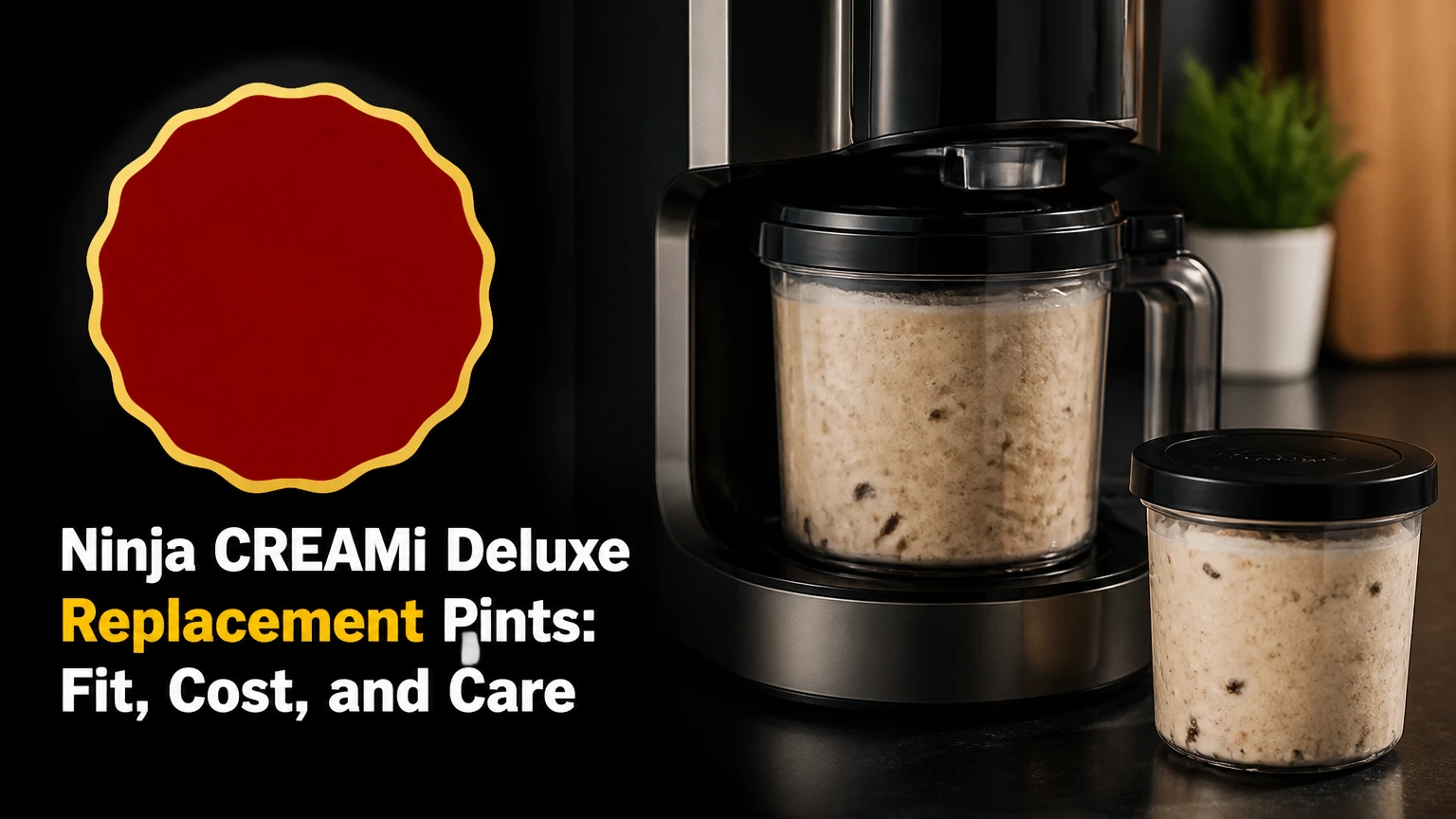
Ninja CREAMi Deluxe replacement pints are 24 oz containers made for the Ninja CREAMi Deluxe NC500 and NC501 series, including the matching outer bowl and processing paddle system. The correct replacement includes a compatible tub and storage lid, while standard 16 oz CREAMi containers are physically different and should not be substituted.
What Is a Ninja CREAMi Deluxe Replacement Pint?
A Ninja CREAMi Deluxe replacement pint is a freezer container with approximately 24 US fluid ounces, or 709 ml, of nominal capacity. The container holds a frozen dessert base, and its storage lid protects the base before processing or the leftovers afterward.
The word “pint” can mislead buyers because the Deluxe container is larger than a traditional US pint of 16 fluid ounces. Ninja uses “pint” as the product category name, but the Deluxe tub is a 24 oz XL container. The useful target is therefore the model family and physical fit, not the word pint alone.
The tub freezes the base in the same container used for processing. A compatible lid is useful for freezer storage, but the lid is not the part that locks into the machine. The tub’s base geometry, rim, and interaction with the Deluxe outer bowl determine safe use.
Key Facts at a Glance
- Ninja CREAMi Deluxe replacement pints have a nominal 24 oz capacity, equal to approximately 709 ml.
- NC500 and NC501 series machines require the larger Deluxe container, not the standard 16 oz tub.
- The Deluxe system can process a full container or a designated top or bottom half.
- A level, fully frozen base generally needs at least 24 hours before processing.
- Official two-packs commonly cost about $20-$23, while generic four-packs often cost about $30-$35.
- A listing that says “compatible with all Ninja CREAMi models” requires model-number verification before purchase.
Which Ninja CREAMi Deluxe Replacement Pints Fit?
Replacement tubs labeled for the NC500 or NC501 Ninja CREAMi Deluxe series are the safest choice. A listing should identify the Deluxe family specifically and show the base feet or grooves that interface with the Deluxe outer bowl, rather than relying on a generic claim about universal compatibility.
Ninja product pages and retailer listings commonly identify official Deluxe replacement pints as compatible with NC500-series machines. Because marketplace listings can reuse photographs or titles, compare the model number, capacity, base shape, lid design, and seller return terms before ordering.
The following screening table separates commonly confused container families.
| Container family | Nominal capacity | Intended machine family | Interchangeable with NC500/NC501? |
|---|---|---|---|
| CREAMi Deluxe XL pint | 24 oz, 709 ml | NC500, NC501 series | Yes, when correctly labeled |
| Original CREAMi pint | 16 oz, 473 ml | NC300 series and related original models | No |
| CREAMi Breeze container | Varies by model | Breeze-specific machines | No, unless the manual explicitly says so |
| Swirl or specialty tub | Model-specific | Swirl or specialty systems | No, unless the model listing confirms it |
Why Are 16 Oz Pints Incompatible?
Standard 16 oz CREAMi pints are incompatible with the Deluxe machine because the Deluxe container and processing system use a different capacity and interface. A 16 oz tub may look similar, but a similar appearance does not establish the correct lock, blade position, or processing clearance.
The reverse is also true. A 24 oz Deluxe tub should not be forced into an original 16 oz CREAMi machine. The safe rule is simple: match the replacement container to the model number printed on the machine, manual, or original packaging.
Official, Generic, or Stainless Steel?
Official Ninja pints provide the clearest compatibility path, generic plastic pints usually reduce the unit cost, and stainless-steel tubs prioritize durability over visibility. The best option depends on whether your main risk is fit uncertainty, replacement cost, or long-term wear.
Official parts are preferable when the machine is under warranty, the household processes frequently, or returning an incompatible item would be inconvenient. Generic tubs can make sense when the seller publishes exact compatibility and accepts returns. Stainless steel is a more specialized choice because opaque walls make fill-level inspection harder.
| Option | Typical pack and price | Main material | Primary advantage | Main limitation |
|---|---|---|---|---|
| Official Ninja two-pack | 2 tubs, $19.98-$22.99 | BPA-free plastic | Highest model-label confidence | Higher cost per tub than large packs |
| Generic plastic four-pack | 4 tubs, $29.80-$34.99 | Plastic, seller-specified | Lower typical unit cost | Variable feet, lids, and fit |
| Generic plastic two-pack | 2 tubs, about $16-$25 | Plastic, seller-specified | Lower upfront spend | Fewer containers for freezer rotation |
| Stainless-steel pack | 1-4 tubs, about $15-$35 each | 304 stainless steel when specified | Durability and odor resistance | Opaque, heavier, and fit must be verified |
What Should You Check Before Buying a Generic Tub?
Check five details before buying a generic replacement: NC500 or NC501 compatibility, 24 oz capacity, matching base feet or grooves, a secure lid, and a return policy. Product photographs alone are insufficient because many marketplace listings use nearly identical images for different CREAMi generations.
Use this purchase checklist:
- Find the exact machine model on the rear label or instruction manual.
- Reject listings that mention only “Ninja CREAMi” without naming Deluxe or NC500/NC501.
- Confirm 24 oz or 709 ml nominal capacity.
- Compare the bottom profile with your original Deluxe tub.
- Check whether the lid is included and whether replacement lids are sold separately.
- Read recent reviews for reports of wobbling, cracking, leakage, or failed locking.
- Confirm that the seller accepts returns for an incorrect fit.
A low price is not a bargain if a loose base causes the outer bowl to wobble or a poor lid leaks in the freezer. The container is a mechanical accessory, not merely a food-storage cup.
How Much Do Replacement Pints Cost?
Typical US prices range from about $10-$11.50 per tub for an official two-pack to about $7.45-$8.75 per tub for a generic four-pack. Retailer, color, shipping, sales tax, and stock status can change the final amount, so compare delivered unit cost rather than pack price.
| Purchase | Typical quantity | Typical pack price | Approximate unit cost | Best use |
|---|---|---|---|---|
| Official Ninja pack | 2 tubs | $19.98-$22.99 | $9.99-$11.50 | Warranty-conscious buyers |
| Generic plastic pack | 4 tubs | $29.80-$34.99 | $7.45-$8.75 | Frequent batch preparation |
| Two generic tubs | 2 tubs | $16-$25 | $8-$12.50 | Small households testing fit |
| Stainless-steel pack | 1 tub | $15-$35 | $15-$35 | Durability-focused users |
Prices are typical retail ranges, not fixed manufacturer prices. Marketplace discounts can narrow the gap, while shipping can erase the apparent savings on a single two-pack.
How Many Pints Should You Own?
Most active households need six to ten Deluxe pints for continuous rotation, but four containers can be sufficient for occasional use. The number depends on how many bases you freeze each week and whether you can wait a full 24 hours between preparation and processing.
| Household pattern | Bases prepared weekly | Practical inventory | Reason |
|---|---|---|---|
| Occasional single user | 1-2 | 2-4 tubs | Covers one frozen base plus a spare |
| Couple using the machine weekly | 3-4 | 4-6 tubs | Keeps several flavors in rotation |
| Family dessert preparation | 5-7 | 6-8 tubs | Reduces repeated thawing and refreezing |
| Protein-dessert meal prep | 8-12 | 8-10 tubs | Supports multiple recipes across the week |
An important planning detail is that one Deluxe container can produce more than one serving, but processing the full 24 oz container is not always necessary. If your household uses half-container processing, inventory still matters because the unused half remains a frozen base for later use.
How Should You Freeze and Process One?
Fill the Deluxe tub only to the marked Max Fill line, freeze the base level for at least 24 hours at approximately 0°F, or -18°C, then install the tub in the Deluxe outer bowl using the correct paddle and program. The most important success factor is a completely solid, level base.
Ninja’s user guidance states, “Freeze for at least 24 hours.” The time matters because the CREAMi paddle shaves a solid frozen block; a soft center can create uneven resistance and a poor texture.
Step 1: Prepare the Base
Pour a fully mixed ice cream, sorbet, smoothie bowl, or other approved base into the 24 oz tub. Leave the contents below the Max Fill line because expansion, ingredients, and paddle clearance all make overfilling risky.
For liquid bases, inspect the surface before freezing. Large fruit pieces, hard candy, or unblended nuts can create stress during processing and should follow the recipe and manual’s ingredient guidance.
Step 2: Freeze the Tub Level
Place the uncovered or correctly prepared tub on a level freezer shelf until solid, then use the storage lid after the base has frozen if your container instructions permit it. A tilted freezer shelf creates a slanted block, and the blade can remove material unevenly.
A freezer set near 0°F is a practical benchmark. Freezers that run warmer, are frequently opened, or hold the tub near the door may require more than 24 hours.
Step 3: Install the Paddle and Outer Bowl
Remove the storage lid, fit the processing paddle into the Deluxe outer bowl according to the machine manual, and lock the container assembly into place. Never process a tub with its storage lid attached.
Step 4: Select the Appropriate Program
Choose the program that matches the frozen base, then use the Deluxe system’s full-container or designated half-container capability when the model and recipe support it. Do not improvise a half-container boundary or process an unapproved volume.
Step 5: Re-spin Only When Needed
If the first result is dry or powdery, add approximately 1-2 tablespoons of compatible liquid and run Re-spin. The amount is a practical starting point, not a universal recipe rule; high-protein and low-fat bases often need more adjustment than full-fat ice cream.
You will know the process worked when the surface is cohesive, the paddle completes its cycle without abnormal resistance, and the texture matches the program’s intended result. Stop if the bowl wobbles, the machine strains, or the container appears damaged.
Why Does a Frozen Base Turn Powdery or Icy?
A powdery or icy result usually comes from recipe composition, insufficient freezing, a slanted surface, or the need for a Re-spin, rather than from the replacement pint alone. Low-fat, low-sugar, and high-protein bases freeze harder and often need added liquid or a second processing cycle.
Use the diagnostic table before blaming the container.
| Symptom | Likely cause | First correction | When to replace the tub |
|---|---|---|---|
| Dry powder after first spin | Low-fat or low-sugar base | Add 1-2 tbsp liquid and Re-spin | Replace only if the tub is distorted |
| Large ice crystals | Base froze slowly or unevenly | Freeze level for another 24 hours | Replace if the lid leaked |
| Bowl vibration | Tub not seated or damaged feet | Stop, inspect, and reseat | Replace cracked or warped tub |
| Mixture above Max Fill | Overfilled container | Do not process; reduce volume | Replace only if overflow damaged parts |
| Soft center | Freezer too warm or short freeze | Freeze another 12-24 hours | Replace if the tub cannot sit level |
| Leaking lid | Lid seal or warped rim | Transfer base and inspect seal | Replace lid or tub if the rim is cracked |
An expert rule of thumb is to diagnose the frozen block first. Replacing a container will not fix a base with too little sugar, too little fat, or too little freezing time.
How Should You Clean and Store the Containers?
Clean the tub, lid, and paddle after use according to the specific model instructions, and verify dishwasher claims for generic replacements separately. Many Ninja CREAMi components are marketed as dishwasher-safe, but a generic seller’s material and temperature guidance may differ from the official part.
Use warm water and dish detergent for immediate hand washing when residue remains around the rim or threads. Avoid abrasive tools that can scratch plastic, and inspect the bottom feet after cleaning because freezer residue can interfere with seating.
| Component | Inspection point | Storage practice | Replacement warning |
|---|---|---|---|
| 24 oz tub | Cracks, warping, cloudy stress marks | Store upright and dry | Replace after structural damage |
| Storage lid | Seal, deformation, cross-threading | Keep loosely stacked if wet | Replace when leakage persists |
| Outer bowl | Locking interface and paddle fit | Dry before storage | Stop use if the lock is damaged |
| Processing paddle | Bent shaft, trapped residue | Store clean and dry | Replace after bending or impact |
Do not freeze a container at an angle simply because the freezer has limited shelf space. A flat shelf is more important than a particular freezer location, although the back of the freezer often experiences fewer temperature swings than the door.
Which Replacement Pint Is Best for Each Buyer?
The official Ninja two-pack is the best choice for NC500 or NC501 owners who value predictable fit, a generic four-pack is the best value for frequent batch preparation, and stainless steel suits users who prioritize durability and do not need to see the contents. No option wins every category.
| Buyer situation | Best choice | Typical quantity | Decision reason | Main compromise |
|---|---|---|---|---|
| New NC500 owner | Official Ninja | 2 | Clearest compatibility | Higher unit price |
| Weekly family use | Generic plastic | 4 | More freezer rotation | Must verify seller quality |
| Long-term heavy use | Stainless steel | 1-4 | Strong material and odor resistance | Opaque and heavier |
| Small freezer | Official or generic two-pack | 2 | Lower storage footprint | Less flavor rotation |
| Warranty-sensitive buyer | Official Ninja | 2 | Easier part identification | Fewer tubs per dollar |
The official option is also the sensible first purchase when your original container is lost and you have no reference for the bottom geometry. After confirming fit, a carefully screened generic pack can expand capacity at a lower typical unit cost.
What Is the Best Alternative to an Official Pint?
A generic 24 oz plastic container is the closest practical alternative to an official Deluxe pint, provided the listing explicitly names the NC500 or NC501 series and includes a compatible base interface. A stainless-steel container is not automatically a better alternative because material quality cannot compensate for an incorrect lock or clearance.
Generic products vary in wall thickness, lid seal, transparency, and dimensional tolerance. Community reports and informal tests sometimes describe different textures with generic containers, but these outcomes are difficult to isolate from recipe, freezing, and machine variables. Treat generic performance claims as product-specific rather than universal.
What Mistakes Cause Replacement Pints to Fail?
The most expensive mistakes are buying a 16 oz container, trusting “universal” compatibility, overfilling, processing a partially frozen base, and ignoring damage around the feet. Each error creates a different risk, so the correction must match the failure.
- Buying by the word pint: Confirm 24 oz and Deluxe compatibility.
- Skipping the model number: Match NC500 or NC501 rather than a product photograph.
- Filling above Max Fill: Remove excess before freezing and processing.
- Freezing on a slope: Move the tub to a level shelf and refreeze.
- Using a cracked base: Stop processing immediately and replace the tub.
- Assuming a lid proves compatibility: The lid can fit while the base interface remains wrong.
A replacement container should be retired after a crack, severe warp, damaged locking feet, or a rim that no longer seals. Cosmetic discoloration alone is less serious, but deep scratches and stress lines justify replacement when the tub is repeatedly frozen and processed.
How Do You Verify a Listing Before Ordering?
Verify the model family, capacity, included parts, seller identity, return policy, and delivered price before placing an order. The most reliable listing names “Ninja CREAMi Deluxe,” “NC500 series,” or “NC501,” and specifies 24 oz rather than claiming compatibility with every CREAMi model.
Search the manufacturer’s parts catalog first when an official component is available in your region. For marketplace products, save a screenshot of the compatibility statement and compare the received tub with the listing before discarding packaging.
| Listing detail | Acceptable specification | Risky wording | Buyer action |
|---|---|---|---|
| Model fit | NC500, NC501, CREAMi Deluxe | “All CREAMi models” | Ask seller for exact models |
| Capacity | 24 oz, 709 ml | “Large size” | Reject without a numeric capacity |
| Pack contents | Tub plus storage lid | “Replacement container” | Confirm whether lid is included |
| Base design | Feet or grooves shown | No underside photo | Request a bottom image |
| Returns | 30-day or longer return window | Final sale | Choose a protected listing |
Regional stock changes quickly, especially for official color bundles. Compare the retailer’s current delivered price and return terms rather than relying on an old promotional price.
FAQ
Can I use a Deluxe pint in an original Ninja CREAMi?
No. A 24 oz Deluxe pint is designed for NC500 and NC501 machines, while original CREAMi models generally use a 16 oz container with a different physical interface. The larger tub should not be forced into an original machine, and an original tub should not be used in the Deluxe system.
Does the Ninja CREAMi Deluxe make a full 24 oz serving?
The Deluxe container has a nominal 24 oz capacity, but the usable recipe volume remains controlled by the Max Fill line. Ingredients can expand or behave differently during freezing, so the marked line is the operating limit rather than the container’s entire measured volume.
Can I refreeze a half-processed Deluxe pint?
Yes, a partially processed base can generally be refrozen in the container when the tub and base remain clean and undamaged. Texture may change after refreezing, and a later Re-spin may be needed. Do not refreeze a mixture that has been left at unsafe temperatures for an extended period.
Are generic CREAMi Deluxe pints safe to buy?
Generic Deluxe pints can be reasonable purchases when they specify NC500 or NC501 compatibility, 24 oz capacity, matching base geometry, and a usable return policy. Generic quality is inconsistent, so inspect the tub for warping, leakage, and poor seating before processing food.
Can I store a frozen pint without its lid?
A storage lid protects the frozen base from freezer odors, spills, and surface dehydration, so covered storage is preferable. If the lid is missing, seal the container with a suitable food-safe method only if the manufacturer permits it, and never process the tub with a storage lid attached.
The Bottom Line
Ninja CREAMi Deluxe replacement pints are 24 oz containers for the NC500 and NC501 Deluxe family, not interchangeable 16 oz original CREAMi tubs. Choose official Ninja parts for the lowest fit uncertainty, a verified generic four-pack for lower typical cost per container, or stainless steel when durability outweighs visibility. Check the model number, Max Fill line, base feet, lid, and return policy before buying, then freeze every base level for at least 24 hours. A correctly matched ninja creami deluxe replacement pints pack protects both processing performance and freezer rotation.