

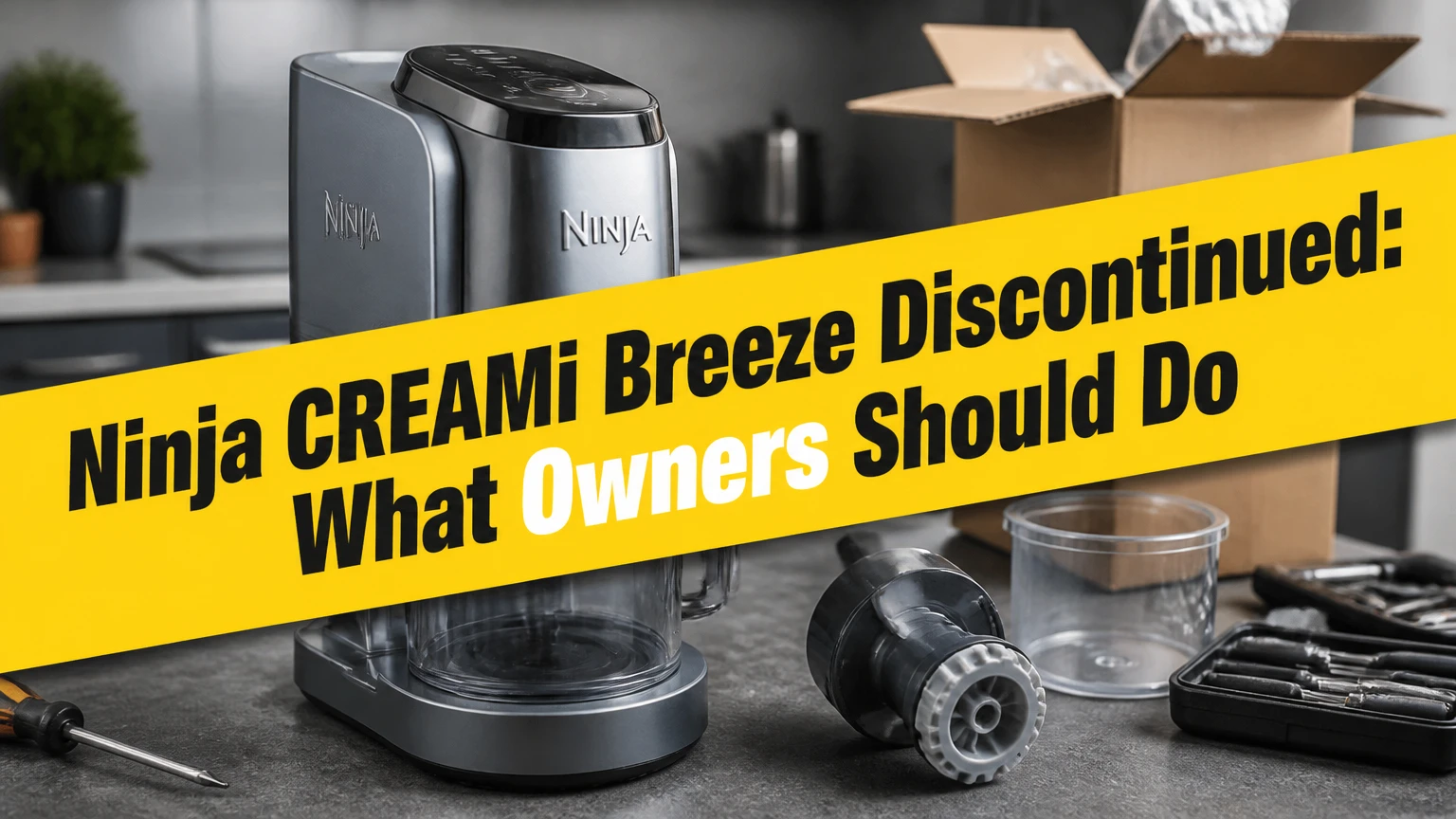
The Ninja CREAMi Breeze appears to be discontinued or no longer actively supported as a current retail model, but the available evidence does not establish an official U.S. CPSC recall or prove that every reported failure came from a systemic defect. Owners should verify the model label, stop using any unit that smokes or overheats, and contact SharkNinja before attempting repair or buying replacement parts.
Key Facts at a Glance
The Ninja CREAMi Breeze was sold as a smaller CREAMi with model families commonly identified as NC100 and NC200.
Breeze containers use a model-specific locking and alignment system and should not be assumed compatible with NC301 or NC501 machines.
The appliance requires a frozen base, typically frozen level for at least 24 hours at approximately 0°F, or -18°C.
Community reports describe smoke, error codes, broken paddles, and lid or spindle problems, but reports alone do not constitute a product recall finding.
A reported warranty exchange involving a newer CREAMi is not a guaranteed current SharkNinja policy.
The Ninja CREAMi NC301 and Deluxe NC501 are the practical replacement candidates for most former Breeze owners.
Is the Ninja CREAMi Breeze Discontinued?
The Ninja CREAMi Breeze is no longer a dependable current-market product, and its limited retail availability has led consumers to describe it as discontinued. SharkNinja’s product catalog, regional inventory, and support policies can change, so “discontinued” should mean unavailable as an active model rather than proof of a formally announced safety withdrawal.
The Breeze was introduced as a more compact alternative to the original CREAMi platform. Its distinctive design placed the processing lid directly on the pint rather than using the larger outer-bowl arrangement associated with models such as the NC301. That reduced the number of parts on the counter, but it also made the Breeze’s pint, lid, paddle, and locking geometry more specialized.
A product disappearing from a manufacturer’s website can have several explanations: a short product lifecycle, retailer sell-through, a regional model change, or a replacement by a newer model. The supplied sources include reviews, marketplace listings, social posts, and community discussions, but they do not provide a formal SharkNinja discontinuation notice or a U.S. Consumer Product Safety Commission recall record.
Why did the Breeze disappear?
The most defensible explanation is that the Breeze had a short retail lifecycle and accumulated unfavorable owner reports, while SharkNinja moved consumers toward other CREAMi models. The available material does not prove a single engineering cause, a quantified failure rate, or a corporate decision explicitly tied to every reported malfunction.
That distinction matters. A review can document one damaged paddle. A social-media thread can document several smoking machines. Neither source can establish the percentage of units affected across all production. Community reports are still useful for risk assessment, especially when they involve the same component, but they should not be rewritten as an official defect finding.
What Did the Ninja CREAMi Breeze Include?
The Ninja CREAMi Breeze was a compact frozen-dessert processor built around a 16-ounce container and a frozen-base workflow. Reported Breeze variants generally fall into a five-program NC100 family and a seven-program NC200 family, although exact bundles and regional packaging should be checked against the rating label and manual.
| Attribute | Breeze 5-in-1 | Breeze 7-in-1 | Practical meaning |
|---|---|---|---|
| Common model family | NC100 series | NC200 series | Confirm the complete model number |
| Container size | 16 oz | 16 oz | One pint-sized serving batch |
| Core programs | 5 | 7 | Program names vary by package |
| Common programs | Ice Cream, Lite Ice Cream, Sorbet, Milkshake, Mix-In | Core programs plus Gelato and Smoothie Bowl | Check the printed control panel |
| Base temperature | About 0°F | About 0°F | Freeze solid before processing |
| Typical freeze time | At least 24 hours | At least 24 hours | A household freezer may require longer |
| Warranty at launch | Commonly 1 year limited | Commonly 1 year limited | Coverage depends on region and purchase date |
The five-program configuration focused on ice cream, lighter frozen desserts, sorbet, milkshakes, and mix-ins. The seven-program configuration added functions commonly marketed for gelato and smoothie bowls. A program button does not guarantee a specific texture: sugar level, fat content, liquid volume, freezing temperature, and recipe structure all affect the result.
Breeze containers were not ordinary food-storage pints. The container had to mate with the specialized processing lid and motor-base interface. That is why a container that looks similar to a standard CREAMi pint may still be mechanically unsuitable.
How did the Breeze make frozen desserts?
The Ninja CREAMi Breeze froze the prepared base first, then shaved and recombined the solid mixture with a rotating paddle. Traditional compressor-free or freezer-bowl churners agitate a liquid as it freezes, while a CREAMi-style processor starts with a fully frozen block and changes its texture afterward.
The normal workflow had four stages:
- Fill the container to the marked limit.
- Freeze the base level for at least 24 hours.
- Attach the correct lid and process the selected program.
- Add mix-ins or use a re-spin only when the recipe texture requires it.
The paddle does not simply whip air into a liquid. It encounters frozen material and removes small layers while mixing them into a smoother mass. Very hard, uneven, partially thawed, or incorrectly filled blocks can place unusual loads on the drive system.
Practitioner insight: A level frozen surface is a mechanical requirement, not merely a presentation preference. A raised edge or sloped block can make the paddle engage unevenly, increasing vibration and resistance before the program finishes.
What Did the Breeze Cost and How Long Did It Take?
The Ninja CREAMi Breeze originally sold in the approximate $169-$199 USD range, depending on the model and bundle. Each batch typically required at least 24 hours of freezing, followed by a processing cycle that often took only a few minutes, so the appliance reduced active preparation time rather than total dessert time.
| Cost or time item | Typical figure | What changes the figure | Owner implication |
|---|---|---|---|
| Original Breeze retail price | $169-$199 USD | Model, retailer, bundle | Historical price, not a current MSRP |
| Freeze time | 24 hours minimum | Freezer temperature and base composition | Plan batches one day ahead |
| Processing time | Often under 5 minutes | Program and frozen hardness | Active time is short |
| Replacement container listing | Variable used-market price | Scarcity and seller condition | Compatibility matters more than price |
| Original limited warranty | 1 year | Region and purchase date | Save the receipt and serial information |
| Typical replacement machine budget | Varies by retailer | NC301 or NC501 promotions | Compare warranty and included pints |
Used-market prices are poor evidence of value. A low-cost Breeze without a working pint, processing lid, or verified test cycle may become unusable if the missing part is scarce. A higher-priced NC301 or NC501 with a current warranty can carry lower ownership risk even when its purchase price is greater.
Was the Ninja CREAMi Breeze Recalled?
No official U.S. CPSC recall is established by the evidence supplied for this query. Reports of smoking, overheating, error codes, broken paddles, or detached components should be treated as safety complaints and stop-use signals, but they do not prove that SharkNinja issued a formal recall.
A recall normally identifies the affected product, hazard, production or sale dates, remedy, and reporting organization. Consumers can check the CPSC recall database and SharkNinja’s official support pages using the exact model number, rather than relying on a social post that uses “recall” as a general warning term.
| Evidence type | What it can establish | What it cannot establish |
|---|---|---|
| Manufacturer recall notice | Official hazard, scope, and remedy | Whether every owner experienced the defect |
| CPSC listing | U.S. government recall record | Product status in another country |
| Owner review | A reported user experience | Population-wide failure rate |
| Marketplace listing | Availability and asking price | Safety or manufacturer support |
| Community warranty thread | Possible support outcome | A universal replacement guarantee |
| Product manual | Intended operation and warnings | Actual field-failure frequency |
The reports deserve attention because a motorized appliance that emits smoke or smells electrically burnt should not be operated again. However, a responsible status answer must keep three claims separate: the product may be discontinued, owners may have reported serious failures, and no formal recall may be documented in the available record.
What Should Owners Do With a Malfunctioning Breeze?
Owners should unplug a malfunctioning Ninja CREAMi Breeze, preserve the unit and purchase records, document the model and serial number, and contact SharkNinja support before disassembly. Smoke, flames, melting plastic, electrical odor, repeated motor stoppage, or a cracked processing component requires immediate stop-use treatment.
Do not bypass an interlock, hold down a safety switch, use tape to secure a lid, or continue cycling a machine that has already overheated. Do not open the motor housing unless the manufacturer specifically directs a qualified repair process. A damaged paddle or spindle can also contaminate food with fragments, so discard any batch that may contain broken plastic.
Can SharkNinja still replace a Breeze?
SharkNinja may offer a remedy after reviewing the model, purchase date, failure description, and warranty status, but owner reports about free upgrades should not be treated as a guaranteed current program. Some online discussions describe support agents requesting a video confirmation and cord destruction before shipping another CREAMi; the terms may differ by country, date, and case.
Use the official SharkNinja support channel rather than a marketplace seller. Prepare these details:
- Exact model number, such as NC100 or NC200, from the rating label.
- Serial number and purchase date.
- Retailer, receipt, and shipping address.
- Photos or video of the failure, without operating an unsafe unit.
- A concise description of smoke, noise, error codes, breakage, or lock failure.
Never cut the power cord because a forum post recommends it. Perform that step only after official support gives written or recorded instructions and confirms the replacement remedy.
Which Containers and Parts Fit the Breeze?
Breeze containers, lids, and paddles should be treated as model-specific unless SharkNinja confirms compatibility. Standard CREAMi accessories for the NC301 or Deluxe NC501 may have similar capacities or names, but matching volume does not prove that the locking tabs, drive interface, or lid geometry will fit safely.
| Component | Breeze requirement | NC301 comparison | NC501 comparison | Safe buying rule |
|---|---|---|---|---|
| Processing container | Breeze-specific 16 oz interface | Standard 16 oz CREAMi container | Deluxe 24 oz container | Match the exact model family |
| Processing lid | Breeze-specific locking geometry | NC301 lid assembly | NC501 lid assembly | Do not force a different lid |
| Paddle | Breeze-compatible drive stem | NC301 paddle | NC501 paddle | Use the part listed for the base |
| Outer bowl or sleeve | Breeze-specific assembly | NC301 outer bowl system | NC501 outer bowl system | Similar appearance is insufficient |
| Storage lid | Container-dependent | NC301-compatible | NC501-compatible | Confirm diameter and locking design |
| Recipe capacity | 16 oz maximum container | 16 oz container | 24 oz container | Never fill beyond the marked line |
The common mistake is treating a pint as a universal standard. In the CREAMi ecosystem, the container is part of a mechanical assembly, not only a vessel for ingredients. Forcing another model’s container into the base can damage the lock or create an unsafe operating condition.
How Should a Working Breeze Be Operated?
A working Breeze should process only a properly filled, level, fully frozen base in the correct container, with the lid and paddle seated according to the model manual. The safest operating routine prioritizes mechanical alignment and inspection over texture shortcuts such as microwaving or aggressive reprocessing.
Use this owner checklist:
- Freeze the mixture level, with no dome or exposed liquid pocket.
- Keep the container upright during freezing and storage.
- Inspect the paddle for cracks, bends, looseness, or missing material.
- Confirm that the processing lid locks fully before mounting the container.
- Stop immediately if the machine vibrates violently, smells burnt, smokes, or produces abnormal scraping.
- Clean and dry the lid, gasket, container, and paddle after use.
- Use the programmed re-spin function for a powdery result when the manual permits it.
A common online suggestion is to thaw the pint for 5-10 minutes or microwave it briefly. That advice is not a universal safety fix and can produce an uneven surface or partially melted edge. Follow the manual for the exact model instead of using thawing to compensate for an improperly frozen base.
Why do uneven frozen surfaces matter?
An uneven frozen surface can cause the paddle to meet resistance asymmetrically, which may increase vibration and load on the drive components. A level fill line, stable freezer shelf, and fully solid base reduce that risk, although they cannot repair an already damaged machine.
| Symptom | Possible cause | Immediate action | Do not do |
|---|---|---|---|
| Burning smell | Motor or electrical overheating | Stop, unplug, contact support | Run another cycle |
| Smoke | Electrical or mechanical failure | Move away from combustibles after unplugging if safe | Inspect while powered |
| Loud scraping | Paddle, lid, or spindle damage | Stop and inspect after cooling | Hold the lid down |
| Repeated error code | Lock, load, or sensor issue | Record the code and consult the manual | Bypass the interlock |
| Broken paddle | Frozen block resistance or wear | Discard affected food and replace correctly | Use glue or a damaged blade |
| Poor texture only | Base formulation or insufficient processing | Check recipe and permitted re-spin use | Run unlimited full cycles |
Practitioner insight: A powdery result is not automatically a hardware failure. Low-sugar, low-fat, high-protein, and dairy-free bases often freeze harder and need a permitted re-spin, while smoke, electrical odor, or a failing lock is a stop-use event.
How Does the Breeze Compare With Current Alternatives?
The NC301 is the closest functional replacement for a former Breeze owner who wants single-pint portions and the established CREAMi workflow. The NC501 Deluxe is better for larger batches and expanded drink-style functions, while a traditional churner suits users who prefer processing a liquid base without a 24-hour frozen pint.
| Decision factor | Breeze | CREAMi NC301 | CREAMi Deluxe NC501 | Cuisinart ICE-30BC type |
|---|---|---|---|---|
| Status | Discontinued or inactive retail model | Current replacement category | Current replacement category | Actively sold category |
| Container capacity | 16 oz | 16 oz | 24 oz | Commonly up to 2 qt |
| Frozen-base requirement | About 24 hours | About 24 hours | About 24 hours | Depends on model and bowl |
| Outer-bowl workflow | Breeze-specific direct container | Standard outer bowl | Deluxe outer bowl | Freezer bowl or compressor |
| Low-sugar recipe use | Strong fit | Strong fit | Strong fit | Less predictable |
| Main advantage | Compact footprint | Closest familiar workflow | Larger serving size | Liquid churning |
| Main drawback | Parts and support uncertainty | Smaller batch size | Larger footprint and cost | Different texture workflow |
Is the NC301 or NC501 the better replacement?
The NC301 is the better direct substitute because it preserves the 16-ounce serving size and supports the same broad category of frozen dessert recipes. The NC501 is the better household choice when 24-ounce capacity, larger portions, and additional frozen-drink functions justify its larger container and footprint.
Neither alternative removes the need for freezer planning. Both still depend on a fully frozen base and compatible parts, so a buyer who dislikes waiting 24 hours should consider a compressor churner instead of another CREAMi-style processor.
| User situation | Recommended option | Reason | Trade-off |
|---|---|---|---|
| Former Breeze owner with one-person servings | NC301 | 16 oz capacity resembles Breeze use | Smaller output than NC501 |
| Family making larger batches | NC501 | 24 oz container | More counter and freezer space |
| High-protein recipe routine | NC301 or NC501 | Frozen-base processing handles dense recipes | Still requires correct formulation |
| Same-day dessert priority | Traditional churner | Some models process liquid immediately | Texture and recipe flexibility differ |
| Concern about discontinued parts | Current NC301 or NC501 | Active support is more likely | Purchase price may be higher |
| Occasional ice cream maker | Traditional freezer-bowl churner | Simple mechanical workflow | Bowl must be frozen and recipe limits differ |
Should You Buy a Used Breeze?
Most buyers should avoid purchasing a used Ninja CREAMi Breeze unless the seller provides a complete, verifiable unit and the buyer accepts limited parts availability. A low purchase price does not offset the risk of an undocumented electrical fault, unavailable lid, damaged paddle, expired warranty, or incompatible replacement container.
If you are evaluating one locally, inspect the following before paying:
- Confirm the model number and compare it with the seller’s accessories.
- Check the power cord, plug, housing, lid, container, and paddle for heat damage.
- Look for cracks, warped plastic, melted areas, or missing locking tabs.
- Ask whether the machine has produced smoke, error codes, or abnormal noise.
- Confirm that the included container is the correct Breeze version.
- Request a return period if a safe, manufacturer-compliant test is possible.
- Price a current NC301 or NC501 before deciding.
Do not operate a visibly damaged unit merely to prove that it powers on. A motor that starts for ten seconds can still fail under the load of a frozen pint. Used marketplace listings also frequently omit the model suffix, which makes accessory compatibility difficult to establish.
What Are the Most Important Breeze Owner Mistakes?
The most serious Breeze owner mistakes involve incompatible parts, uneven frozen bases, repeated overloaded cycles, and attempts to defeat safety mechanisms. Cleaning errors can create hygiene problems, but they are different from motor, spindle, and electrical failures and should not be conflated.
| Mistake | Likely consequence | Better practice | Risk level |
|---|---|---|---|
| Using an NC301 pint in a Breeze | Lock or alignment failure | Match the exact Breeze container | High |
| Freezing a domed or sloped surface | Uneven paddle loading | Freeze level on a stable shelf | High |
| Repeating a full cycle for powdery texture | Extra motor load | Use permitted re-spin settings | Medium |
| Running a cracked paddle | Fragment or drive damage | Replace before processing | High |
| Leaving moisture in the lid gasket | Odor or mold growth | Wash, rinse, and dry completely | Medium |
| Holding an interlock closed | Defeats a safety feature | Stop and contact support | High |
| Continuing after smoke appears | Escalated electrical or motor damage | Unplug and stop use | High |
A gasket that retains moisture can develop odor or mold, but cleaning the gasket will not solve a bent spindle. Conversely, a machine that makes a powdery dessert may need recipe adjustment rather than replacement. Diagnose the symptom before choosing a remedy.
What is the best support path?
The best support path is the official SharkNinja channel, followed by the retailer if the manufacturer warranty or return window does not apply. Community groups can help identify model-specific parts and recurring symptoms, but they cannot authorize a warranty remedy or certify electrical safety.
Keep written records of every case number, requested photo, shipping instruction, and replacement condition. If support requests destruction of the appliance or cord, obtain the instruction from an official representative and understand whether the action ends your ability to pursue a retailer return or third-party claim.
Which Replacement Should You Choose?
Choose the NC301 for the closest Breeze replacement, the NC501 Deluxe for larger 24-ounce servings, and a traditional churner for same-day liquid processing. The correct decision depends primarily on serving size, freezer-planning tolerance, recipe style, and the importance of current parts and warranty support.
Choose the NC301 when
The NC301 fits a former Breeze owner who usually prepares one 16-ounce batch, wants familiar CREAMi-style processing, and values broad recipe flexibility for dairy-free, reduced-sugar, or protein-focused desserts. Its main limitation is capacity, not the frozen-base concept.
Choose the NC501 when
The NC501 fits households that need larger batches or want functions associated with frozen drinks and larger-format processing. Its 24-ounce container can reduce the number of batches, but buyers should measure freezer clearance and counter depth before purchase.
Choose a traditional churner when
A traditional churner fits users who want a liquid mixture processed without freezing a pint for a full day. The trade-off is that low-sugar or low-fat bases may freeze and churn less successfully, and the finished texture follows a different process from a CREAMi-style shaved frozen block.
FAQ
Can I still find Ninja CREAMi Breeze containers?
Breeze containers may appear through resale marketplaces, discontinued-inventory sellers, or community exchanges, but availability and condition are inconsistent. Verify the exact model family, locking features, and container markings before buying. A generic 16-ounce pint is not a safe substitute for a model-specific Breeze container.
Does the Breeze use the same recipes as the NC301?
Many recipe principles transfer because both appliances process a frozen base, but program names, container limits, and texture results may differ. Keep ingredients below the marked fill line, freeze the mixture level, and follow the recipe guidance for the exact machine rather than assuming identical cycle instructions.
Can I use a Breeze after the warranty expires?
A Breeze can be used after warranty expiration only if the unit is intact, operates normally, and follows the manufacturer’s instructions. Warranty expiration does not make a safe machine unsafe, but it increases the financial risk of failure because discontinued parts and authorized repair options may be limited.
Why is my Breeze making powder instead of ice cream?
A powdery Breeze result commonly comes from a very hard base, low sugar or fat, insufficient processing, or a recipe that needs a permitted re-spin. Check the base formulation and manual first. Do not treat ordinary powderiness as equivalent to smoke, burning odor, abnormal scraping, or a broken component.
Is the Ninja CREAMi Deluxe safer than the Breeze?
The NC501 Deluxe is a current alternative with a different platform and larger container, but no appliance should be labeled risk-free. Buy through an authorized seller, follow the manual, inspect the paddle and locking assembly, and stop using any machine that emits smoke, overheats, or shows physical damage.
Where should I check for a formal recall?
Check the U.S. Consumer Product Safety Commission recall database and the official SharkNinja support site using the complete model number. If you live outside the United States, also check the relevant national product-safety authority, because recall records and remedies can differ by country.
The Bottom Line on Ninja CREAMi Breeze Discontinued
The Ninja CREAMi Breeze is best treated as a discontinued or inactive model with uncertain parts availability, not as a clearly documented recalled appliance based solely on online reports. Owners should stop using any unit with smoke, electrical odor, severe vibration, or component damage and ask SharkNinja for the current remedy. For replacement buyers, the NC301 is the closest 16-ounce successor, the NC501 is the larger option, and a traditional churner is better for same-day liquid processing.