

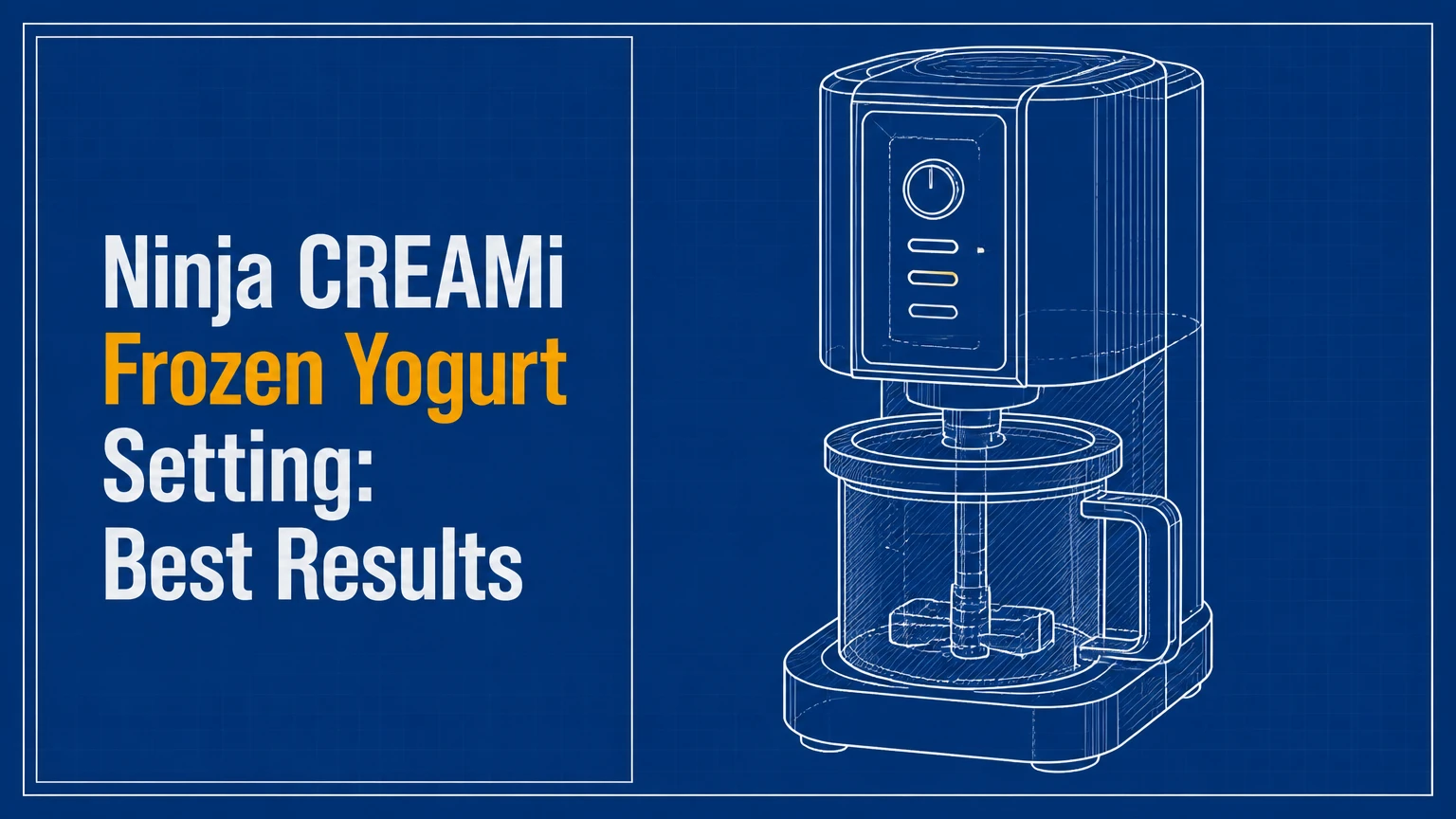
The Ninja CREAMi Frozen Yogurt setting is a program that processes a fully frozen yogurt base into a scoopable dessert by rotating and lowering the Creamerizer paddle through the frozen pint. Unlike a churn-style freezer, the Ninja CREAMi freezes the mixture first, then reduces the frozen block into a smoother texture.
Key Facts
Freeze the filled pint level for at least 24 hours before processing.
Use the Frozen Yogurt program for yogurt-led bases, especially Greek yogurt mixtures.
A crumbly first result usually needs one Re-Spin, not a different base or longer freezing.
Add 1 tablespoon of milk, yogurt, or another compatible liquid when the mixture remains dry.
Process hard cookies, nuts, and chocolate pieces with Mix-In after the base becomes smooth.
Standard CREAMi pints hold about 16 fluid ounces; CREAMi Deluxe containers hold about 24 fluid ounces.
What the Ninja CREAMi Frozen Yogurt Setting Does
The Frozen Yogurt program is designed for a solid yogurt base rather than liquid cream. The machine’s drive system lowers the rotating paddle into the frozen mixture, shaving portions from the block and blending them into a denser, smoother dessert.
The Ninja CREAMi Owner’s Guide instructs users to “freeze for 24 hours” before processing. That instruction matters because the machine depends on a firm, stable block. A partially frozen pint can flex around the paddle, produce uneven shavings, and place unnecessary resistance on the drive system.
The program does not create the same texture as a traditional compressor ice cream maker. A churner freezes while it incorporates air; the CREAMi works on a prepared frozen block. The finished result depends heavily on the yogurt’s water, sugar, protein, and fat content.
Operating facts at a glance
| Attribute | Typical value | Practical meaning |
|---|---|---|
| Minimum freeze time | 24 hours | Allows the center to freeze solid |
| Standard pint capacity | 16 fl oz | Applies to many original CREAMi models |
| Deluxe pint capacity | 24 fl oz | Applies to CREAMi Deluxe containers |
| Initial program duration | About 2 minutes | Varies by model and program |
| Re-Spin duration | About 1 minute | Used after a dry or crumbly result |
| Recommended freezer range | 0°F or colder | A normal home-freezer target for reliable freezing |
The exact program profile differs among CREAMi generations. The Frozen Yogurt button should therefore be treated as a manufacturer-selected processing cycle, not as a guaranteed speed specification. Ninja does not publish a universal RPM figure for every model, so claims that all units operate at one exact blade speed are unreliable.
How Does the Frozen Yogurt Program Work?
The Ninja CREAMi paddle enters the frozen base from above and processes the mixture progressively from the surface downward. This action breaks frozen material into smaller particles and combines those particles with the unfrozen components present in the pint.
The texture change comes from mechanical reduction, blending, and controlled incorporation of the base. The program does not independently correct a formula with too much water, too little sugar, or insufficient stabilizing solids. A poor base can remain icy or powdery after processing.
The processing sequence
- Freeze the base. Fill the container below the maximum line, secure the lid, and freeze the pint level for at least 24 hours.
- Inspect the surface. Remove any loose ice, then check whether a raised center has formed.
- Flatten the hump. Scrape a dome level with the surrounding surface so the paddle meets a more even block.
- Install the container. Lock the pint into the outer bowl according to the model’s owner guide.
- Select Frozen Yogurt. Use the program intended for a yogurt-based frozen dessert.
- Evaluate the texture. If the result is smooth, serve or add mix-ins. If it is dry, use Re-Spin.
- Add solid pieces last. Place cookies, fruit pieces, nuts, or chocolate in the center and select Mix-In.
Expert insight: a smooth pint can still be a weak formula
A first cycle can make a low-sugar yogurt mixture appear smooth while leaving it hard and icy after storage. Mechanical processing changes particle size, but it cannot replace dissolved solids. Sugar, milk solids, fruit solids, and stabilizers all influence how much free water becomes ice.
Which Base Works Best?
Whole-milk Greek yogurt usually produces the thickest and most stable frozen yogurt because its protein and milk solids bind water while its fat limits an icy mouthfeel. Nonfat yogurt can work well, but it generally benefits from additional dissolved sugar or a small amount of milk.
The most reliable formula has enough soluble solids to soften the frozen block without becoming liquid. Honey, maple syrup, sugar, fruit purée, and sweetened condensed milk all affect sweetness and freezing behavior, so the total formula matters more than one ingredient.
| Base type | Typical yogurt | Helpful addition | Likely result |
|---|---|---|---|
| Full-fat Greek | 5% milk fat | 1-2 tbsp honey per pint | Dense, tangy, creamy |
| Reduced-fat dairy | 2% milk fat | 2-4 tbsp milk or fruit purée | Smooth, lighter body |
| Nonfat dairy | 0% milk fat | 1-2 tbsp syrup plus milk | Tangy, less rich |
| Plant-based | Coconut, oat, or almond yogurt | 1/8 tsp guar gum or 1 tbsp syrup | Variable, often softer |
| High-protein | Greek yogurt plus 20-30 g protein powder | 2-4 tbsp milk | Thick, potentially powdery |
| Fruit-forward | Yogurt plus 1/4-1/2 cup fruit purée | 1 tbsp sugar or honey | Bright flavor, more ice risk |
Dairy and plant-based choices
Coconut yogurt supplies fat but can become firm when frozen. Oat yogurt often contains more starch and may process softly, while almond yogurt can lack the protein needed for structure. Check the ingredient label rather than assuming that every non-dairy yogurt behaves alike.
For vegan bases, a small amount of guar gum can reduce ice crystal growth, but excess gum creates a stretchy or gummy texture. Start below 1/8 teaspoon per pint and blend it thoroughly before freezing.
Protein powder behavior
Protein powder absorbs liquid and can produce a dry, chalky result. Whey, casein, and plant proteins behave differently, so a recipe that works with whey may need more liquid when made with pea or rice protein.
Mix the powder into the yogurt before freezing. Do not sprinkle dry powder into the finished pint unless the manufacturer’s instructions for your model specifically permit it. A Re-Spin with 1-2 tablespoons of milk can improve texture, but it cannot remove a strongly chalky flavor.
What Is the Correct Freezing Method?
The correct freezing method is a level, fully solid pint held for at least 24 hours in a consistently cold freezer. The goal is a uniform block, not merely a frozen surface.
Do not process a pint that has been frozen for only a few hours. Freezer temperature, container fill level, sugar concentration, and base volume affect the time required for the center to freeze. Twenty-four hours is the dependable household rule because it gives the interior time to solidify.
| Freezing condition | Typical outcome | Corrective action |
|---|---|---|
| Level pint, 24 hours | Uniform processing | Use Frozen Yogurt |
| Raised center, 24 hours | Paddle encounters uneven resistance | Scrape surface flat |
| Pint tilted in freezer | Slanted, irregular shavings | Refreeze level for 6-12 hours |
| Base frozen 8-16 hours | Soft or partially frozen center | Continue freezing to 24 hours |
| Freezer warmer than 10°F | Slower, softer freezing | Extend freezing time |
| Pint frozen several weeks | Drier surface or freezer burn | Use airtight lid and process promptly |
A frozen hump forms because liquid expands as it freezes, especially in a container that is filled near its maximum line. The hump is not automatically dangerous, but a steep dome creates uneven contact with the paddle. Leveling it is a simple preventive step.
Food-safety boundary
Freeze only a base that was refrigerated and handled safely. The freezer does not erase bacterial growth that occurred while yogurt or milk sat warm. Refrigerate leftovers promptly, and discard a mixture that has spent more than two hours at room temperature, or one hour when the surrounding temperature exceeds 90°F.
How to Process a Pint Correctly
A consistent sequence prevents most texture and equipment problems. The key decisions occur before pressing the program button, because the machine cannot compensate for a tilted pint, an overfilled container, or a base with very little soluble solid.
- Blend the formula completely. Dissolve sugar and protein powder before freezing. Strain large fruit seeds if a smooth texture matters.
- Fill below the line. Leave the required headspace shown in the container markings. Expansion during freezing can force the lid upward.
- Freeze level for 24 hours. Keep the pint away from the freezer door if temperature swings are frequent.
- Check the block. Remove the storage lid, inspect the top, and flatten a large dome.
- Install the pint securely. The outer bowl and paddle must lock into place without forcing the mechanism.
- Run Frozen Yogurt once. Stop if the appliance displays an error, vibrates abnormally, or makes a grinding sound.
- Assess the result. Smooth and scoopable means the base is ready. Fine crumbs usually indicate insufficient liquid or a very cold, low-sugar formula.
- Add liquid only when needed. Use 1 tablespoon at a time, then run Re-Spin.
- Add mix-ins after the base is smooth. Use pieces no larger than the size recommended by the owner guide.
In practice, one Re-Spin is common with nonfat, high-protein, and low-sugar mixtures. Repeated cycles can warm the outer layer while the center remains firm, producing a softer surface without solving the formula problem.
Frozen Yogurt Versus Other CREAMi Programs
The Frozen Yogurt program is the logical first choice when yogurt supplies most of the base. It is not automatically the best button for every low-calorie, dairy-free, or fruit-heavy recipe.
| Program | Best base | Typical texture | Poor fit |
|---|---|---|---|
| Frozen Yogurt | Greek or dairy-free yogurt | Tangy, dense, scoopable | Mostly water or juice |
| Ice Cream | Cream, milk, sugar, egg-free custard | Rich, fatty, smooth | Very low-fat yogurt |
| Lite Ice Cream | Low-fat, low-sugar mixture | Light, airy, sometimes crumbly | High-fat cream base |
| Sorbet | Fruit purée, sugar, water | Bright, icy-soft | Protein-heavy dairy base |
| Gelato | Milk-led, moderate-fat formula | Dense, low overrun | Large hard inclusions |
Program names are not interchangeable recipe categories. A yogurt base processed on Ice Cream may still become edible, but the cycle does not guarantee a better result. Conversely, a low-calorie yogurt mixture can remain crumbly on Frozen Yogurt because its water content is high.
Expert insight: program choice cannot fix freezing-point chemistry
The most common misconception is that Lite Ice Cream or Frozen Yogurt can make any diet recipe creamy. When a base contains little sugar, fat, or milk solids, more water freezes into larger crystals. Re-Spin reduces the particles temporarily, but storage can reveal the original imbalance.
What Does a Homemade Pint Cost?
A homemade yogurt pint typically costs about $2.00-$6.00 in ingredients in the United States, depending on yogurt brand, fruit, sweetener, and protein powder. The appliance price is separate and should not be treated as an ingredient cost.
| Formula | Yogurt cost | Add-in cost | Typical total |
|---|---|---|---|
| Plain full-fat Greek | $1.50-$3.00 | $0.25-$0.75 | $1.75-$3.75 |
| Nonfat vanilla | $1.25-$2.50 | $0.50-$1.25 | $1.75-$3.75 |
| Berry Greek yogurt | $1.50-$3.00 | $1.00-$2.50 | $2.50-$5.50 |
| Vegan coconut yogurt | $2.50-$4.50 | $0.50-$1.50 | $3.00-$6.00 |
| Protein frozen yogurt | $1.50-$3.00 | $1.00-$3.00 | $2.50-$6.00 |
Premium protein powders can cost more than the yogurt itself. Frozen fruit is usually cheaper and more consistent than fresh berries when the fruit is out of season, while jam adds sugar and pectin but can make the result noticeably softer.
Why Is the Result Crumbly, Icy, or Powdery?
A crumbly result usually means the frozen base is very cold, low in sugar, low in fat, or short on liquid. An icy result points more strongly to excess free water, insufficient dissolved solids, or a formula that remained frozen for a long period without an airtight seal.
| Symptom | Most likely cause | First correction |
|---|---|---|
| Fine dry crumbs | Low sugar or low fat | Add 1 tbsp milk, then Re-Spin |
| Powdery protein texture | Too much protein powder | Add 1-2 tbsp milk or yogurt |
| Large icy pieces | High water content | Add sugar, syrup, or milk solids next batch |
| Soupy outer ring | Warm room or repeated cycles | Refreeze 15-30 minutes before serving |
| Hard center after spin | Partial mixing or overfilled pint | Check fill line and run one Re-Spin |
| Gummy texture | Too much guar gum or starch | Reduce stabilizer in the next batch |
| Sour, separated flavor | Yogurt quality or prolonged storage | Use fresher yogurt and airtight storage |
Do not immediately add a large amount of liquid. One tablespoon can change the texture; four tablespoons can turn a pint into a soft, wet dessert that needs refreezing.
What happens if the pint is too full?
An overfilled pint can expand into the lid, interfere with closure, and place pressure on the processing assembly. The mixture also has less room to move during processing. Discarding a small excess before freezing is safer than forcing the lid closed.
What happens if hard mix-ins are added before processing?
Hard nuts, frozen fruit chunks, and thick chocolate pieces can resist the paddle and produce uneven processing. They may also become pulverized rather than remaining recognizable pieces. Process the base first, create a central well if the model’s instructions call for one, and use Mix-In for controlled distribution.
How Should Frozen Yogurt Be Stored and Served?
Freshly processed yogurt dessert is usually at its softest immediately after the initial cycle or Re-Spin. If stored again, the pint commonly becomes firmer because the mixture loses the temporary softness created by mechanical processing.
For a firmer serving, refreeze the processed pint with its lid attached. Let it sit at room temperature for approximately 5-15 minutes before scooping, depending on freezer temperature and sugar level. Do not repeatedly thaw and refreeze the entire container because that increases ice formation and reduces quality.
A practical storage method is:
- Smooth the surface after serving.
- Seal the pint tightly.
- Label the flavor and processing date.
- Use within 1-2 weeks for best texture.
- Re-Spin only the portion that needs softening when possible.
The CREAMi is best for portioned preparation, not for producing a large tub of permanently soft frozen yogurt. Its container size determines serving volume, and the dessert’s texture changes after every freeze cycle.
Frequently Asked Questions About ninja creami frozen yogurt setting
Can I use regular yogurt instead of Greek yogurt?
Yes. Regular yogurt can produce a softer, less dense dessert because it usually contains more water and fewer milk solids than Greek yogurt. Drain some whey or add milk powder, fruit solids, or a modest amount of syrup if the finished pint freezes icy or collapses quickly.
Can I make a sugar-free frozen yogurt pint?
Yes, but sugar-free yogurt often freezes harder and more crumbly because it lacks dissolved sugar. Use a compatible liquid sweetener, sufficient milk solids, or a tested stabilizer. Some sugar alcohols can create cooling sensations or digestive discomfort, so adjust them gradually rather than replacing sugar gram for gram.
Can lactose-free yogurt be processed in the machine?
Lactose-free dairy yogurt works in the same way as comparable ordinary yogurt. Lactase breaks lactose into simpler sugars, but fat and total solids still determine texture. Choose full-fat lactose-free Greek yogurt for a dense result, then follow the same 24-hour freezing and Re-Spin procedure.
Can I process a pint immediately after mixing it?
No. The base must freeze solid before processing. Refrigerating the mixture is not enough, and a short freeze can leave a soft center that processes unevenly. Prepare the pint one day ahead, freeze it level, and reserve the next day for processing and serving.
How much fruit should I add to frozen yogurt?
Start with about 1/4 cup of smooth fruit purée per standard pint, then adjust sweetness and liquid. Larger quantities increase free water and can make the dessert icy. Fold small fresh pieces into the finished base with Mix-In rather than freezing large chunks inside the block.
Is the Frozen Yogurt program suitable for a completely dairy-free recipe?
Yes, provided the plant-based yogurt has enough fat, solids, or stabilizer to form a workable frozen base. Coconut yogurt is often the richest option, while almond yogurt may need more structure. Test a small batch first because brand formulations vary substantially in protein, starch, and water.
Final Recommendation
The Ninja CREAMi Frozen Yogurt setting works best when the recipe is treated as a frozen formulation rather than ordinary refrigerated yogurt. Freeze the filled pint level for 24 hours, flatten a large hump, process once, and use a 1-tablespoon liquid adjustment before Re-Spin if the texture is crumbly.
Whole-milk Greek yogurt offers the easiest path to a dense result, while low-fat, vegan, and high-protein bases require more attention to sugar, liquid, solids, and stabilizers. For the best answer to the query “ninja creami frozen yogurt setting,” choose the program because the base is yogurt-led, not simply because the dessert is low-calorie or tangy.